
What Are Earmarks in Congress? How Community Project Funding Works
Earmarks direct federal money to a specific local project at a lawmaker's request. Here is what they are called now, the rules, and how a request moves.
12 minute read9 sources
In this article
- What are earmarks in Congress?
- What are earmarks called now?
- How does an earmark request work, step by step?
- House vs Senate: the earmark rules side by side
- Why were earmarks banned?
- Why were earmarks brought back?
- How much money goes to earmarks?
- Earmarks vs pork barrel spending vs appropriations
- What earmarks mean for advocates and local groups
- The bottom line

An earmark is a line in a federal spending bill, or in the committee report that goes with it, that sends a set amount of money to a specific project, organization or place because a member of Congress asked for it. Today the House calls earmarks Community Project Funding and the Senate calls them Congressionally Directed Spending.
Earmarks skip the usual formula or competition that federal agencies use to hand out grants. Congress stopped approving them in 2011, brought them back for the 2022 budget year with new disclosure rules, and still uses them in each year's spending bills. This guide explains the official definition, what earmarks are called now, why they were paused and restored, and how a request moves from a local group to a signed grant.
People search for this topic in many ways: "what are earmarks in Congress," "earmarks simple definition government," "what are earmarks called now," "why were earmarks banned," and "earmarks vs pork barrel." Each one is answered below.
What are earmarks in Congress?
The word has been used loosely for a long time, but the House and Senate each wrote a formal definition into their rules in the 110th Congress (2007 to 2008). The Congressional Research Service (CRS), the nonpartisan research arm of Congress, sets the two definitions side by side in Lifting the Earmark Moratorium: Frequently Asked Questions.
The House version, in House Rule XXI, clause 9, defines a congressional earmark as a provision or report language included primarily at a member's request that provides, authorizes or recommends a specific amount of spending authority for a contract, loan, grant or other expenditure with or to an entity, or targeted to a specific state, locality or congressional district, "other than through a statutory or administrative formula driven or competitive award process." The Senate's version, in Senate Rule XLIV, uses almost the same words and calls the item a congressionally directed spending item.
The rules also cover two smaller cousins: a limited tax benefit (a tax break written for 10 or fewer beneficiaries) and a limited tariff benefit (a tariff change that helps 10 or fewer entities). Most people who say "earmark" mean the spending kind, and that is the focus here.
Earmarks simple definition
If you need one line: an earmark is money in a spending bill that a member of Congress directs to a named project in their state or district, instead of letting an agency choose the recipient. The earmark entry in the PolicyPage glossary says nearly the same thing.
A simple way to picture it: Congress hands an agency a large budget for, say, water systems. Most of that money goes out through the agency's normal process, where towns apply and compete. An earmark sets aside a slice of that budget and writes a specific town's name and project on it.
What are earmarks called now?
The Government Accountability Office (GAO), the auditing agency that works for Congress, explains the new names in its post Tracking the Funds. Starting with the fiscal year 2022 spending bills, members began a new process for requesting money for specific projects. Funds that used to be called earmarks are now called Community Project Funding in the House and Congressionally Directed Spending in the Senate.
The names changed, but the rule definitions did not. CRS notes in Community Project Funding: House Rules and Committee Protocols that Community Project Funding requests are still subject to the House rules governing earmarks. So when you see "CPF" on a House website or "CDS" on a Senate website, you are looking at earmarks.
Earmarks are part of the annual appropriations process, the 12 yearly bills that fund federal agencies. If you want the bigger picture of how those bills are written, our guide to how the federal budget process works walks through it from the President's budget to the final vote.
How does an earmark request work, step by step?
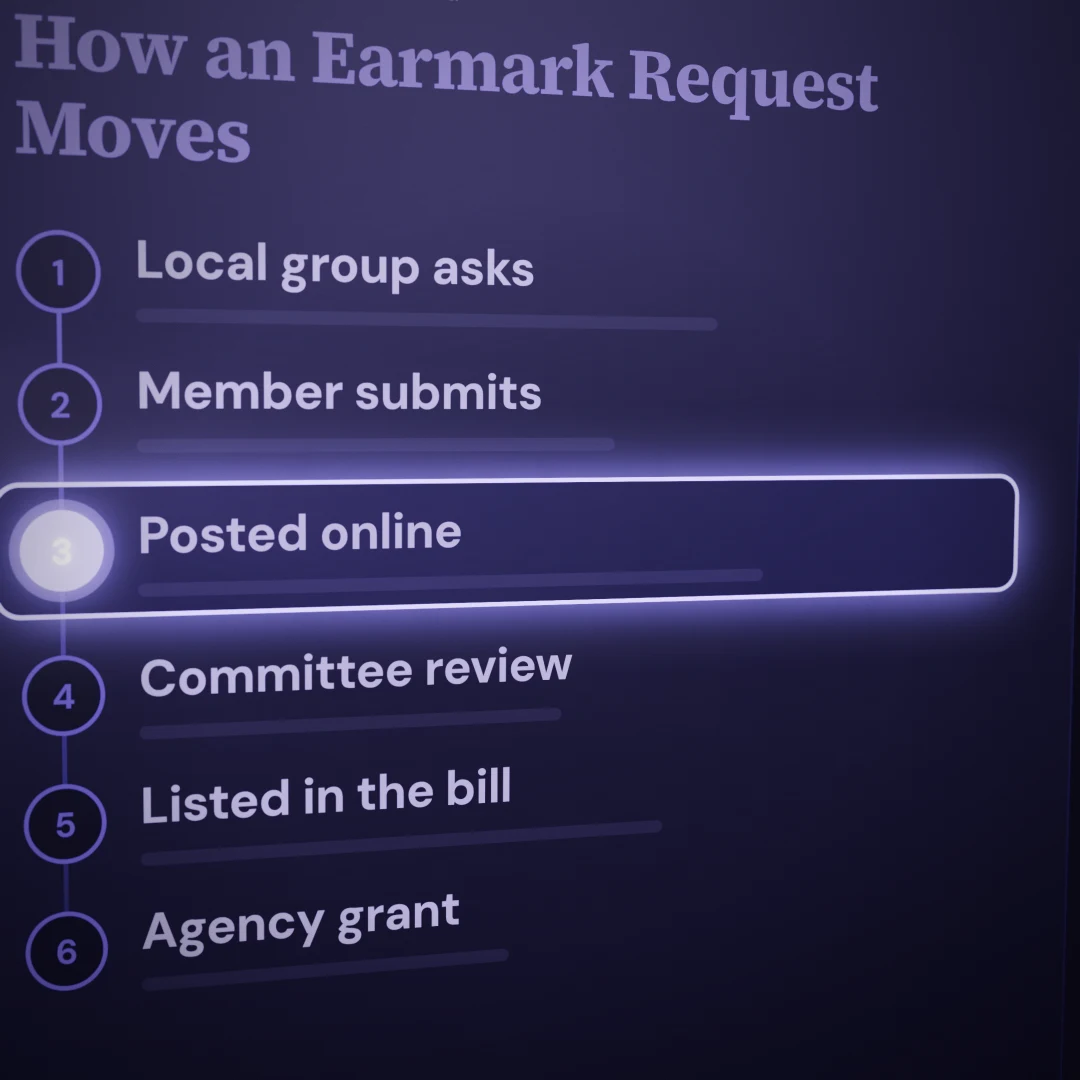
The process follows the yearly spending calendar. Using the House Appropriations Committee's FY27 guidance overview and CRS's report on how federal agencies administer earmarks, here is the path a project takes:
- A local group asks its member of Congress. A city, county, school district, tribe or eligible nonprofit brings a project to its representative or senators, usually in the winter or early spring.
- The member picks projects and submits them. In the House, the committee opened its online portal on February 25 for the 2027 budget year and set a limit of 20 projects per member. Subcommittee deadlines ran from March 13 to March 27, 2026.
- The member posts the requests online. House members had to post their requests on their websites by dates between March 27 and April 17, 2026, to comply with House rules. Senators must post theirs too.
- The Appropriations Committee reviews and chooses. Only some requests are funded. The committee checks that each project meets federal law, House or Senate rules and the committee's own requirements.
- Funded projects are listed with the bill. The committee publishes a table of the projects in each bill, with the member who requested each one. The earmark only becomes real money if that bill is enacted.
- The agency reviews the project and signs a grant. The recipient still has to apply to the agency and qualify, and is usually paid back for costs it has already spent.
A request is not a promise. The House committee says that because of high demand it cannot fund every eligible request. And being named in a bill is not the end of the paperwork, as the next section explains.
What happens after the bill passes
CRS explains that once Congress provides the money, the Office of Management and Budget (OMB) releases it to the right program office, and that office uses its normal grant rules. The recipient must still file a full grant application, which can include a benefit-cost analysis, engineering studies or environmental reviews. A project can lose its money if the recipient is found ineligible or the project does not meet the program's requirements.
The same CRS report gives a real example. In fiscal year 2023, the Federal Emergency Management Agency (FEMA) Pre-Disaster Mitigation program carried out $233 million in congressionally directed projects for 32 states and two tribes. Recipients had to register on several federal systems and apply through Grants.gov, and FEMA advised starting at least four weeks before the deadline. Most grant programs pay by reimbursement, so the recipient spends its own money first and then asks to be repaid.
House vs Senate: the earmark rules side by side
The two chambers use different names and slightly different rules. This table pulls together the main requirements from the House and Senate Appropriations Committees' 2027 pages and the CRS reports cited here.
| Rule | House (Community Project Funding) | Senate (Congressionally Directed Spending) |
|---|---|---|
| Where the rule lives | House Rule XXI, clause 9, and Rule XXIII, clause 17 | Senate Rule XLIV |
| Who may receive funds | State and local governments and eligible nonprofits; no for-profit recipients (committee policy since FY2022) | Requests that meet the rule and that the committee deems appropriate for federal support |
| Financial interest | Member certifies that the member and immediate family have no financial interest | Senator certifies that the senator and immediate family have no financial interest |
| Public posting | Member posts every request online; committee posts tables of funded projects | Senator posts requests and certification on their website; committee posts a chart of all requests |
| Limit on requests | 20 projects per member for FY2027 | No limit stated on the committee's FY2027 page |
| Before the floor vote | Bill report lists earmarks and sponsors, or states there are none | List must be on a public website at least 48 hours before the vote to proceed |
Sources: CRS reports R45429, R46722 and RS22867; the House FY27 guidance overview; and the Senate committee's FY 2027 Congressionally Directed Spending page.
Not every bill takes earmarks
Some of the 12 House spending bills do not accept Community Project Funding at all. For the 2027 budget year, the House committee lists Community Project Funding as "not applicable" for the Defense, Financial Services and General Government, Legislative Branch, and National Security and Department of State bills. Others accept requests only for certain accounts. The Transportation and Housing bill, for example, lists accounts such as the Airport Improvement Program, Highway Infrastructure Projects, Transit Infrastructure Grants and the Department of Housing and Urban Development (HUD) Economic Development Initiatives.
So if a project fits only a bill that takes no earmarks, it cannot be funded that way.
Why were earmarks banned?
CRS says the House and Senate wrote formal earmark disclosure rules in 2007 to 2008 "in response to congressional concern over the earmarking process," and that "as concern over earmarks continued," both chambers began observing an earmark moratorium in the 112th Congress (2011 to 2012).
The ban was never a law or a chamber rule. CRS explains that it was set by party rules and committee policies, and enforced by leaders who control which bills reach the floor. For example:
- The House Republican Conference adopted a standing order for the 112th Congress saying no member should request an earmark, and kept similar language through the 116th Congress (2019 to 2020).
- The Senate Appropriations Committee announced a two-year earmark moratorium on February 1, 2011, and later extended it.
- The Senate Republican Conference adopted a resolution on November 14, 2012, saying its members should not request congressionally directed spending items.
Because the ban was never written into chamber rules, CRS notes that lifting it did not require changing those rules. Congress only had to start writing earmarks into bills again.
Why were earmarks brought back?
On February 26, 2021, the House Appropriations Committee announced that it would accept requests for Community Project Funding for fiscal year 2022. CRS quotes the committee's stated reason: the program would "allow Members to put their deep, first-hand understanding of the needs of their communities to work to help the people we represent."
The return came with new limits on top of the old disclosure rules. According to CRS, the House committee's 2021 protocols:
- capped each member at 10 requests (since raised; the 2027 limit is 20);
- required members to post every request online on a searchable website;
- required evidence of community support;
- banned Community Project Funding for for-profit recipients;
- expanded the no financial interest certification to cover a member's immediate family;
- limited total Community Project Funding to no more than 1% of discretionary spending; and
- asked GAO to audit a sample of funded projects.
Whether earmarks are good policy is a long running debate, and this guide does not take a side. The current rules are mostly about disclosure: who asked, for what, for whom, and whether they have a personal stake.
How much money goes to earmarks?
GAO tracks the totals. In its Tracking the Funds post, GAO reports that Congress designated $9.1 billion for almost 5,000 projects in fiscal year 2022 and $15.3 billion for about 7,200 projects in fiscal year 2023. CRS puts the 2023 figure at 7,234 projects run by 19 federal agencies, with about $12 billion going to tribal, state, local and territorial governments, nonprofits and colleges.
GAO lists the five largest purposes over those two years:
- community and regional development, such as libraries and domestic violence shelters;
- natural resources and the environment, such as watersheds and sewer systems;
- transportation, such as runways, bus lines and traffic lights;
- national defense, such as facilities on military bases; and
- health, such as children's mental health services.
The money also moves slowly. In its review of the 2022 projects, GAO found that by the end of fiscal year 2022, agencies had committed funds to almost half of the projects (2,343) and had actually paid out money on 305, about 6% of them. For funds that expired after one year, agencies committed 99.2% before the deadline. That gap between "funded in the bill" and "money in the bank" is normal, and it is worth knowing before you promise anyone a start date.
Earmarks vs pork barrel spending vs appropriations
These terms get mixed up. Here is how they differ:
| Term | What it means |
|---|---|
| Appropriation | A law that gives an agency legal authority to spend money for a fiscal year |
| Earmark | A provision inside a spending bill or its report that directs part of the money to a specific recipient or place at a member's request |
| Community Project Funding or Congressionally Directed Spending | The House and Senate names for earmarks since fiscal year 2022 |
| Programmatic request | A member's request to fund a whole program at a certain level, with no named recipient |
| Pork barrel spending | An informal phrase people use for earmarks; it is not a term in House or Senate rules |
The House committee's FY27 page describes the request types plainly. A programmatic request asks for a funding level for a program. A language request asks for bill or report wording that "encourages, urges, or directs some type of action" without sending money to a particular entity. A Community Project Funding request asks for money for a specific project in a member's community.
An earmark is also different from an authorization, which creates or continues a program and may recommend how much it should get. Earmarks live in the spending bills, which are written and changed during each committee's markup.
What earmarks mean for advocates and local groups
For a city, a county or a nonprofit, the request process rewards preparation. A few practical points follow from the rules above:
- Start early. Requests close in the late winter and early spring for the budget year that starts the next October. If you first ask in the summer, you are almost a year late.
- Match the right bill and account. Check which bills and accounts accept requests. A project that fits only a bill marked "not applicable" cannot be earmarked there.
- Show a federal connection. The House committee stresses that projects need a federal nexus, meaning a clear link to a federal program's purpose.
- Bring proof of local support. The House committee asks members to show community support, so letters from local officials or partners help.
- Plan for the grant. CRS advises that recipients should be ready to put in the same money and staff time they would need for a regular competitive grant, including cost sharing and reporting.
- Keep it public friendly. Every request will be posted online with your organization's name and address, so describe the project clearly and accurately.
When you meet an office about a project, staff will want the basics fast: what it is, where it is, what it costs, which account it fits, and who supports it. A one-page brief that answers those questions with sources is easier for a busy staffer to use than a thick packet. If you are preparing for that meeting with a member of Congress or a Florida legislator, PolicyPage can turn your project details and supporting documents into a free, cited one-page brief tailored to the office you are visiting.
The bottom line
Earmarks are money in a federal spending bill that a member of Congress directs to a specific project. They were paused by party and committee policy from 2011 until the 2022 budget year, when they returned under the names Community Project Funding and Congressionally Directed Spending. Today every request is posted online, members certify they have no financial stake, and the totals are tracked by GAO. Knowing the calendar, the accounts and the paperwork is what turns a good local idea into a funded project.
Frequently asked questions
What are earmarks in Congress?
Earmarks are provisions in a federal spending bill or its report that direct a set amount of money to a specific project, organization or place at a member of Congress's request, instead of through a formula or competitive grant process.
What are earmarks called now?
Since the fiscal year 2022 spending bills, the House calls earmarks Community Project Funding and the Senate calls them Congressionally Directed Spending. The House and Senate earmark rules still apply to them.
Why were earmarks banned?
Amid concern over the earmarking process, House and Senate party rules and the Senate Appropriations Committee set an earmark moratorium starting in 2011. It was never written into law or chamber rules.
When did earmarks come back?
The House Appropriations Committee announced on February 26, 2021, that it would accept Community Project Funding requests for fiscal year 2022, and the Senate also accepted Congressionally Directed Spending requests that year.
How much money goes to earmarks?
GAO reports that Congress designated $9.1 billion for almost 5,000 projects in fiscal year 2022 and $15.3 billion for about 7,200 projects in fiscal year 2023.
Can a for-profit company get an earmark?
Under House Appropriations Committee policy since fiscal year 2022, Community Project Funding may go only to state or local government grantees and eligible nonprofits, not to for-profit recipients.
Is an earmark the same as pork barrel spending?
Pork barrel spending is an informal phrase people use for earmarks. House and Senate rules use the terms congressional earmark and congressionally directed spending item.
Terms in this article
Sources
- 1.Lifting the Earmark Moratorium: Frequently Asked Questions (R45429), Congressional Research Service, via EveryCRSReport.com
- 2.Community Project Funding: House Rules and Committee Protocols (R46722), Congressional Research Service, via EveryCRSReport.com
- 3.Earmark Disclosure Rules in the Senate: Member and Committee Requirements (RS22867), Congressional Research Service, via EveryCRSReport.com
- 4.Considerations for Implementing Congressionally Directed Spending: How Federal Agencies Administer Earmarks (IF12703), Congressional Research Service, via EveryCRSReport.com
- 5.Tracking the Funds: Community Project Funding and Congressionally Directed Spending, U.S. Government Accountability Office
- 6.Tracking the Funds: Agencies Have Begun Executing FY 2022 Community Project Funding/Congressionally Directed Spending (GAO-23-106318), U.S. Government Accountability Office
- 7.FY27 Guidance Overview, House Committee on Appropriations
- 8.FY27 Community Project Funding, House Committee on Appropriations
- 9.FY 2027 Appropriations Requests and Congressionally Directed Spending, U.S. Senate Committee on Appropriations
New to some of the terms here? The advocacy glossary defines them in plain English.