
How Does the Federal Budget Process Work? 5 Steps From Request to Law
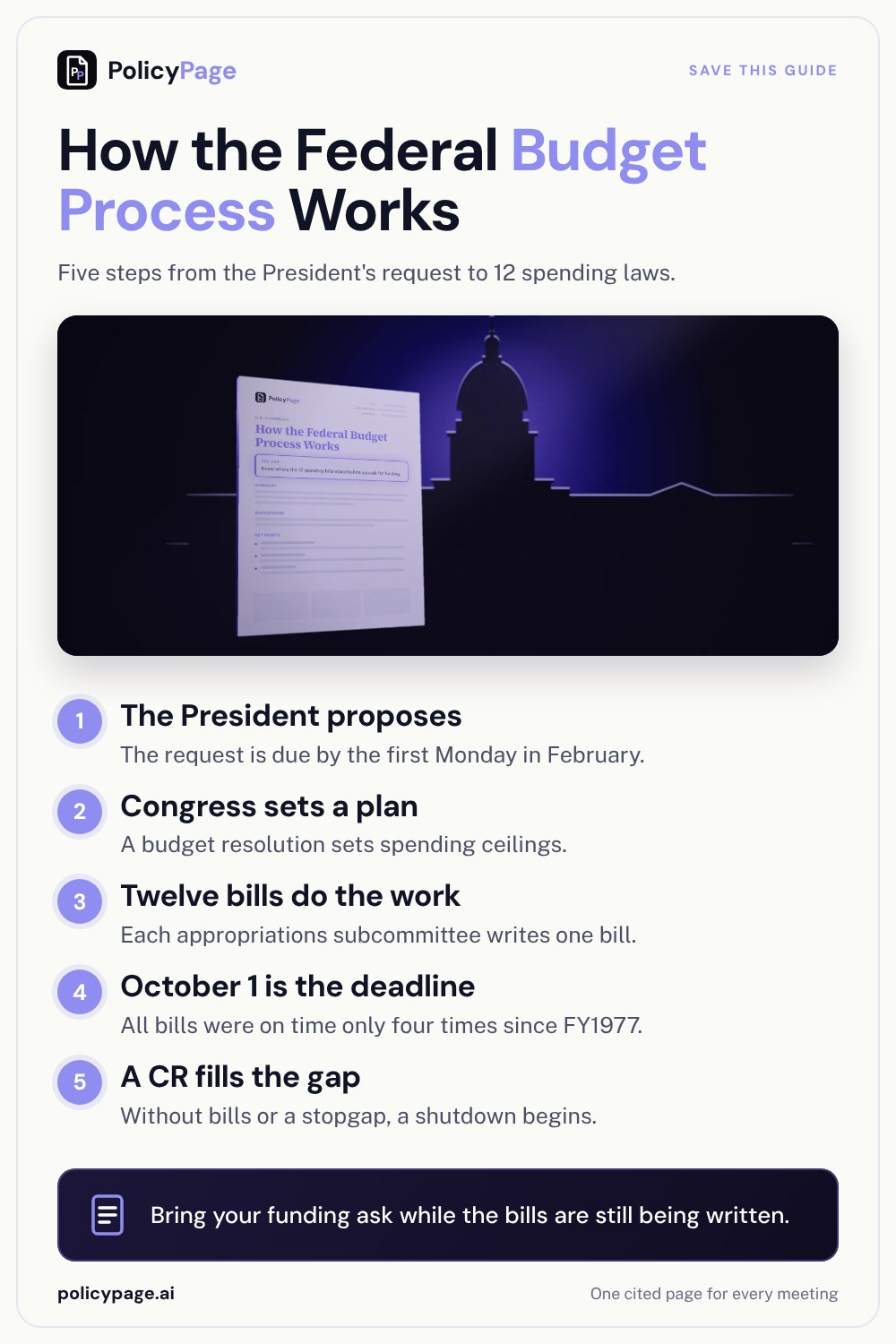
The federal budget process runs from the President's request in February to 12 spending bills Congress must pass by October 1. Here are the five steps.
12 minute read9 sources
In this article
- What is the federal budget process?
- What does the federal budget pay for?
- How does the federal budget process work, step by step?
- Step 1: Agencies and OMB build the President's budget
- Step 2: The President submits the budget to Congress
- Step 3: Congress sets a budget resolution
- Step 4: Appropriations subcommittees write 12 bills
- Step 5: Both chambers pass the bills and the President signs
- What happens if Congress misses October 1?
- Appropriations vs authorization: what is the difference?
- Where the FY2027 budget stands now
- When to weigh in: the budget process for advocates
- Save this guide
The federal budget process is how the U.S. government decides how much to spend each year and on what. It starts when the President sends Congress a budget request, and it ends only when Congress passes, and the President signs, 12 appropriations bills that fund federal agencies for a fiscal year that begins October 1.
In between, Congress is supposed to adopt a budget resolution, hold hearings, write and mark up each spending bill, and pass every bill through both the House and the Senate. The law sets a calendar for all of this. In practice, Congress almost never finishes on time, which is why stopgap funding bills and shutdown deadlines are a normal part of the fall in Washington.
This guide walks through the five main steps in plain English, shows the official timeline next to what happened this year, explains appropriations vs authorization, and shows where advocates can weigh in. People search for this in many ways: "how does the federal budget process work," "federal budget process steps," "appropriations process," and "who creates the federal budget." Each is answered below.
What is the federal budget process?
The Constitution gives Congress the "power of the purse." It says no money can be drawn from the Treasury except through appropriations made by law, as the Congressional Research Service (CRS) explains in The Appropriations Process: A Brief Overview. In other words, federal spending needs a law.
The Constitution does not say how Congress should write those laws, so the process grew over time. The modern version rests on two pieces of law. One, now 31 U.S.C. 1105, requires the President to send Congress a budget each year. The other, the Congressional Budget Act of 1974, set up the budget resolution and a yearly timetable that includes the Congressional Budget Office (CBO) and the House and Senate Budget Committees.
The process runs on the federal fiscal year, which goes from October 1 of one year to September 30 of the next, according to USAGov. So "fiscal year 2027" (FY2027) began on October 1, 2026, and ends on September 30, 2027.
What does the federal budget pay for?
Not every dollar goes through the yearly process. The Center on Budget and Policy Priorities (CBPP) explains in its Introduction to the Federal Budget Process that federal spending falls into two basic categories, plus interest:
- Mandatory spending covers programs like Social Security and Medicare. Their spending is set by the laws that created them, so it continues each year without a new vote. CBPP estimated (as of June 2024) that this is about 61 percent of the budget.
- Discretionary spending is the money Congress decides each year through appropriations bills. It pays for most of what federal agencies do, from national parks to defense. CBPP put it at about 26 percent.
- Interest on the debt is the rest.
When people talk about "the budget fight" in the fall, they almost always mean discretionary spending. That is the part that needs a new law every single year. Mandatory programs change only when Congress passes a law that changes them, sometimes through the fast track called budget reconciliation.
How does the federal budget process work, step by step?
The process has five main steps. The Congressional Budget Act sets target dates for most of them, listed in 2 U.S.C. 631:
| Target date in law | What is supposed to happen |
|---|---|
| First Monday in February | The President submits the budget |
| February 15 | CBO reports to the Budget Committees |
| 6 weeks after the budget | Committees send views and estimates to the Budget Committees |
| April 1 | Senate Budget Committee reports the budget resolution |
| April 15 | Congress finishes the budget resolution |
| May 15 | The House may start on annual appropriations bills |
| June 10 | House Appropriations reports its last bill |
| June 30 | The House finishes its appropriations bills |
| October 1 | The fiscal year begins |
These dates are targets, not hard deadlines. Only October 1 has real teeth, because that is when money runs out. Here is what each step involves.
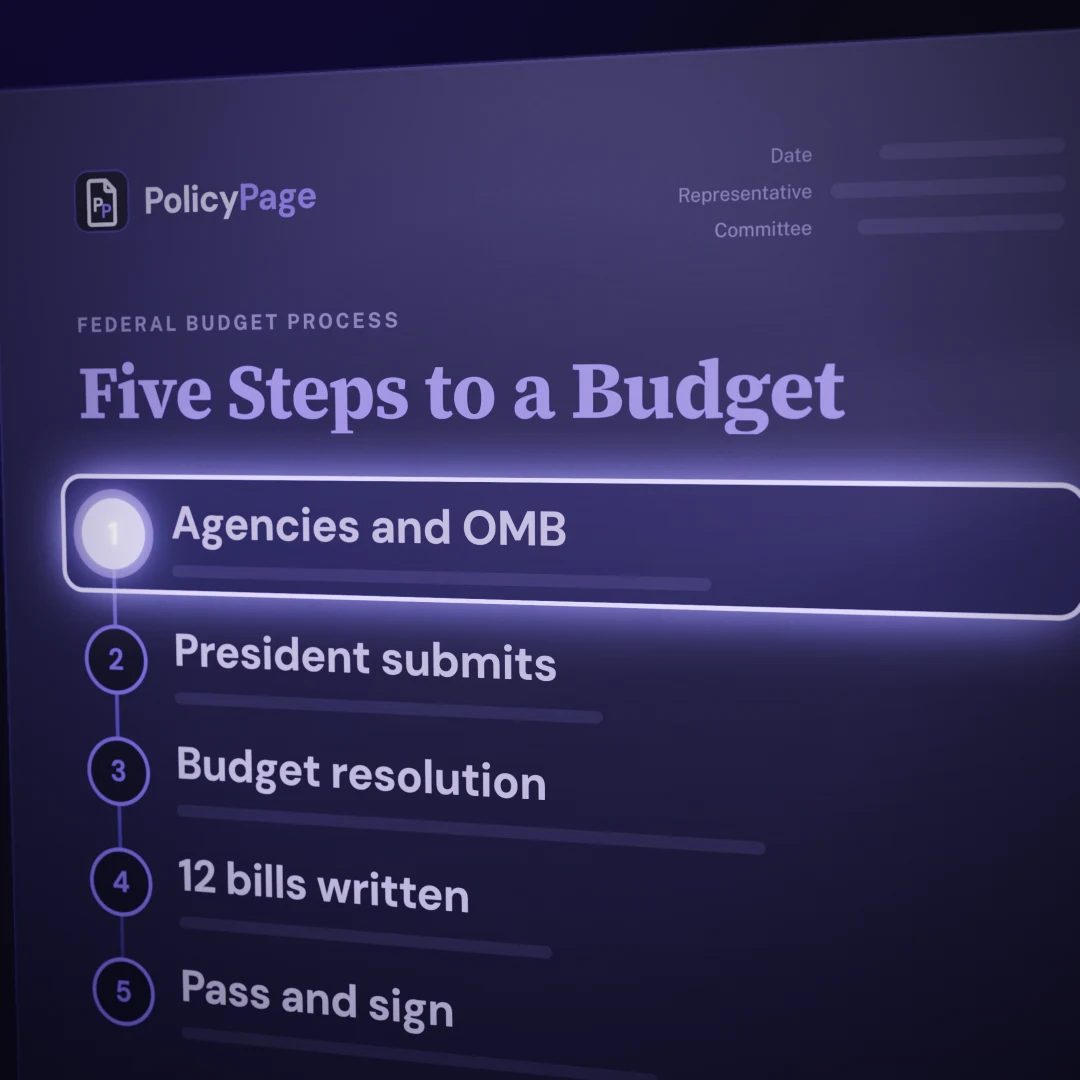
Step 1: Agencies and OMB build the President's budget
The budget starts inside the executive branch, about a year before it would take effect. Each federal agency writes a budget request and sends it to the White House Office of Management and Budget (OMB), as USAGov describes. OMB reviews the requests, weighs them against the President's priorities, and puts together one proposal for the whole government.
CRS notes in its Introduction to the Federal Budget Process that OMB has played a central role in shaping the President's budget, in managing how agencies spend money once it is approved, and in coordinating policy across agencies.
So who creates the federal budget? The answer has two parts. The President proposes it, with OMB doing most of the work. Congress decides it, because only Congress can pass the laws that actually provide money.
Step 2: The President submits the budget to Congress
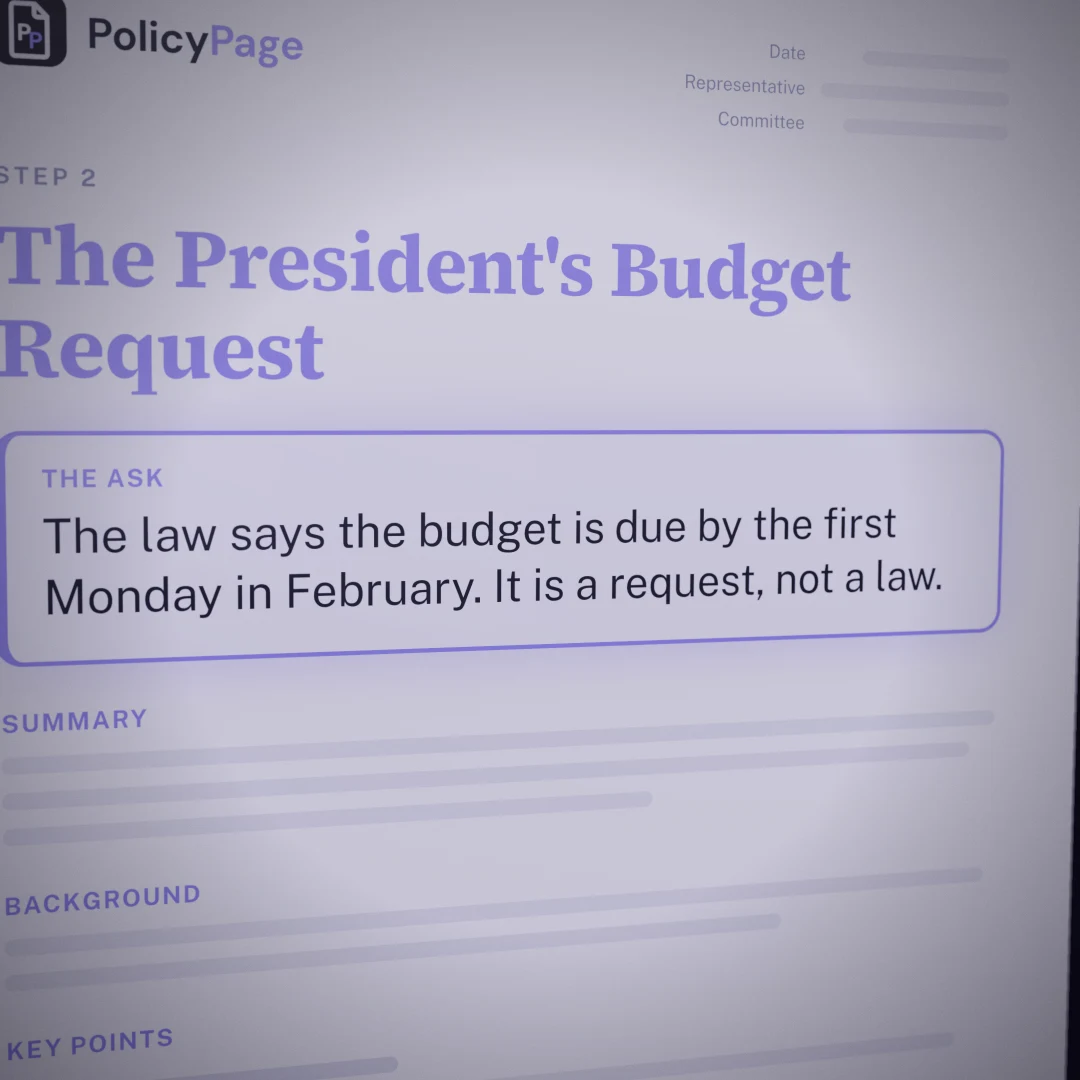
Federal law says the President must submit a budget for the next fiscal year on or after the first Monday in January and no later than the first Monday in February, under 31 U.S.C. 1105. The budget includes a message, a summary, and detailed supporting information.
The deadline often slips. For FY2027, the Committee for a Responsible Federal Budget (CRFB) reported that the Administration released its budget request on April 3, 2026, about two months after the date in the law. CRFB also noted that this year's request focused mainly on discretionary spending.
The President's budget is a request, not a law. Congress can follow it, change it, or ignore it. Its real power is that it sets the opening numbers and tells Congress what the Administration wants. Shortly after it arrives, agencies send the Appropriations Committees detailed "budget justifications" that explain their plans line by line, according to CRS.
Step 3: Congress sets a budget resolution
Next, Congress is supposed to adopt a budget resolution. This is a plan for total spending and revenue, written by the House and Senate Budget Committees and approved by both chambers.
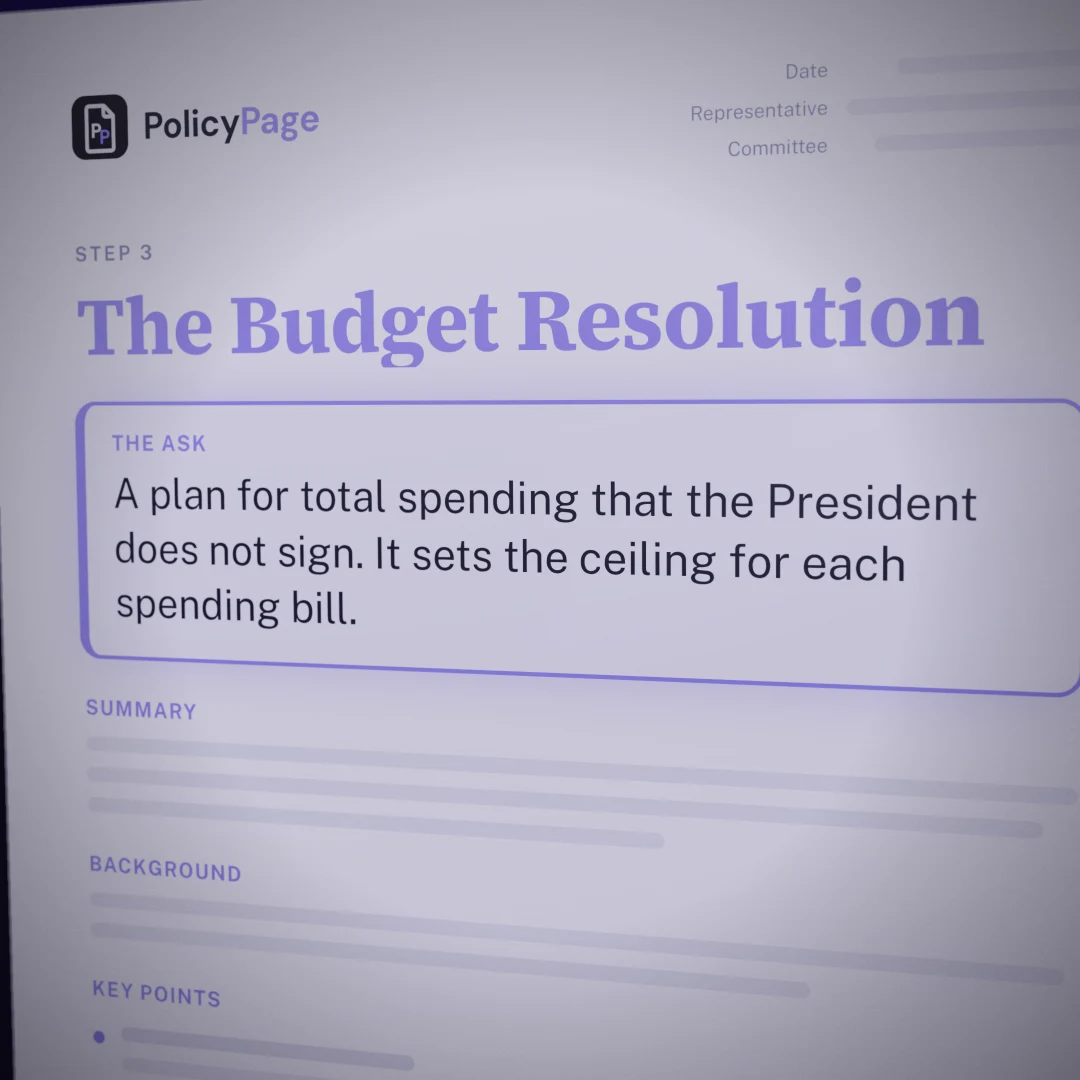
A budget resolution is a concurrent resolution, not a law. The President does not sign it, and it cannot spend a single dollar, as CRS explains. Its job is to set the framework. The most important number in it for appropriations is the "302(a) allocation," the total amount the Appropriations Committees may spend. The Appropriations Committees then split that total among their 12 subcommittees. These splits are called "302(b) suballocations," and each one works as a ceiling for one spending bill.
Congress often misses the April 15 target or skips the budget resolution entirely. The law allows the House to start on spending bills after May 15 even without one. When there is no agreement, each chamber can pass a "deeming resolution" to set spending limits on its own, according to CRS. A budget resolution is also the first step toward reconciliation, which our guide to budget reconciliation covers in detail.
Step 4: Appropriations subcommittees write 12 bills
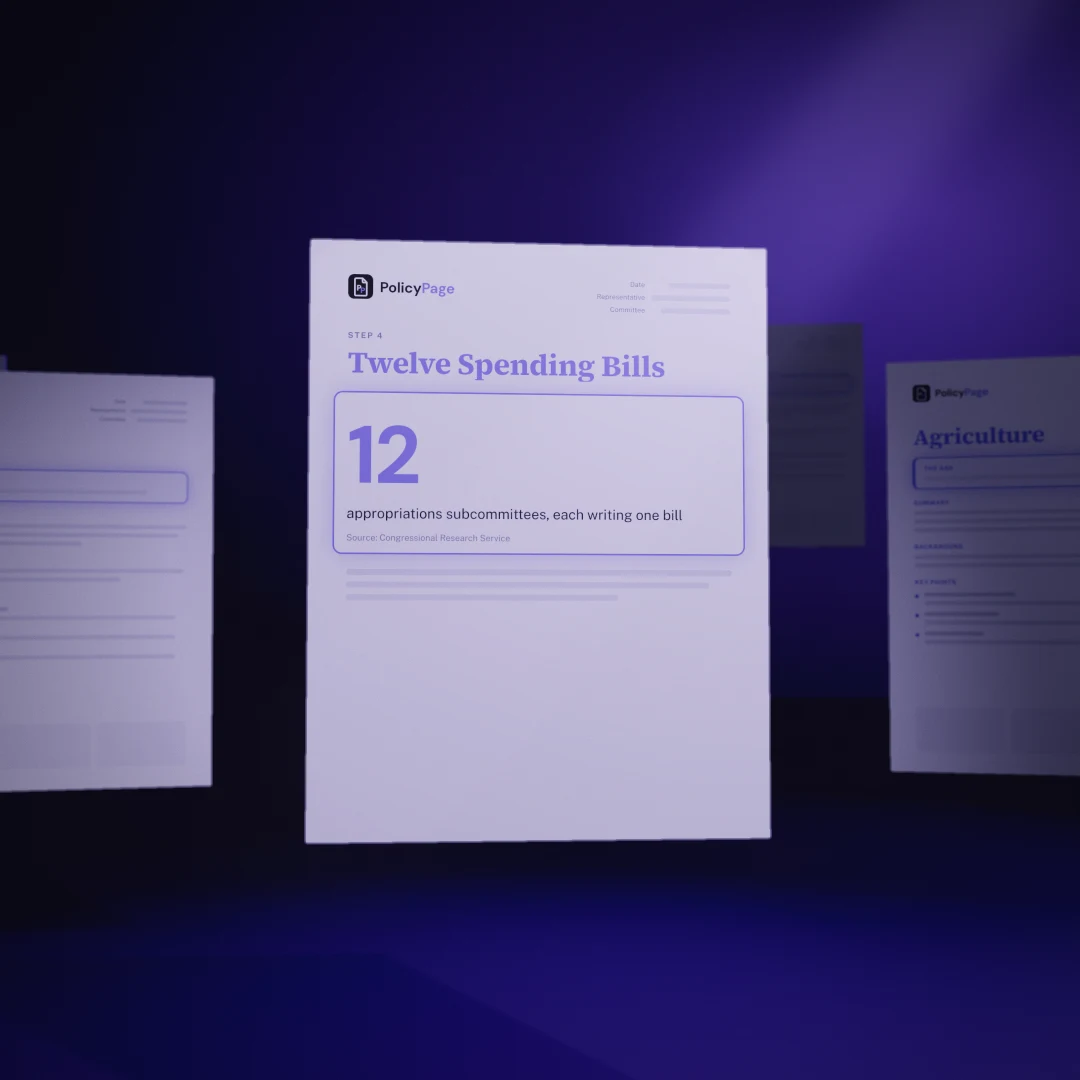
This is the heart of the appropriations process. Since 2007, the House and Senate Appropriations Committees have each had 12 subcommittees, and each one writes one regular appropriations bill, CRS reports. They are organized by subject, such as Defense; Agriculture; Homeland Security; Interior and Environment; Labor, Health and Human Services, and Education; and Transportation and Housing.
Each subcommittee follows roughly the same path:
- Hearings. Agency officials testify about their budget requests and answer questions.
- Member requests. The committees invite other members of Congress to submit requests online. CRS describes three kinds: programmatic requests (support for a program or a funding level), language requests (wording for the bill or its report), and Community Project Funding in the House or Congressionally Directed Spending in the Senate, the modern form of earmarks. Our guide to what earmarks are and how Community Project Funding works covers the request rules and deadlines.
- Subcommittee markup. The subcommittee chair presents a draft, called the chair's mark, and members offer amendments. Our guide to what a markup is explains how this works.
- Full committee markup. The full Appropriations Committee amends and votes to report the bill.
Each bill comes with a committee report. CRS notes that report language is not law, but agencies tend to follow it because it shows what Congress intends. For advocates, the report is often where a specific program gets its instructions.
Step 5: Both chambers pass the bills and the President signs
Once a bill is reported, it goes to the floor. In the House, appropriations bills are debated under a special rule from the Rules Committee that limits which amendments can be offered. In the Senate, appropriations bills get no special fast track. They can be filibustered like most bills, so they usually need unanimous consent or a cloture vote of 60 senators to move, according to CRS.
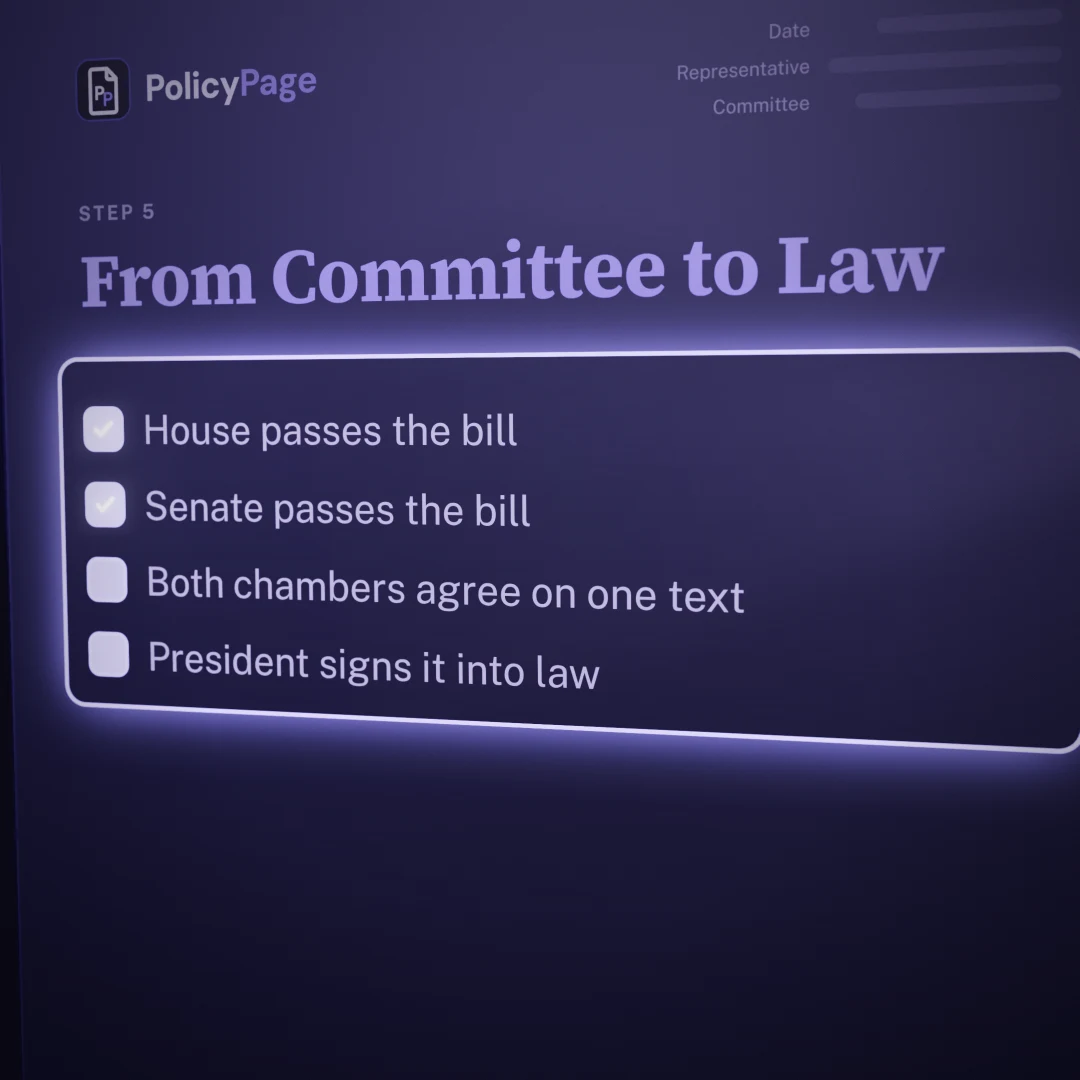
The House and Senate must then pass identical text. They work out differences through a conference committee or by trading amendments back and forth. The final version usually comes with an explanatory statement that tells agencies how to spend the money.
Congress often combines bills to save floor time. A package of a few bills is called a minibus. A package of most or all of them is an omnibus. Finally, the bill goes to the President to sign or veto, as USAGov notes. Once it becomes law, agencies may spend the money only in the amounts, for the purposes, and in the time periods the law sets.
What happens if Congress misses October 1?
Missing the deadline is the rule, not the exception. CRS reports that since FY1977, when the October 1 fiscal year began, Congress has passed all of its regular appropriations bills before the fiscal year started only four times, most recently for FY1997.
When the bills are not done, Congress usually passes a continuing resolution, or CR. A CR keeps agencies running for a set time, usually at last year's funding rate, with rules that block new programs and a few exceptions called "anomalies," as CRS describes. Some CRs last only weeks. Others, called full-year CRs, last until September 30.
If neither the regular bills nor a CR is in place, a funding gap begins. Under the Antideficiency Act, affected agencies must stop most of their work until Congress acts. That is a government shutdown, explained step by step in our guide to how government shutdowns work.
Congress can also pass supplemental appropriations during the year, usually for urgent needs like natural disasters. That is separate from the debt limit, which controls how much the Treasury can borrow to pay for spending Congress has already approved.
Appropriations vs authorization: what is the difference?
This is one of the most common points of confusion. An authorization is a law that creates or continues a program and sets its rules. It may also suggest how much money the program should get. An appropriation is the law that actually provides the money.
CRS puts it simply: an authorization does not by itself fund anything, and Congress does not have to fund every program it authorizes. A program can exist in law and still receive nothing in a given year. The best-known yearly authorization is the National Defense Authorization Act (NDAA), which sets defense policy while a separate defense appropriations bill provides the money. Another big one is the farm bill, which renews food, farm and nutrition programs about every five years.
| Authorization | Appropriation | |
|---|---|---|
| What it does | Creates or continues a program and sets its rules | Provides the money to spend |
| How often | Permanent, yearly, or for several years | Usually every year |
| Who writes it | The committee with subject jurisdiction | The Appropriations Committees |
| Can money be spent from it alone? | No | Yes |
House and Senate rules generally expect spending bills to fund only programs already authorized, and they generally bar new policy language in spending bills. Congress can still fund a program whose authorization has expired, and it often does, according to CRS.
Where the FY2027 budget stands now
Here is how this year's process lines up against the timetable, using the sources opened for this guide:
- Budget request: Released April 3, 2026, about two months after the February deadline, according to CRFB.
- House: The House Appropriations Committee reported all 12 of its FY2027 bills, and the House passed 3 of them before the stopgap became law, according to the CRS report Overview of Continuing Appropriations for FY2027.
- Stopgap: None of the 12 bills was law by fall. On September 2, 2026, the President signed the Continuing Appropriations and Extensions Act, 2027 (P.L. 119-103). It funds agencies covered by all 12 bills from October 1 through December 11, 2026, a 72 day period. CBO estimated it provides an annualized $1.701 trillion in discretionary budget authority, CRS reports.
- Senate: On November 12, the Senate Appropriations Committee released the text of five FY2027 bills, after releasing two others earlier that week, according to the National Association of Development Organizations.
The next deadline is December 11. CRS notes that unless Congress enacts regular bills or another CR before it expires, a funding gap could begin on December 12, 2026.
When to weigh in: the budget process for advocates
The budget calendar is also an advocacy calendar. Each step has a moment when input matters most:
- Late winter and spring: While the subcommittees study the President's budget, the Appropriations Committees typically invite member requests through online systems, as CRS describes. This is when offices gather requests for programs, report language, and community projects, so it helps to know your member's internal deadline.
- Spring and early summer: Subcommittee hearings and markups. Staff are deciding numbers, so specific, cited figures help most.
- Late summer and fall: Floor votes, CR talks, and final negotiations. Asks shift from "add this" to "protect this in the final bill."
- Any time: Committee reports and explanatory statements are public. Reading last year's language for your program shows what Congress already said about it.
A funding request is easier for staff to act on when it names the bill, the account, the amount, and the reason, on one page. If you are preparing for a meeting with a congressional office about funding, PolicyPage writes a free, cited, one page brief tailored to the member you are meeting.
For the bigger picture of how any bill moves through Congress, see our guide to how a bill becomes law.
Save this guide
Frequently asked questions
How does the federal budget process work in simple terms?
The President proposes a budget, Congress sets an overall plan, the Appropriations Committees write 12 spending bills, both chambers pass them, and the President signs them. The goal is to finish before the fiscal year starts on October 1.
What are the 5 steps of the federal budget process?
Agencies and OMB build the President's budget, the President submits it to Congress, Congress adopts a budget resolution, the Appropriations subcommittees write and mark up 12 bills, and both chambers pass the bills for the President to sign.
Who creates the federal budget?
The President proposes the budget, with the Office of Management and Budget doing most of the work. Congress decides the final budget, because only Congress can pass the laws that provide money.
When is the President's budget due?
Federal law says no later than the first Monday in February. The date often slips; the FY2027 request was released on April 3, 2026.
What is the difference between appropriations and authorization?
An authorization creates or continues a program and sets its rules. An appropriation provides the money. A program can be authorized and still get no funding in a given year.
What happens if Congress does not pass a budget by October 1?
Congress usually passes a continuing resolution to keep agencies running for a set time. If no regular bill or continuing resolution is in place, a funding gap begins and affected agencies must shut down most work.
How often does Congress pass all 12 appropriations bills on time?
Rarely. CRS reports that since FY1977, Congress has finished all regular appropriations bills before October 1 only four times, most recently for FY1997.
Terms in this article
Sources
- 1.The federal budget process, USAGov
- 2.Introduction to the Federal Budget Process, Center on Budget and Policy Priorities
- 3.Introduction to the Federal Budget Process (R46240), Congressional Research Service, via EveryCRSReport
- 4.The Appropriations Process: A Brief Overview (R47106), Congressional Research Service, via EveryCRSReport
- 5.Overview of Continuing Appropriations for FY2027 (Division A of P.L. 119-103) (R49353), September 17, 2026, Congressional Research Service, via EveryCRSReport
- 6.2 U.S. Code 631: Timetable, Legal Information Institute, Cornell Law School
- 7.31 U.S. Code 1105: Budget contents and submission to Congress, Legal Information Institute, Cornell Law School
- 8.An Overview of the President's FY 2027 Budget, Committee for a Responsible Federal Budget
- 9.Senate Appropriations Chair Releases Five FY2027 Funding Bills Ahead of December 11 Deadline, National Association of Development Organizations
New to some of the terms here? The advocacy glossary defines them in plain English.