
What Is a Markup in Congress? Meaning, Steps, and What Happens Next
A markup is the committee meeting where members debate and amend a bill, then vote on sending it to the full House or Senate. Here is how each step works.
10 minute read13 sources
In this article
- What is a markup in simple terms?
- What is a markup in government?
- What happens during a markup, step by step
- What is a chair's mark?
- What does full markup mean?
- How is a House markup different from a Senate markup?
- What happens to a bill after markup?
- Can the public watch a markup?
- Why does markup matter for advocates?
- Save this guide

A markup is the committee meeting where members of Congress debate a bill, propose changes to it, and vote on those changes. It usually ends with a vote on whether to send the bill to the full House or Senate. In simple terms, a markup is where a committee edits a bill and decides if it should move on. It takes its name from the idea of marking up a draft, and it is a stage where a bill's text can change a lot.
What is a markup in simple terms?
Think of a bill as a draft going through an editing meeting. Everyone at the table has a copy. People suggest changes, argue about them, and vote on each one. At the end, the group decides whether the edited draft is ready for the next stage.
That is close to what happens in a committee. The Congressional Research Service (CRS), which writes nonpartisan reports for Congress, describes markups as meetings where members propose and vote on amendments and then vote on whether to report the bill to the chamber. The word comes from members marking up the legislation in front of them.
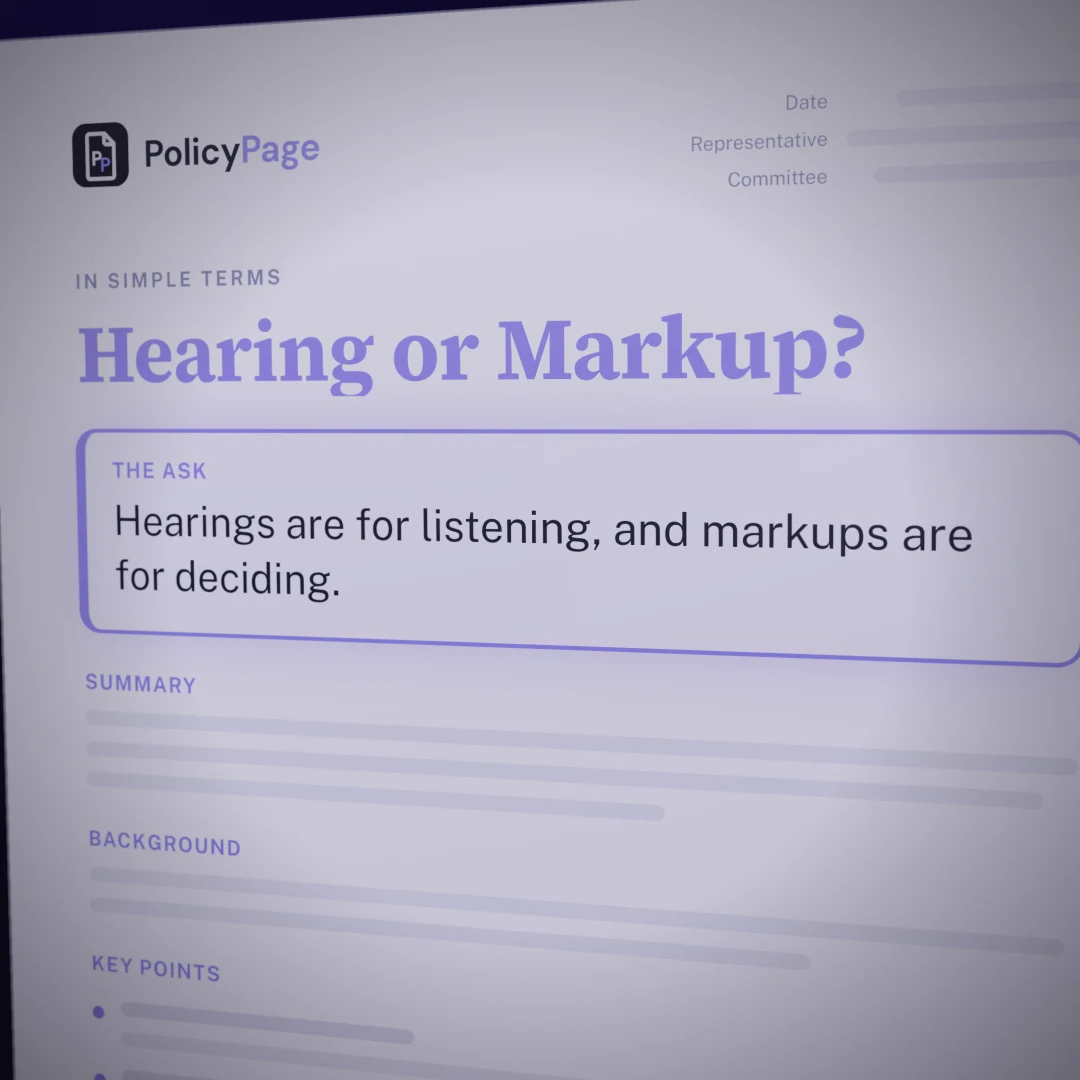
A markup is different from a committee hearing. At a hearing, a committee gathers information, usually by listening to witnesses. At a markup, the committee acts on legislation. A short way to remember it: hearings are for listening, and markups are for deciding.
Other meanings of markup
If you searched for "markup" and landed here, you may have meant something else. In business, a markup is the amount added to a product's cost to set its price. In computing, markup is the code that formats a web page, as in Hypertext Markup Language (HTML). Those meanings have nothing to do with Congress. This guide covers only the government meaning, which is also what a civics or American government class means by a committee markup.
What is a markup in government?
Congress sends most bills to committees, and those committees do most of the detailed work on them. CRS notes that a committee takes up only a relatively small percentage of the measures sent to it. So a markup is a sign that a bill has cleared a real hurdle: someone with power over the committee's agenda chose to spend time on it.
That someone is usually the chair. CRS says the chair sets the agenda in the House and has primary authority in the Senate over which measures get a markup and what text is used. Members who want a different agenda do have tools, but CRS describes the House options as rarely used or rarely successful.
One detail surprises many people. A committee cannot directly rewrite a bill that has been referred to it. CRS explains that the committee votes on amendments it wants the full chamber to adopt. The Senate works the same way: amendments adopted at markup go to the floor as recommendations. So when a committee "changes" a bill at markup, it is really recommending those changes to everyone else.
What happens during a markup, step by step
Each committee writes its own rules, and those rules cannot conflict with the rules of its chamber. The details vary, but most markups follow the same five steps.
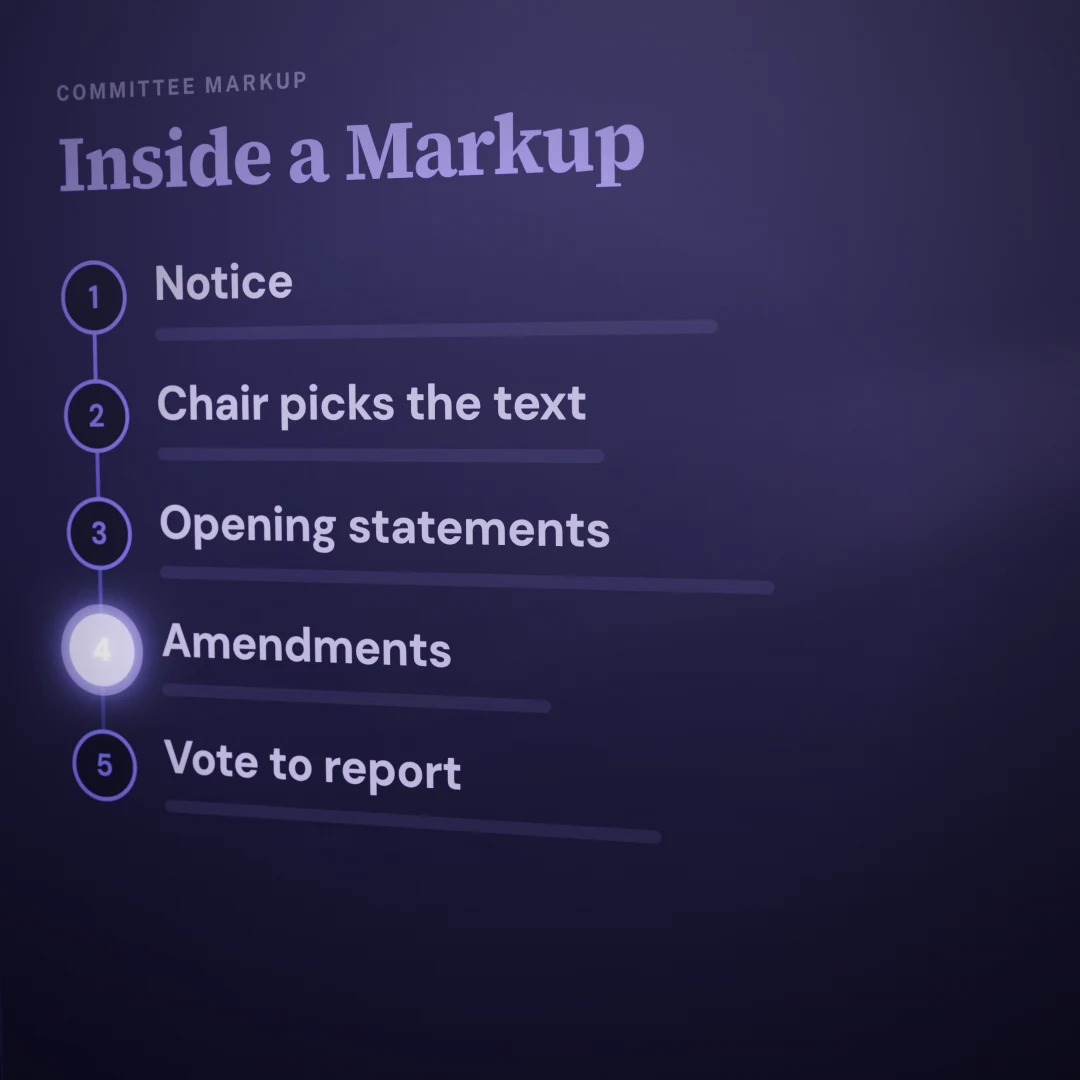
Step 1: The committee gives notice
Before a House markup, members get notice. Under House Rule XI, a markup may not begin before the third day after notice is given, and weekends and holidays are not counted unless the House is in session. The text must also be publicly available online at least 24 hours in advance. The chair and the top minority member can agree to skip the notice period for good cause, or the committee can vote to do so.
The Senate is looser. CRS reports that Senate rules do not require advance notice of a markup, though committees must tell the Office of the Daily Digest when one is scheduled. Many Senate committees also give advance notice under their own rules.
Step 2: The chair picks the text
The committee needs one document to work from. In the House, CRS lists three options: a bill that was introduced and referred to the committee, a full replacement called an amendment in the nature of a substitute, or a draft that has not been introduced, often called a chair's mark. In the Senate, choosing the text is generally the chair's call as well.
Step 3: Members make opening statements
The chair typically opens the meeting and recognizes the top minority member. Other members may speak. In the House, opening statements usually run five minutes or less. Formal reading of the bill is often waived.
Step 4: Members offer and vote on amendments
This is the heart of the meeting. Members offer amendments one at a time, debate them, and vote. In the House, a bill is read for amendment section by section unless the committee agrees otherwise. An amendment to the bill is a first-degree amendment, and an amendment to that amendment is a second-degree amendment.
Often the first amendment is a substitute that replaces the entire text. Our glossary covers the same idea at the state level under committee substitute. A substitute lets a chair bring in a new version that already includes changes worked out before the meeting.
Any House member can ask for a roll call vote, which needs support from at least one-fifth of the members present, though some committees set a lower bar. Those results must be posted within 48 hours.
Step 5: The committee votes to report the bill
At the end, the committee does not technically vote on the bill itself. It votes on a motion to order the bill reported to the chamber, along with the amendments it adopted. This is why you may read that a bill was "ordered reported."
This vote has a stricter attendance rule than the rest of the meeting. In the House, committees can set a quorum of as little as one-third of their members for other business, but a majority of the committee must be physically present for the final vote. The Senate has the same two levels: one-third to do business and a physically present majority to report.
What is a chair's mark?
A chair's mark is a version of the legislation put forward by the committee's chair as the starting point for a markup. In the Senate, CRS describes it as the chair's recommendations, which may reflect a lot of input from other members, especially those in the majority party.
Draft markups are not common in most House committees. CRS notes that the Appropriations and Rules Committees regularly use them because those committees can originate measures on their own. The House Appropriations Committee's markup page shows how this looks in practice, with annual spending bills listed by subcommittee and by date. For how that spending process fits together, see our glossary entry on appropriations.
What does full markup mean?
A "full markup" or "full committee markup" means the entire committee is meeting, not one of its subcommittees. Some bills get two markups: one in a subcommittee and then one in the full committee.
The procedures are the same at both levels in the House, but the result is not. A subcommittee sends its work to the parent committee, and it generally cannot report directly to the House. The full committee then usually starts from the subcommittee's product. Normally, only the full committee sends the bill on to the chamber.
Whether a subcommittee goes first depends on the bill and on the committee's rules. Some committees give subcommittees a lot of independence, and others mostly use them for hearings.
How is a House markup different from a Senate markup?
The two chambers look similar here, but a few rules differ in ways that change what can happen in the room.
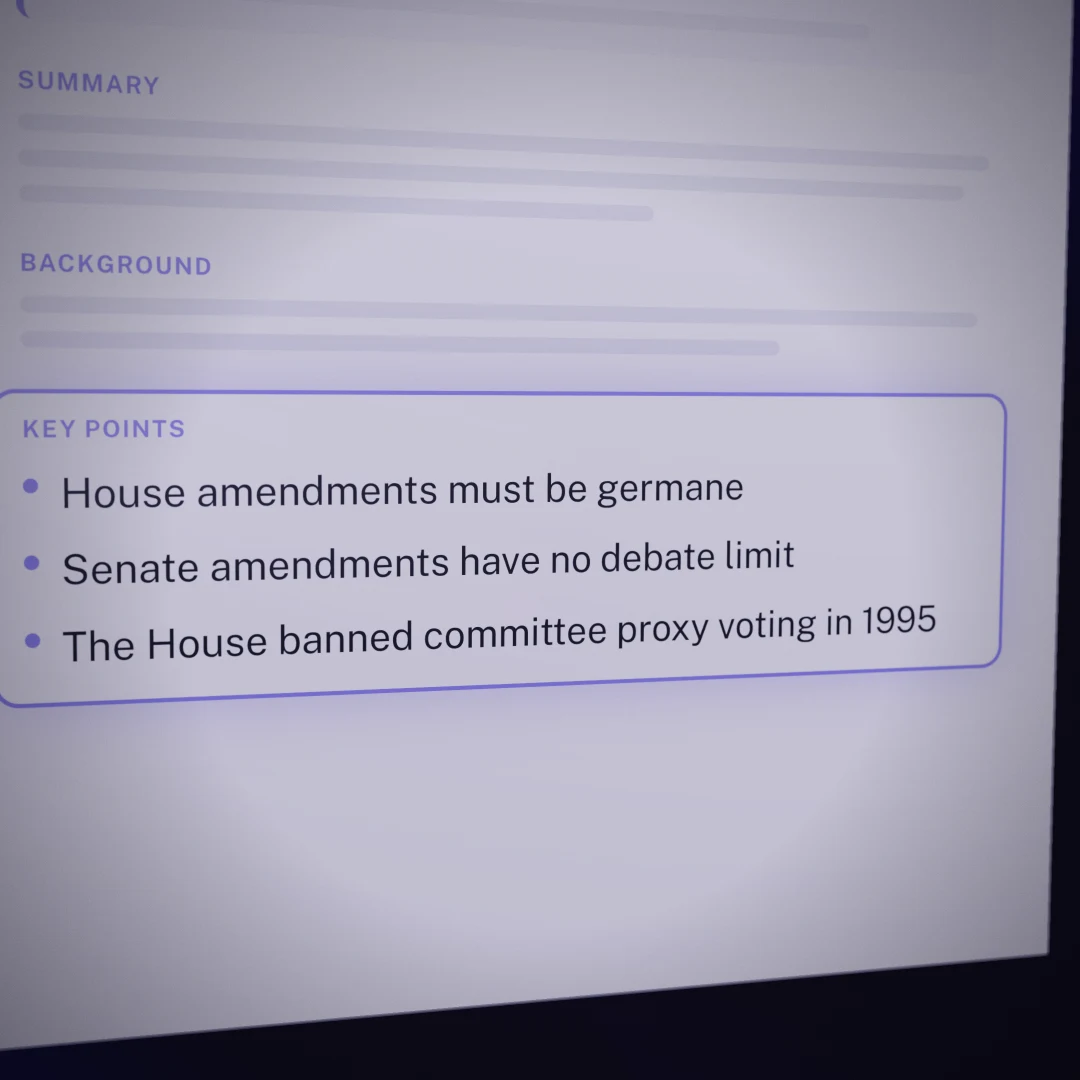
- Staying on topic. In the House, each amendment must be germane, which means related to the text being amended. Senate rules have no general germaneness requirement for committee amendments, although a committee can agree to one, and Senate Rule XV bars reporting amendments that contain significant matter outside the committee's jurisdiction.
- Debate time. House members generally debate amendments under a five-minute rule, and the committee can vote to end debate. In the Senate, amendments have no debate limit.
- Proxy votes. A proxy lets an absent member's vote be cast by someone else. The House banned committee proxy voting in 1995. Senate committees may allow it, but only within limits: proxies cannot count toward the quorum to report a bill, and yes votes cast in person must outnumber all no votes, including no votes cast by proxy.
- Holding over. Senate committee members can ask to hold an item over to the next meeting, often to develop amendments or to slow a contested bill. Committee rules set the terms.
The Senate also tends to be less formal. CRS says Senate committees often proceed by unanimous consent, and they often adopt several amendments and report measures that way.
What happens to a bill after markup?
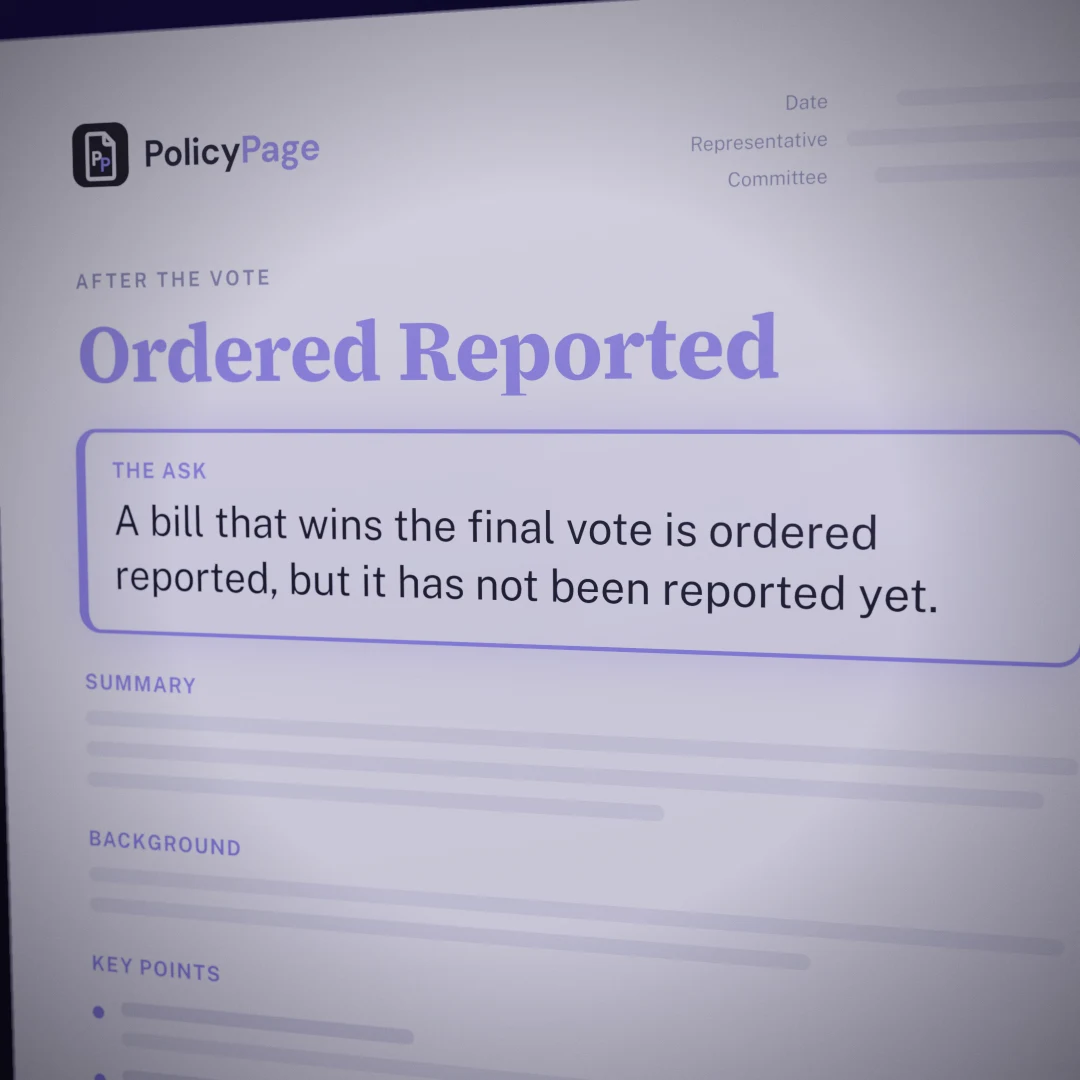
A bill that wins the final vote is ordered reported, but it has not been reported yet. In the House, CRS explains that the formal step comes when the committee report is filed, and the chair must do this promptly. Filing puts the bill on a House calendar, which is a list of measures eligible for the floor.
The committee report explains the bill. Members who disagree, or who want to add to it, can file their own views. House members get at least two additional calendar days to do this if they give notice when the bill is approved. Senators get at least three calendar days. Senate rules do not require a written report at all, though content rules apply if a committee writes one.
If the final vote fails in the Senate, the measure stays in committee and can be taken up again.
Clearing markup is an important step, but it is not the end. A reported bill still needs a floor vote, and in the House the Rules Committee often shapes how that happens. Our guide on how a bill becomes law walks through the rest of the path, and how a bill really dies covers the many ways bills stop moving.
Can the public watch a markup?
Usually, yes. House markups are open to the press and the public unless a majority of members present vote to close them for limited reasons. Senate committee meetings are also open by default, and a majority of a committee may close one on specific grounds, such as national security.
To find one, try these places:
- Congress.gov. The site's committee schedule shows meetings by day or week. With a Congress.gov account, you can sign up for a weekly email.
- The House committee repository. The clerk's public site, docs.house.gov, is where House committee documents are posted. The rules also require draft text, amendments, and roll call votes to become public on set timelines. Adopted amendments must be posted within 24 hours, and the others within 48 hours.
- The committee's own website. Many committees list upcoming and past markups, often with the meeting date, time, and room.
Why does markup matter for advocates?
If you work on an issue, markup acts as a deadline. Once a committee has voted, the text is much harder to change. Most of the work has to come first.
The timing rules show why. The House notice period can be as short as a few days, and the text may be public only 24 hours in advance. Some House committees use an amendment roster to sort amendments submitted ahead of time, and some Senate committees bar first-degree amendments unless they were filed by a deadline. If you hope a member will offer an amendment, the office needs your language well before the meeting.
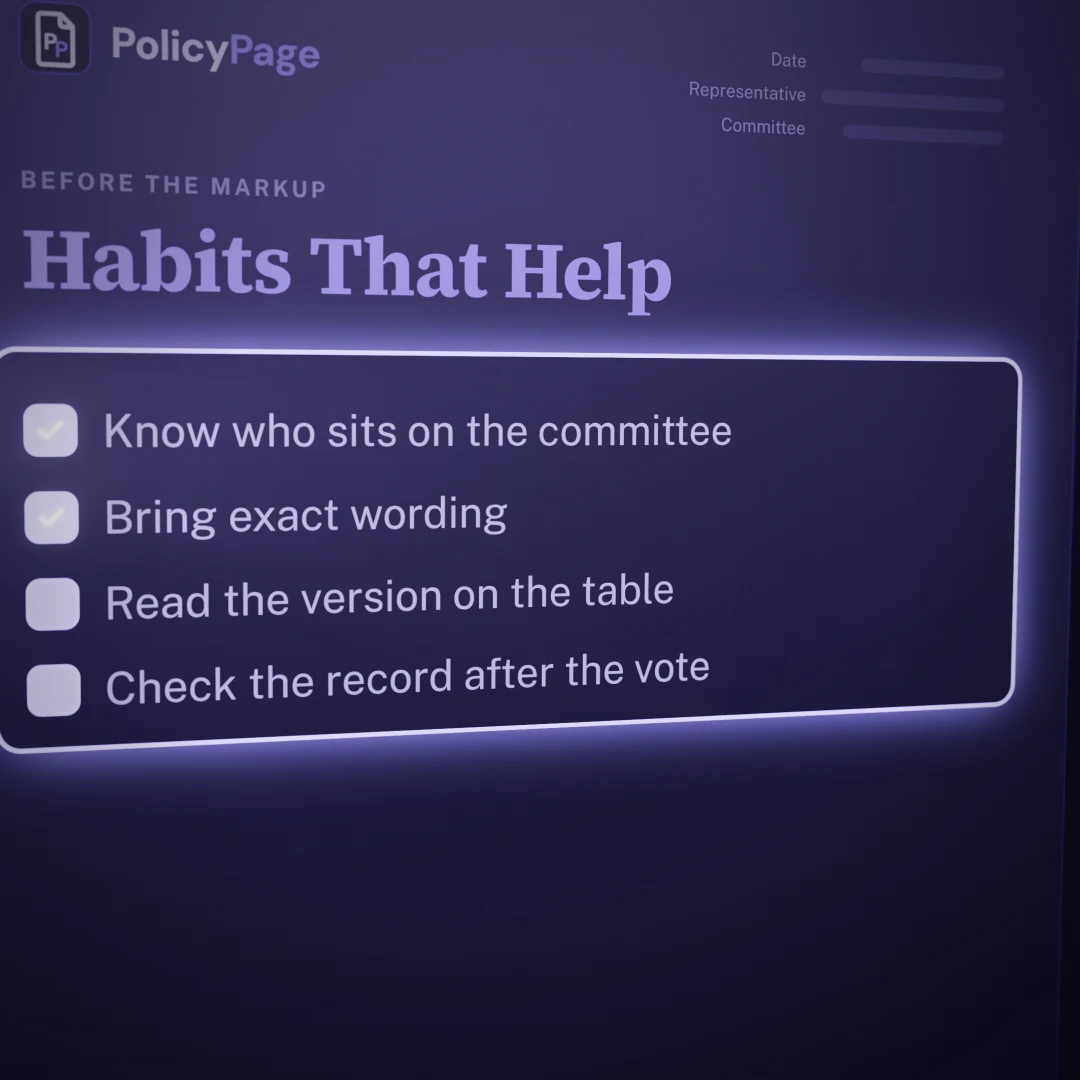
A few habits help:
- Know who sits on the committee. The chair controls the schedule and the text, and committee members cast the votes that count at this stage.
- Bring exact wording. A staff member can act on a specific edit to a specific section more easily than on a general concern. The legislative director in an office is often a good person to talk to.
- Read the version on the table. The text being marked up may not match the introduced bill. Check for a substitute or a chair's mark.
- Check the record after the vote. Roll call results and adopted amendments tell you where members landed and what changed.
If you are preparing to meet with a member or their staff before a markup, PolicyPage writes a free, one page, cited brief for the specific member you are meeting, built around their district or state.
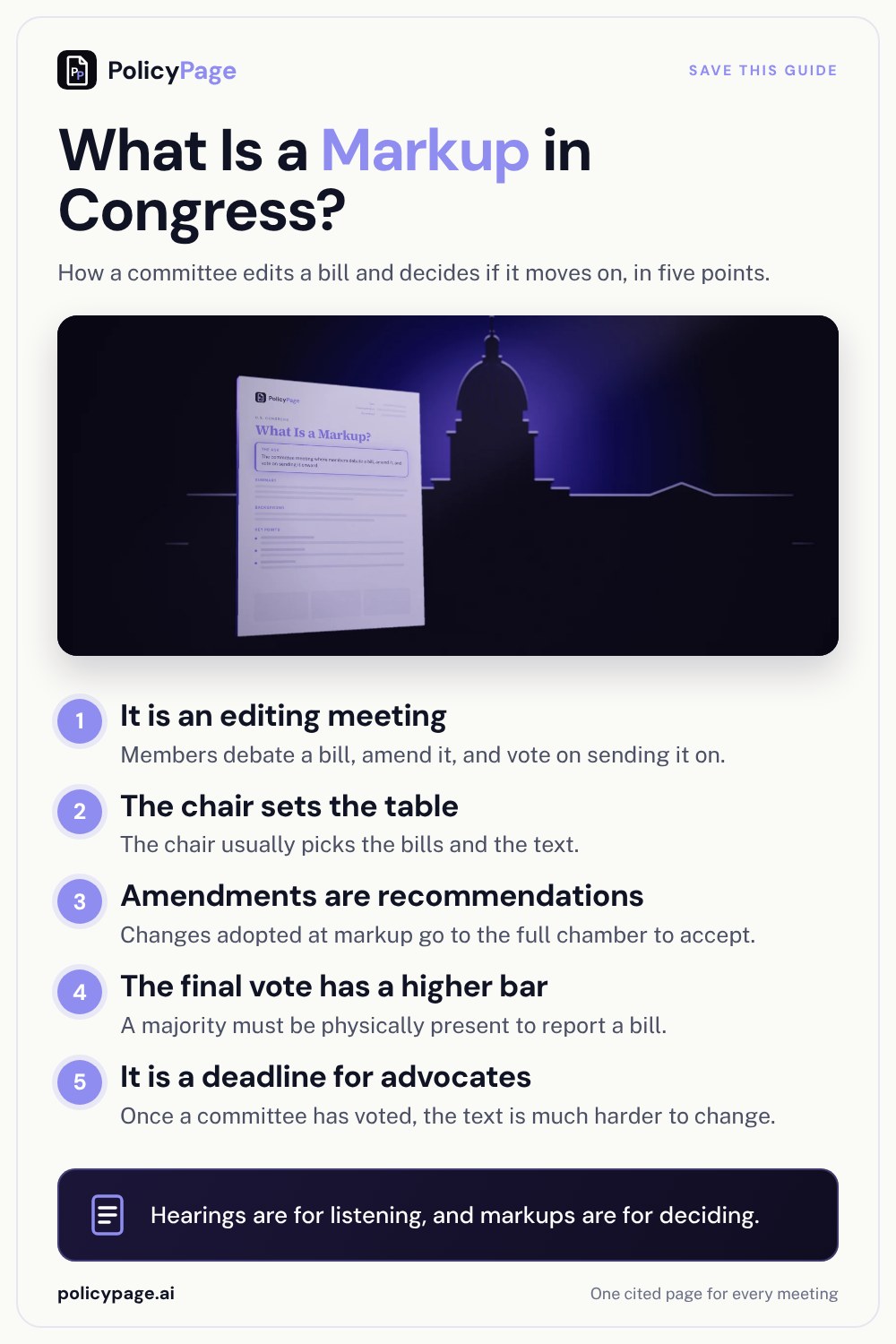
Save this guide
Frequently asked questions
What is a markup in Congress?
A markup is a committee meeting where members debate a bill, offer and vote on amendments, and usually vote on whether to send the bill to the full House or Senate.
What is a markup in simple terms?
It is an editing session for a bill. Committee members propose changes, vote on them, and then decide whether the edited version should move forward to the full chamber.
What is the difference between a hearing and a markup?
A hearing is for gathering information, usually from witnesses. A markup is where the committee acts on the legislation by voting on amendments and on whether to report the bill.
What does full markup mean?
A full markup, or full committee markup, means the entire committee is meeting rather than a subcommittee. Normally, only the full committee reports a bill to the chamber. A subcommittee sends its work to the parent committee.
What happens to a bill after markup?
If the committee votes to report it, the bill is ordered reported and the committee files it with the chamber, usually with a written report in the House. It can then be considered for a floor vote, which is not guaranteed.
Are markups open to the public?
Usually, yes. House and Senate committee markups are open by default, though a committee can vote to close a meeting for limited reasons such as national security.
What is a chair's mark?
A chair's mark is a draft version of the legislation offered by the committee's chair as the starting point for a markup. It can reflect input from other committee members.
Terms in this article
Sources
- 1.The Committee Markup Process in the House of Representatives (RL30244), Congressional Research Service
- 2.The Committee Markup Process in the Senate (R48298), Congressional Research Service
- 3.House Rules and Precedents Affecting Committee Markup Procedures (97-1045), Congressional Research Service
- 4.House Committee Markup: Reporting (98-267), Congressional Research Service
- 5.House Committee Markup: Vehicle for Consideration and Amendment (98-188), Congressional Research Service
- 6.House Committee Markups: Manual of Procedures and Procedural Strategies (R41083), Congressional Research Service
- 7.Markup in Senate Committee: Choosing a Text (98-244), Congressional Research Service
- 8.Preparation for Senate Committee Markup (98-243), Congressional Research Service
- 9.Proxy Voting and Polling in Senate Committee (RS22952), Congressional Research Service
- 10.Senate Rules for Committee Markups (98-711), Congressional Research Service
- 11.How to Track House Approps Markups, First Branch Forecast
- 12.Congress.gov Public Quick Start Guide, Library of Congress
- 13.Markups, House Committee on Appropriations
New to some of the terms here? The advocacy glossary defines them in plain English.