
What Is a Floor Vote? How the House and Senate Vote on Bills
A floor vote is a vote by the full House or Senate, not a committee. Here is how voice, division and roll call votes work, and how many votes each one needs.
12 minute read8 sources
In this article
- What is a floor vote in Congress?
- What does a full floor vote mean?
- How does a floor vote work in the House?
- How does a floor vote work in the Senate?
- How many votes does it take to pass on the floor?
- How can you find out how a member voted?
- How do floor votes work in state legislatures?
- Why floor votes matter for your meeting
- The short version
- Save this guide

A floor vote is a vote taken by the full membership of a legislative chamber, such as the whole House or the whole Senate, rather than by a single committee. In Congress, a floor vote can be a quick voice vote, a standing count, or a recorded roll call that shows exactly how each member voted.
The word "floor" simply means the main chamber where all members meet, as opposed to the smaller committee rooms where bills are studied first. People search for this term in many ways: "floor vote meaning," "floor vote definition government," "what is a floor vote in Congress," "full floor vote meaning," and "how does a floor vote work." This guide answers each of them in plain English, puts the House and the Senate side by side, and explains how to look up how any member voted.
What is a floor vote in Congress?
A bill usually goes to a committee first. The committee holds hearings, makes changes at a markup, and decides whether to send the bill on. Only after that does the bill reach the floor, where every member of the chamber can debate it and vote on it. That vote of the whole chamber is the floor vote.
The House describes its own floor in its guide to the legislative process on the House floor. It explains that votes on final passage and other questions may be taken by the electronic voting system, which registers each member's response. These are called yea and nay votes or recorded votes. The same page notes that the House may also vote by voice, and that no record of each member's position exists for a voice vote.
So a floor vote is not one single kind of vote. It is a family of methods, and the method used decides what the public can learn about each member. A useful comparison is a classroom. A teacher can ask everyone who agrees to say "yes" out loud, ask people to stand and be counted, or go around the room and write down each student's name and answer. Congress uses all three.
The Senate works the same way in broad terms. The Senate's page About Voting describes voice votes, division votes, and roll call votes, and notes that in most cases a simple majority is required for a measure to pass.
What does a full floor vote mean?
A "full floor vote" is the same thing as a floor vote. The word "full" stresses that the entire chamber is voting, not a committee or subcommittee. When news reports say a bill is "headed for a full floor vote," they mean it has cleared committee and the whole House or Senate is about to decide on it.
This matters because a committee vote and a floor vote are very different events. A committee is a small group of members who focus on one subject. A floor vote is open to every member of the chamber. A bill can pass a committee and still never reach the floor, because leaders decide what comes up and when. Our guide to how a bill becomes law walks through that path from start to finish.
A floor vote also does not always mean a vote on the whole bill. Members vote on the floor on amendments, on motions to send a bill back to committee, on the rules for debate, and on final passage. The House explains, for example, that a vote to "recommit" a bill to committee may come first, and that if that attempt fails, a vote on final passage is ordered.
How does a floor vote work in the House?
The Congressional Research Service (CRS), the nonpartisan research office that serves Congress, explains the details in its report on House voting procedures. It says there are four forms of votes in the House: a voice vote, a division vote, a yea and nay vote, and a recorded vote. Here is how each one works, in the order a question usually moves through them.
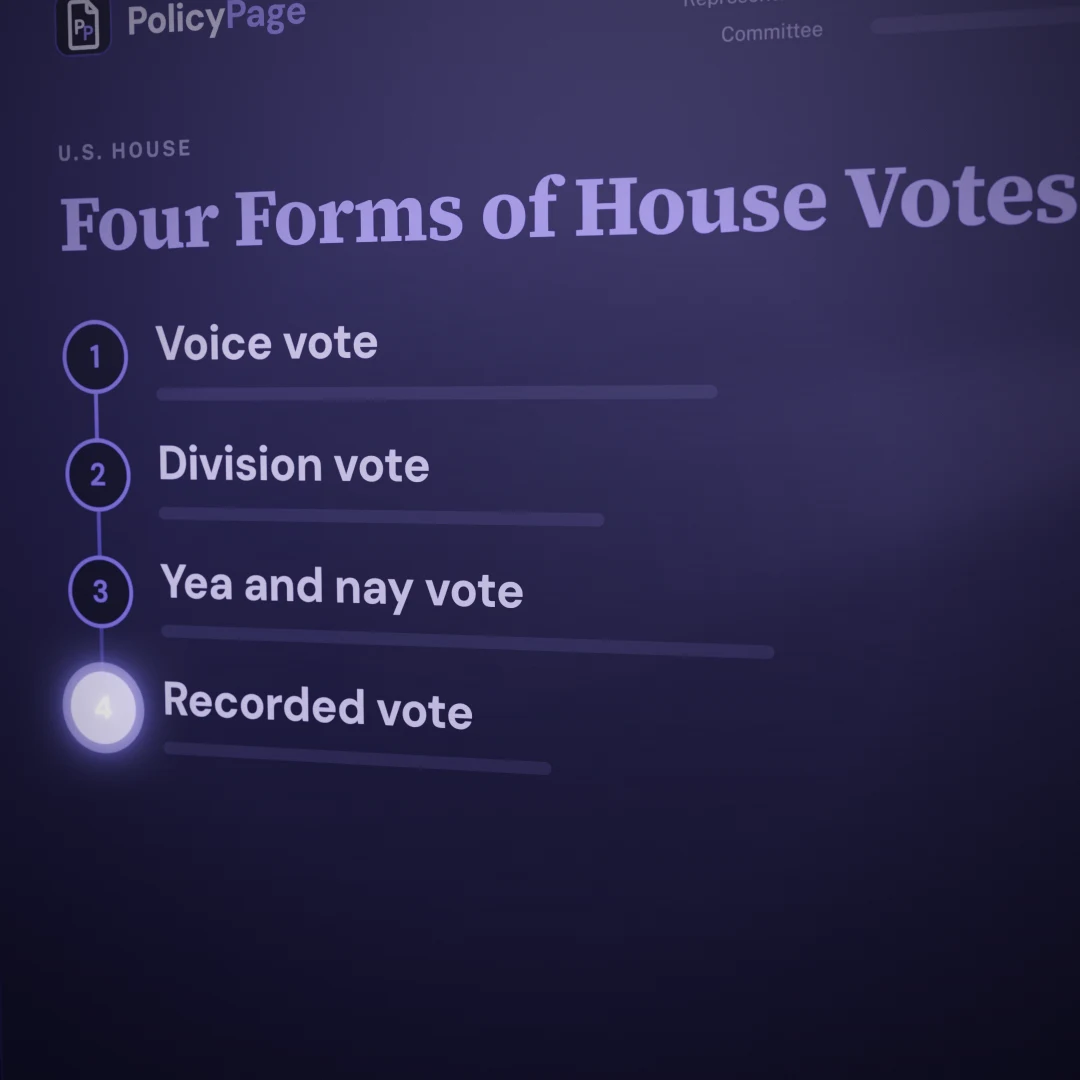
- Voice vote. CRS says most questions are first put to a voice vote. The presiding officer asks those in favor to say "aye," then those opposed to say "no," and then announces which side appears to have it. There is no record of how any individual member voted.
- Division vote. If the presiding officer is unsure of a voice vote, or a member demands a division, members in favor stand to be counted, then those opposed stand. Only the totals are announced, not names. CRS notes that division votes are rare in current practice.
- Yea and nay vote. This is the roll call people picture. The Constitution says the yeas and nays are taken at the desire of one fifth of those present. Any member can demand them, and if one fifth of the members present support the demand, the vote is ordered. CRS says these votes are taken by electronic device.
- Recorded vote. This also records each member's vote electronically. A recorded vote is ordered when at least one fifth of a quorum supports the request. CRS explains that with a full quorum of 218, that means 44 members.
The difference between the last two is mostly about how many members must back the request. One fifth of those present can order the yeas and nays. One fifth of a quorum, or 44 members, can order a recorded vote. Either way, the result is a public list of every member's position.
Timing is part of the process too. CRS says the minimum time for a vote by electronic device is 15 minutes, and that this is a minimum, not a maximum, so the chair can hold a vote open longer. The Speaker can shorten some votes to as little as two minutes when they follow another electronic vote. The Speaker can also postpone certain votes and group them together, and CRS says postponed votes generally occur within two legislative days. That is why the House often holds a string of votes back to back.
Much of the House's work on big bills happens in a setting called the Committee of the Whole. Despite the name, it is the full House meeting under special rules that make debate and amending easier. CRS says only three forms of votes are allowed there: voice, division, and recorded. A recorded vote there needs the support of 25 members, and the quorum is 100.
Some House votes need more than a simple majority. The House Clerk's roll call vote search lists vote types such as "2/3 Recorded Vote" and "2/3 Yea-And-Nay" alongside ordinary recorded votes. One common two-thirds vote is suspension of the rules, the fast track covered in our guide to suspension of the rules.
How does a floor vote work in the Senate?
The Senate uses fewer forms and its own customs. CRS explains them in its report on voting and quorum procedures in the Senate. The Senate votes in three ways: by voice, by division, or by roll call. CRS says contested questions are usually decided by roll call, while many uncontested questions are decided "without objection," without even a voice vote.
Here is the basic flow. Unless a roll call has been ordered in advance, a question is first put to a voice vote, and any senator may then ask for a division or a roll call. In a division vote, senators stand and are counted, but CRS notes the presiding officer announces only which side won, not the numbers. Division votes are unusual in today's Senate.
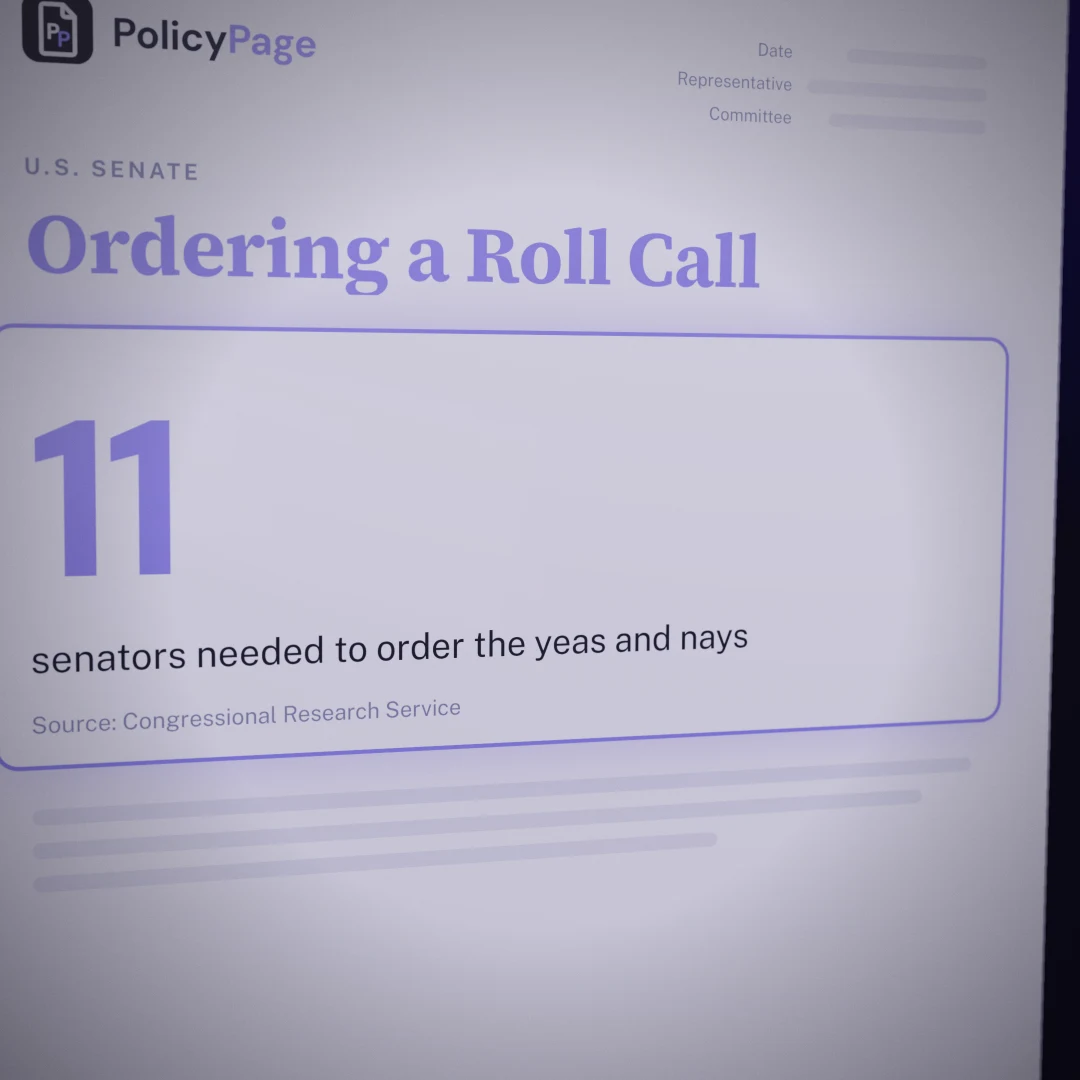
To get a roll call, a senator "asks for the yeas and nays." The Senate assumes a quorum is present, so the request needs support from one fifth of the smallest possible quorum. CRS says that means at least 11 senators, one fifth of the minimum quorum of 51. An interesting detail: ordering the yeas and nays decides how the vote will happen, not when. A senator can offer an amendment and ask for the yeas and nays right away, even if the vote comes hours or days later.
When the roll call begins, the clerk calls every senator's name in alphabetical order. The Senate's About Voting page explains that each senator votes yea or nay as the clerk calls the name, and the clerk records the votes on a tally sheet. CRS adds that bells and lights in the Capitol and Senate office buildings signal that senators have 15 minutes to come and vote. That 15 minute window is set by unanimous consent, normally on the first day of each Congress, and votes are often held open longer so more senators can reach the floor.
Senate floor time also includes many quorum calls. CRS explains that senators often "suggest the absence of a quorum" not to count heads, but to pause the floor so leaders can talk and work out a deal. These pauses usually end by unanimous consent before the clerk finishes the roll, a tool explained in our guide to how unanimous consent works.
How many votes does it take to pass on the floor?
Most floor votes are decided by a simple majority. CRS defines a simple majority in the Senate as at least 50 percent plus one of the senators voting, provided a quorum is present. A budget reconciliation bill is a well known case: its debate is time limited, so it can pass the Senate by simple majority. Some questions need a bigger share. The table below puts the main thresholds in one place, using the two CRS reports and the Senate's voting page.
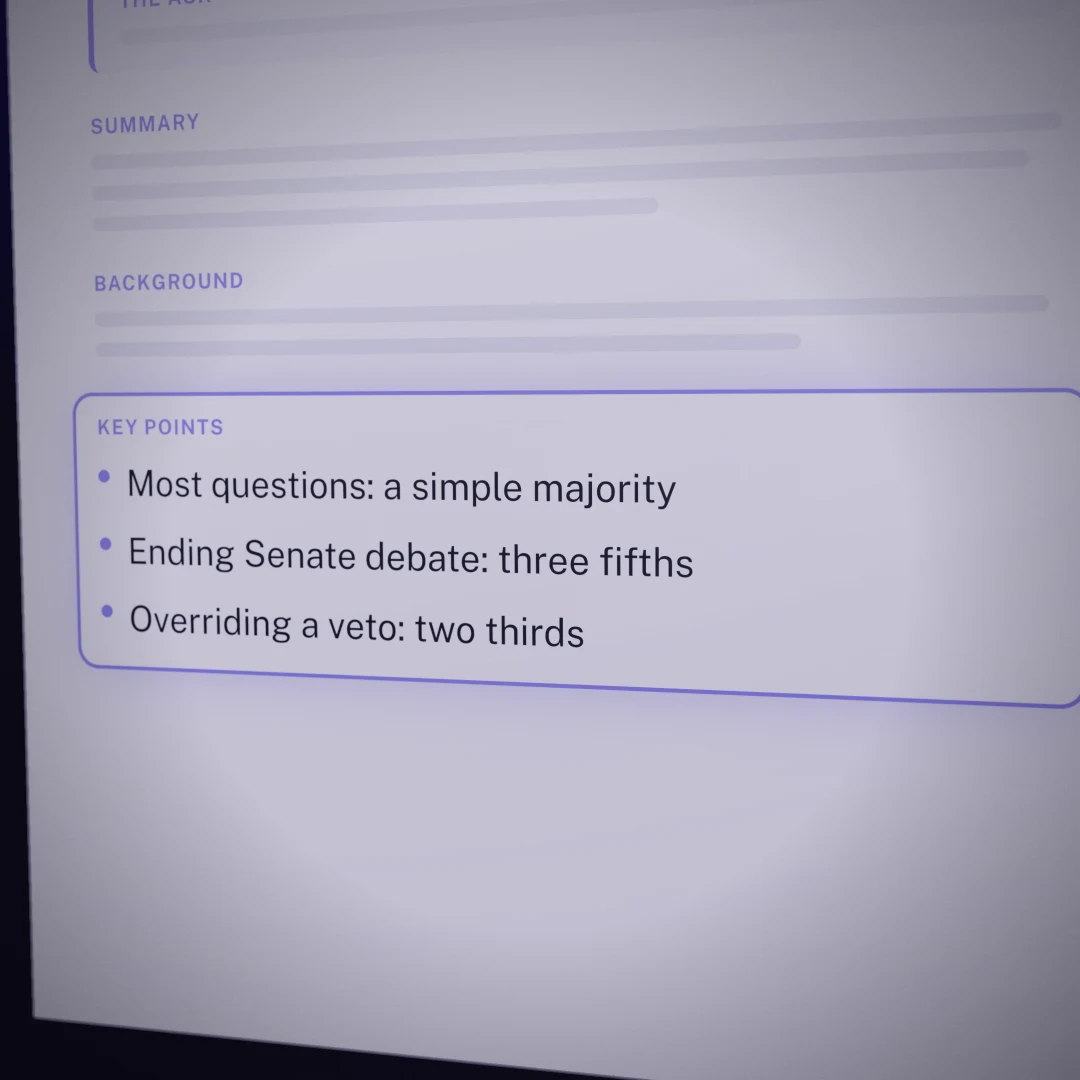
| Question | Chamber | Votes needed |
|---|---|---|
| Most bills, amendments and motions | Senate | Simple majority of those voting, with a quorum present |
| Order a roll call (yeas and nays) | Senate | At least 11 senators |
| Order a recorded vote | House | One fifth of a quorum, or 44 members |
| Order a recorded vote in the Committee of the Whole | House | 25 members |
| End debate through cloture | Senate | Three fifths of senators duly chosen and sworn |
| Override a veto, expel a member, approve a treaty | Senate | Two thirds |
The cloture line is why so much Senate news centers on 60 votes. Cloture is the way the Senate ends debate so a bill can reach a final vote, and with a full Senate, three fifths is 60. Our guide to what cloture is and how the Senate ends a filibuster explains the full process. CRS also lists the votes the Constitution says need two thirds, including overriding a presidential veto, expelling a senator, and approving a treaty. Our guide to the veto override covers that last step in depth.
Ties can happen in the Senate. The Senate's page on votes to break ties quotes the Constitution: the Vice President is President of the Senate but has no vote unless the Senate is equally divided. The page reports that 309 tie breaking votes have been cast since 1789.
Before a big floor vote, each party's whip counts how members plan to vote, so leaders know whether they have the votes before the roll is called. Our guide to the whip in Congress explains how that count works.
How can you find out how a member voted?
Only recorded votes leave a public record of each member's choice. That is why the type of floor vote matters so much. If a bill passes by voice vote, there is no list of who said aye. If it passes by roll call, every member's vote is public.
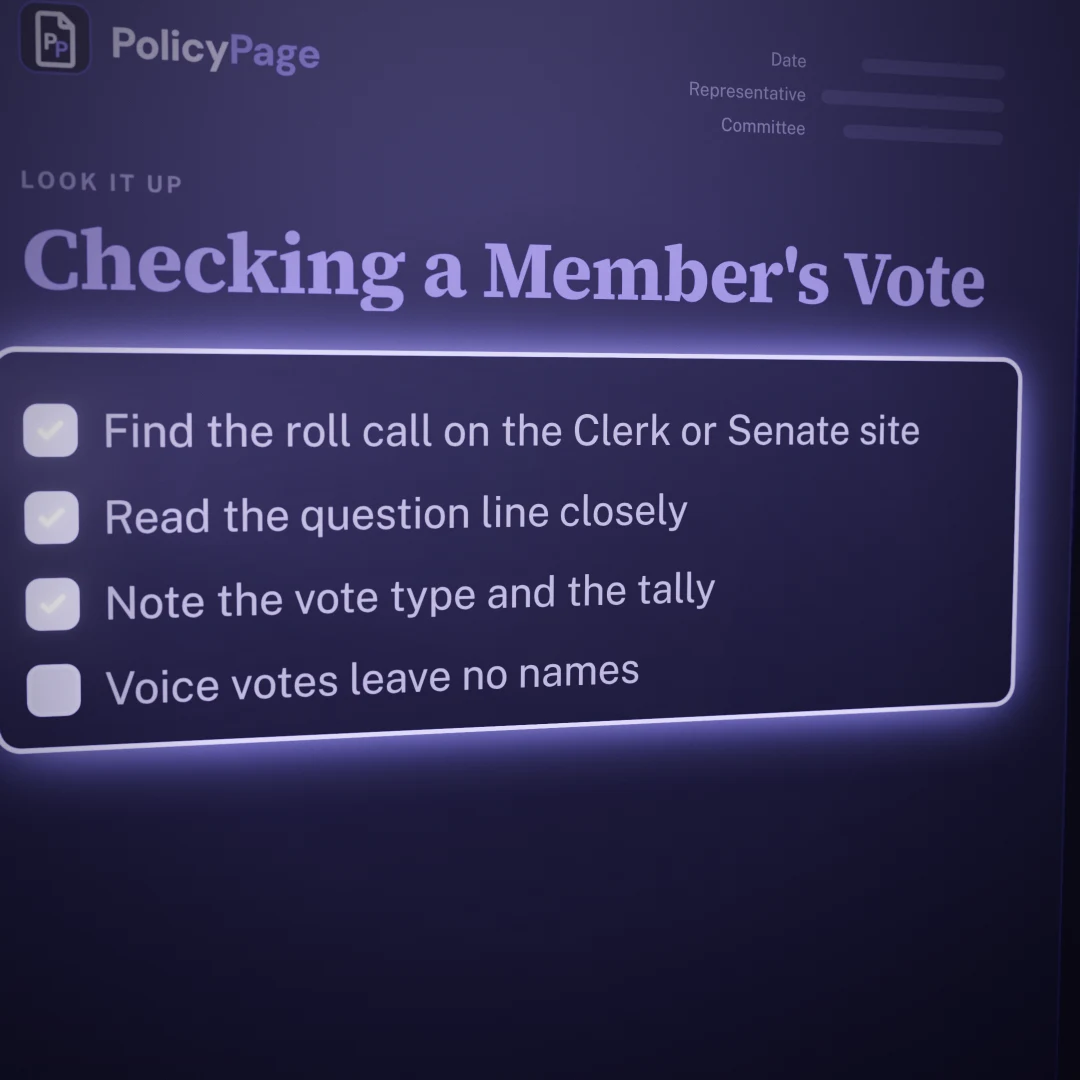
Both chambers publish their roll call votes for free.
- House. The Office of the Clerk runs a roll call vote search. You can filter by vote type, including recorded votes, yea and nay votes, two thirds votes, and quorum calls.
- Senate. The Senate's roll call votes page lists recent votes with the date, the tally, the result, and the question. It says results are compiled by the Senate bill clerk under the direction of the Secretary of the Senate, and it links to past votes by Congress and year going back to 1989.
When you look up a vote, read the "question" line closely. A vote "on the motion to proceed" or "on the cloture motion" is not the same as a vote "on passage." A member may vote one way on bringing a bill up and another way on the bill itself, so the question tells you what the vote was really about.
How do floor votes work in state legislatures?
State legislatures use the same basic tools, with their own rules and numbers. The West Virginia Legislature's citizen's guide to floor action is a clear example. It describes three methods: a roll call vote, also called calling for the yeas and nays; a voice vote; and a division vote, where members rise and the numbers are recorded without names.
In West Virginia, roll call votes use voting machines, and the results appear on display boards in the chamber. The guide says voice votes are used to save time. It also lists the minimum votes needed out of the full membership: a simple majority is 51 in the House and 18 in the Senate, and two thirds is 67 in the House and 23 in the Senate.
Every state sets its own thresholds, so the numbers that apply in Florida, Texas, or New York will differ. The idea stays the same everywhere. The floor is where the whole chamber decides, and a recorded vote is where each member's position becomes part of the public record.
Why floor votes matter for your meeting
By the time a bill reaches the floor, most of the shaping is done. The glossary entry for floor vote makes this point: the floor is the most visible step and usually the least changeable. Committee work, the Rules Committee in the House, and deals reached during quorum calls in the Senate often decide the outcome before the roll is called. In the House, a discharge petition can force a vote.
That is why timing matters when you meet with a member's office. If the bill is still in committee, your ask might be a cosponsorship, a hearing, or an amendment. If a floor vote is coming, the ask is usually simpler: a yes or a no. Knowing the vote type also helps. A recorded vote puts the member's choice on the public record, and staff will want to know how that vote affects people in the district or state.
When you are getting ready for that meeting, one clear page beats a stack of handouts. PolicyPage writes a free, cited, one-page brief for the member you are meeting, so staff can see where your bill stands and what you are asking them to do.
The short version
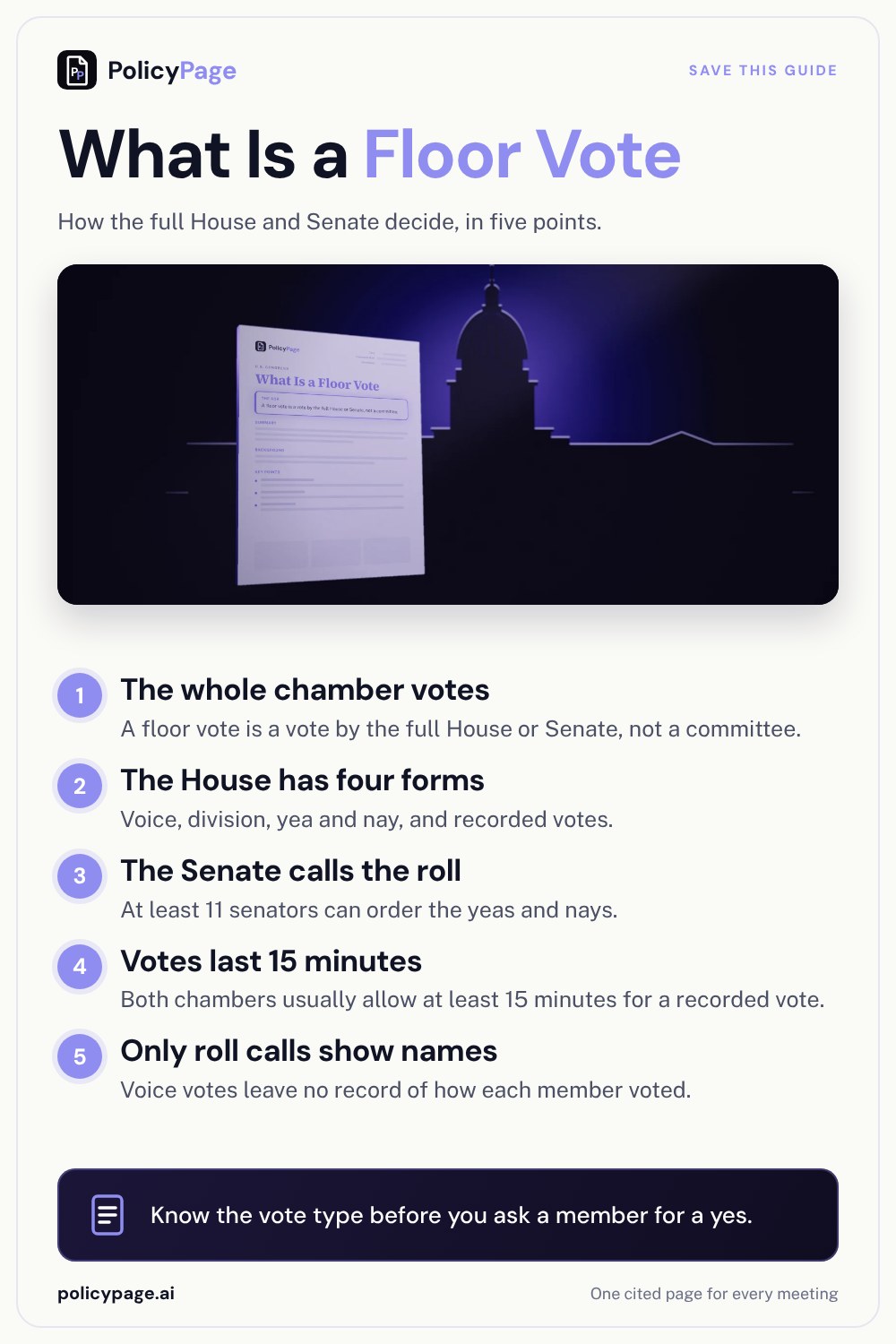
A floor vote is a vote by the whole chamber. In the House, it can be a voice vote, a division, a yea and nay vote, or a recorded vote, and electronic votes last at least 15 minutes. In the Senate, it can be a voice vote, a division, or a roll call, with names called in alphabetical order over a 15 minute window. Most questions pass by a simple majority, but ending Senate debate takes three fifths and overriding a veto takes two thirds. Only recorded votes show how each member voted, and both chambers post those records online for free.
Save this guide
Frequently asked questions
What is a floor vote?
A floor vote is a vote by the full membership of a legislative chamber, such as the whole House or Senate, rather than by a committee. It can be a voice vote, a standing count, or a recorded roll call.
What does full floor vote mean?
A full floor vote means the entire chamber is voting, not a committee. When a bill is headed for a full floor vote, it has cleared committee and the whole House or Senate is about to decide on it.
What are the types of floor votes in the House?
The House has four forms of votes: voice, division, yea and nay, and recorded votes, according to the Congressional Research Service. Only yea and nay and recorded votes show how each member voted.
How does a roll call vote work in the Senate?
At least 11 senators must support a request for the yeas and nays. The clerk then calls each senator's name in alphabetical order, and senators usually have 15 minutes to vote.
How long does a floor vote take in the House?
An electronic vote in the House lasts at least 15 minutes, and the chair can hold it open longer. Some votes that follow another electronic vote can be shortened to two minutes.
How many votes does it take to pass a bill on the Senate floor?
Most questions pass by a simple majority of senators voting, with a quorum present. Ending debate through cloture usually takes three fifths of all senators, which is 60 when the Senate is full.
How can I find out how my member of Congress voted?
Look up recorded votes on the House Clerk's roll call vote search or the Senate's roll call votes page. Voice votes do not record individual members' positions.
Terms in this article
Sources
- 1.House Floor, U.S. House of Representatives
- 2.House Voting Procedures: Forms and Requirements (98-228), February 3, 2023, Congressional Research Service
- 3.Voting and Quorum Procedures in the Senate (96-452), March 26, 2020, Congressional Research Service
- 4.About Voting, U.S. Senate
- 5.Votes to Break Ties in the Senate, U.S. Senate
- 6.Roll Call Votes, U.S. Senate
- 7.Roll Call Votes, Office of the Clerk, U.S. House of Representatives
- 8.Floor Action: Citizen's Guide, West Virginia Legislature
New to some of the terms here? The advocacy glossary defines them in plain English.