
What Is the Debt Limit? How the Debt Ceiling Works and Where It Stands
The debt limit is the legal cap on how much the U.S. Treasury can borrow to pay bills Congress already approved. Here is how it works and where it stands now.
12 minute read10 sources
In this article
- What is the debt limit?
- How does the debt limit work?
- What is the debt limit right now?
- What are extraordinary measures and the X date?
- What happens if the debt limit is reached and not raised?
- Debt limit vs deficit vs government shutdown
- Why does the U.S. have a debt limit?
- How does Congress raise or suspend the debt limit?
- Why the debt limit matters for your meeting
- The short version
- Save this guide

The debt limit, also called the debt ceiling, is the legal cap on how much money the U.S. Treasury can borrow. It does not approve new spending. It limits borrowing to pay for spending and tax laws that Congress has already passed, from Social Security checks to interest on the national debt.
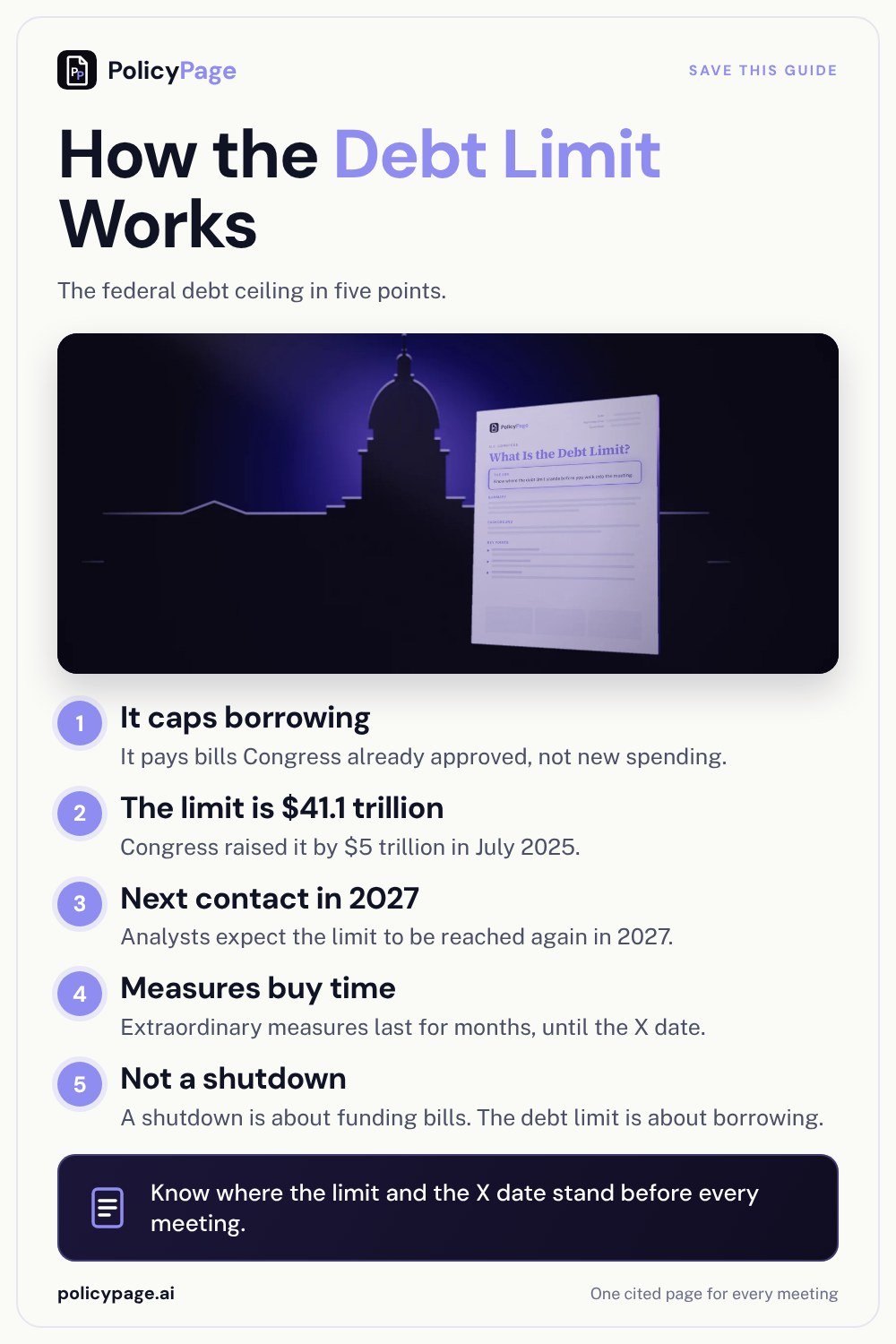
Right now the limit is $41.1 trillion. Congress raised it by $5 trillion in July 2025, and independent analysts expect the government to reach it again in 2027. When that happens, the Treasury can keep paying bills for a while using special accounting steps, but not forever.
People search for this in many ways: "debt limit," "what is the debt limit right now," "debt ceiling meaning," "how does the debt ceiling work," "debt ceiling vs deficit," and "debt ceiling vs government shutdown." This guide answers each one in plain English, with the latest official and independent figures, a side by side comparison with the deficit and a shutdown, and what it all means if you are meeting with a member of Congress.
What is the debt limit?
The Treasury Department defines the debt limit as the total amount of money the federal government is authorized to borrow to meet its existing legal obligations. Treasury lists what those obligations include: Social Security and Medicare benefits, military salaries, interest on the national debt, tax refunds, and other payments. In the same place, Treasury states plainly that the debt limit does not authorize new spending commitments.
Think of it like a credit card limit that a family sets for itself after it has already agreed to its monthly bills. The bills are coming either way. The limit only decides whether the family can borrow enough to pay them. That is the key idea most people miss: raising the debt limit pays for past choices, and refusing to raise it does not cancel those choices.
The Congressional Research Service (CRS), the nonpartisan research office that serves Congress, describes it the same way in its overview, The Debt Limit. CRS calls it a statutory constraint on the amount of money Treasury may borrow to fund federal operations. The limit is written into federal law at 31 U.S.C. 3101, and CRS notes that the debt subject to the limit is more than 99% of total federal debt.
Is the debt limit the same as the debt ceiling?
Yes. The two names mean the same thing. The Tax Policy Center, a nonpartisan research group, opens its briefing book entry by calling the debt limit "the legal maximum on how much debt the federal government can accumulate," and puts "debt ceiling" right beside it. News stories tend to say "debt ceiling," while Treasury and CRS usually say "debt limit."
How does the debt limit work?
The government borrows because it usually spends more than it takes in. Treasury's Fiscal Data guide to the national debt explains that a deficit happens in a year when spending is greater than revenue, and Treasury covers the gap by selling securities such as bills, notes and bonds. The national debt is the total of all that borrowing over time, plus the interest owed.

Here is the order of events in plain terms:
- Congress passes spending laws. That includes yearly appropriations and programs like Social Security that pay out automatically under existing law.
- Congress passes tax laws. These decide how much money comes in.
- Treasury borrows the difference. When spending is higher than revenue, Treasury sells securities to cover the gap.
- The debt limit caps the total. Fiscal Data explains that once the ceiling is reached, the government cannot increase the amount of outstanding debt.
That last step is what makes the debt limit unusual. The spending and the taxes were set in other laws, often years earlier. The Tax Policy Center puts it this way: raising the limit "is not related to approving new spending." It is about paying for choices lawmakers already made.
CRS lays out three basic options Congress has when the government nears the limit. It can leave the limit in place, raise it to a new dollar amount, or temporarily suspend it. A suspension means the limit does not apply for a set period, and when that period ends, the limit is reset to cover the borrowing done in the meantime.
What is the debt limit right now?
The debt limit is $41.1 trillion. CRS reports that P.L. 119-21, the 2025 budget reconciliation law, increased the limit by $5.0 trillion, to $41.1 trillion. The Government Publishing Office lists the law's approval date as July 4, 2025. The debt limit change is in section 72001 of the law, which, as quoted in the notes to 31 U.S.C. 3101, increases the limit by $5,000,000,000,000.

The Bipartisan Policy Center (BPC), a think tank that tracks the debt limit closely, explains in When Will We Reach the Debt Limit (Again)? that the increase took the limit from $36.1 trillion to $41.1 trillion. The Brookings Institution's Hutchins Center notes in What is the federal debt ceiling? that the government had hit the old $36.1 trillion limit on January 1, 2025.
How much room is left? The National Taxpayers Union (NTU) published an updated projection on November 12, 2026. It reports that debt subject to the limit totaled $40.33 trillion as of October 30, 2026, leaving $777 billion in remaining borrowing authority.
When will the U.S. hit the debt limit again?
Estimates differ a little, but they point to 2027:
- CRS says recent projections suggest borrowing will approach the limit sometime in fiscal year 2027.
- BPC (June 2026) says the government will most likely reach the limit sometime between late winter and mid summer of 2027.
- NTU (November 2026) says the limit will likely be reached in February 2027, with a range of February to March 2027 depending on how much tax revenue comes in.
Reaching the limit is not the same as running out of money. As NTU points out, hitting the limit does not immediately mean the government will be unable to pay its bills on time. That is where extraordinary measures come in.
What are extraordinary measures and the X date?
When the government reaches the limit, Treasury can use a set of accounting steps to keep paying bills without adding to the debt that counts against the limit. These are called extraordinary measures. Fiscal Data describes them as measures authorized by Congress that let Treasury temporarily suspend certain intragovernmental debt, which is money the government owes to its own accounts.

CRS groups the measures into three kinds: suspending or delaying some debt sales and auctions, underinvesting or disinvesting certain government funds, and swapping debt securities for debt that does not count against the limit. The Committee for a Responsible Federal Budget (CRFB), a fiscal policy group, gives examples in its Debt Ceiling Q&A. Treasury has redeemed bonds early in federal employee retirement savings accounts, halted contributions to certain government pension funds, suspended a type of security sold to state and local governments, and borrowed from money set aside to manage exchange rate swings. CRFB says extraordinary measures were first used in 1985.
Brookings gives a sense of scale. It notes that in August 2021, pausing reinvestment in the G Fund, a retirement savings fund for federal workers, could free up about $270 billion, and that the money was paid back in full in December 2021.
These steps only buy time. The day they run out is called the X date. BPC defines it as the date on which the government could no longer meet its financial obligations in full and on time. BPC estimates that extraordinary measures typically last roughly six to nine months.
NTU's November 2026 projection puts the X date most likely by the beginning of December 2027. Its range runs from November 2027 to February 2028, depending on revenue. Treat any X date as an estimate. It moves as tax receipts and spending come in.
What happens if the debt limit is reached and not raised?
If the X date arrives and Congress has not acted, the government would not have enough cash and borrowing room to pay every bill on time. Treasury warns that failing to increase the debt limit would cause the government to default on its legal obligations, which it calls "an unprecedented event in American history."

Nobody knows exactly what a full default would look like, because it has never happened. The Tax Policy Center says predictions of a large, intentional default "range from bad to catastrophic." CRS lists the risks of a binding limit, including serious harm to global economies and financial markets and downgrades of U.S. credit ratings.
Even coming close has had costs:
- Higher borrowing costs. CRFB and Brookings both cite a Government Accountability Office (GAO) estimate that the 2011 standoff raised Treasury's borrowing costs by about $1.3 billion in fiscal year 2011.
- Credit downgrades. BPC notes that all three major credit rating agencies have now downgraded U.S. government debt. Standard and Poor's and Fitch acted after the debt limit episodes of 2011 and 2023, and Moody's followed in 2025.
- Market strain. BPC reports that near the end of the 2023 episode, Treasury sold $50 billion of four week securities at a record 5.84% yield.
- A small slip in 1979. The Tax Policy Center describes an accidental, partial default in 1979 that raised U.S. borrowing costs by $40 billion in 2019 dollars.
CRFB also cites a 2023 Moody's Analytics estimate that a default could lead to a 4 percent decline in gross domestic product and nearly 6 million lost jobs. That is one estimate of a scenario, not a forecast, but it shows why the stakes are so high.
Debt limit vs deficit vs government shutdown
These three get mixed up all the time, partly because they all involve the budget and they often make news in the same season. Here is how they compare:
| Debt limit | Deficit | Government shutdown | |
|---|---|---|---|
| What it is | A legal cap on total federal borrowing | The gap in one year when spending is higher than revenue | A lapse in funding for agencies without approved appropriations |
| Set by | A law that raises or suspends the limit | Spending and tax laws together | Yearly funding bills not passed |
| What causes trouble | Borrowing reaches the cap and extraordinary measures run out | Nothing by itself; it adds to the debt | Congress does not pass appropriations bills in time |
| What is at risk | Paying bills already owed, including interest | More debt and interest over time | Agencies cannot take on new spending |
The deficit is a yearly number. The debt is the running total. The debt limit is the cap on that total. A shutdown is a different problem. CRFB explains that a shutdown happens when Congress fails to pass the appropriations bills that let agencies take on new spending. During a shutdown, the government still has borrowing room. During a debt limit standoff, agencies are funded, but the Treasury may not be able to borrow enough to pay for what they spend. Our guide to how government shutdowns work covers shutdowns, continuing resolutions and funding lapses in detail.
Why does the U.S. have a debt limit?
The debt limit started as a way to give the Treasury more freedom, not less. The Tax Policy Center explains that before 1917, Congress had to approve each Treasury loan in a separate law. CRFB says the debt limit was first enacted in 1917 through the Second Liberty Bond Act, during World War I, at $11.5 billion. In 1939, according to both CRFB and the Tax Policy Center, Congress set the first aggregate limit covering nearly all government debt, at $45 billion.
Since then, raising the limit has been routine, even when it has been contentious. CRS counts 104 separate changes to the debt limit between the end of World War II and the present, including 22 since 2001. Treasury says Congress has acted 78 separate times since 1960 to permanently raise, temporarily extend, or revise the definition of the limit. The counts differ because they cover different time spans and count different kinds of changes, but the point is the same: the limit has been changed dozens of times under presidents of both parties.
How does Congress raise or suspend the debt limit?
Congress changes the debt limit by passing a law, like any other law. It can attach the change to a larger bill or pass it on its own. Brookings explains the two main choices: raise the ceiling by a fixed dollar amount, or suspend it for a set period. For example, Brookings notes that in December 2021, Congress raised the limit from $28.9 trillion to $31.4 trillion, and that a two year suspension enacted in August 2019 ended with the limit reset at $28.4 trillion.
CRFB says lawmakers have suspended the limit, instead of raising it by a set amount, eight times since the start of 2013. It also points out a rule that shapes the choice. Budget reconciliation, a special fast track process for budget bills, can be used to raise the limit by a specific dollar amount, but not to suspend it. That is why the July 2025 change was a $5 trillion increase rather than a suspension.
When a change moves outside reconciliation, it goes through the regular process, with votes in both chambers and the President's signature. Our guide to how a bill becomes law walks through each step.
Why the debt limit matters for your meeting
If your organization depends on federal payments, grants or contracts, the debt limit is worth watching even though no one expects a default. Treasury's list of what the limit covers, from benefits to military pay to tax refunds, is a reminder of how many people a standoff could touch.
Debt limit deadlines also tend to pull other issues into the same negotiation. When a must pass bill is moving, offices are often asked what else should ride along with it, and staff have less time for meetings on unrelated bills. Knowing roughly when the limit and the X date are expected helps you time your ask and explain why your issue matters before the calendar fills up.
When you are getting ready for that meeting, one clear page beats a stack of handouts. PolicyPage writes a free, cited, one page brief for the member you are meeting, so staff can see your issue, the latest numbers and your ask at a glance.
The short version
The debt limit is the legal cap on how much the U.S. Treasury can borrow to pay bills that Congress has already approved. It does not authorize new spending. Congress raised it by $5 trillion to $41.1 trillion in July 2025, and as of October 30, 2026, $777 billion of room remained. Analysts expect the government to reach the limit in 2027. After that, Treasury can use extraordinary measures for several months, until the X date, which NTU now projects for around December 2027. Congress has changed the limit more than 100 times since World War II. Treasury says a default would be unprecedented, but even close calls have raised borrowing costs and been followed by credit downgrades.
Save this guide
Frequently asked questions
What is the debt limit?
The debt limit is the legal cap on how much money the U.S. Treasury can borrow to pay obligations the government already has, such as Social Security benefits, military pay and interest on the debt. It does not authorize new spending.
What is the debt limit right now?
The debt limit is $41.1 trillion. The 2025 reconciliation law, P.L. 119-21, raised it by $5 trillion in July 2025.
Is the debt ceiling the same as the debt limit?
Yes. Debt ceiling and debt limit are two names for the same legal cap on federal borrowing.
When will the U.S. hit the debt limit again?
Analysts expect it in 2027. The National Taxpayers Union projected in November 2026 that the limit will likely be reached in February 2027, and the Bipartisan Policy Center estimated late winter to mid summer of 2027.
What is the X date?
The X date is the day the Treasury runs out of extraordinary measures and cash and can no longer pay all of the government's bills in full and on time. It is an estimate that changes as money comes in and goes out.
What are extraordinary measures?
They are accounting steps Congress has authorized that let the Treasury keep paying bills after reaching the debt limit, such as pausing investments in certain federal employee retirement funds. Brookings notes that money taken this way in 2021 was paid back in full.
What is the difference between the debt ceiling and the deficit?
The deficit is the gap between spending and revenue in one year. The debt is the total of all past borrowing, and the debt ceiling is the legal cap on that total.
Is the debt ceiling the same as a government shutdown?
No. A shutdown happens when Congress does not pass funding bills for agencies. A debt limit standoff is about whether the Treasury can borrow enough to pay for spending that was already approved.
Terms in this article
Sources
- 1.Debt Limit, U.S. Department of the Treasury
- 2.The Debt Limit (IF10292), updated September 21, 2026, Congressional Research Service
- 3.Public Law 119-21, approved July 4, 2025, U.S. Government Publishing Office
- 4.31 U.S. Code 3101, Public debt limit, Legal Information Institute, Cornell Law School
- 5.What is the national debt?, U.S. Treasury, Bureau of the Fiscal Service (Fiscal Data)
- 6.When Will We Reach the Debt Limit (Again)?, June 4, 2026, Bipartisan Policy Center
- 7.Debt Limit Likely to Be Hit in February, with the X-Date Reached by December 2027, November 12, 2026, National Taxpayers Union
- 8.Debt Ceiling Q&A, May 7, 2026, Committee for a Responsible Federal Budget
- 9.What is the debt limit?, Urban-Brookings Tax Policy Center
- 10.What is the federal debt ceiling?, July 7, 2025, Brookings Institution, Hutchins Center on Fiscal and Monetary Policy
New to some of the terms here? The advocacy glossary defines them in plain English.