
What Is Budget Reconciliation? How It Works, Step by Step
Budget reconciliation is a fast track that lets Congress pass certain tax, spending and debt limit bills with a simple majority in the Senate. Here is how it works.
12 minute read8 sources
In this article
- What is budget reconciliation in Congress?
- How does budget reconciliation work?
- Step 1: Congress adopts a budget resolution with instructions
- Step 2: Committees write their parts of the bill
- Step 3: The Budget Committees combine the pieces into one bill
- Step 4: The Senate debates for up to 20 hours, then holds a vote-a-rama
- Step 5: Final passage by simple majority, then the President
- What is the Byrd rule?
- Budget reconciliation vs a regular bill vs a continuing resolution
- How many times can Congress use budget reconciliation?
- Which laws were passed through budget reconciliation?
- What reconciliation means for your meeting with Congress
- Save this guide

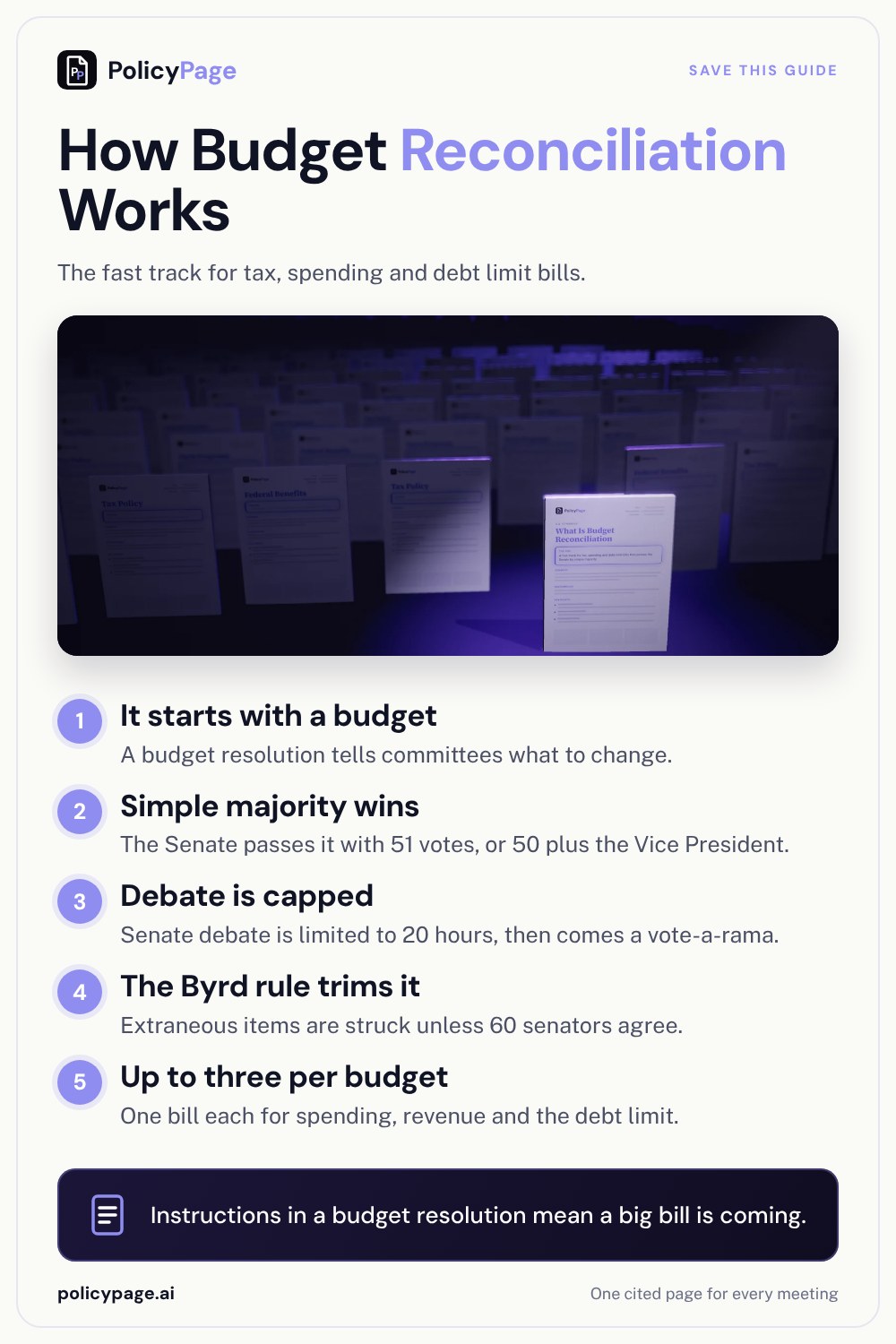
Budget reconciliation is a fast track process that lets Congress pass certain changes to taxes, mandatory spending and the debt limit with a simple majority in the Senate. Because debate on a reconciliation bill is capped at 20 hours, it cannot be filibustered, so it does not need the 60 votes most Senate bills need.
The process starts with a budget resolution, Congress's yearly budget blueprint, which tells specific committees to write the changes. The committees write them, the pieces are combined into one bill, and both chambers vote on it. The catch is a set of limits, most famously the Byrd rule, that keep anything unrelated to the budget out of the bill.
People search for this in many ways: "bill reconciliation meaning," "budget resolution definition," "what is budget reconciliation in Congress," "how does budget reconciliation work," and "budget reconciliation vs filibuster." This guide answers each one in plain English, walks through the five steps in order, and ends with what reconciliation means if you are meeting with a member of Congress.
What is budget reconciliation in Congress?
The Congressional Research Service (CRS), the nonpartisan research office that serves Congress, calls reconciliation an expedited process made available under Section 310 of the Congressional Budget Act of 1974. Its report The Reconciliation Process: Frequently Asked Questions, updated in February 2026, explains the key feature: debate time is limited in the Senate, so cloture, and the three fifths vote it requires, is not needed to reach a final vote.
That is the whole reason reconciliation matters. In the normal Senate, any senator can keep debate going, which is called a filibuster. Ending it takes cloture, which usually means 60 votes. A budget reconciliation bill skips that step. The Peter G. Peterson Foundation puts it simply: reconciliation lets the Senate adopt legislation with a simple majority, which is 51 votes, or 50 votes plus the Vice President breaking a tie.
Think of it like an express lane at the grocery store. You get through faster, but only if your cart holds the right items. In reconciliation, the right items are changes to federal spending, revenue and the debt limit. Everything else has to go through the regular line.
What does "reconciliation" mean here?
The word comes from the idea of bringing current law in line with, or reconciling it to, the budget Congress has agreed on. The budget resolution sets targets. A reconciliation bill changes actual laws, such as tax rates or benefit rules, so that federal spending and revenue match those targets.
This is different from the accounting meaning of reconciling a budget, which is checking your records against your bank statement. If you searched "bill reconciliation meaning" and landed here, the Congress meaning is the one in this guide.
How does budget reconciliation work?
Reconciliation happens in two phases, CRS explains. First, the House and Senate adopt a budget resolution with reconciliation directives. Second, the named committees respond with recommended changes in law. Here are the five steps in order.
Step 1: Congress adopts a budget resolution with instructions
Every reconciliation bill starts with a budget resolution. It is a concurrent resolution, which means the House and Senate must both adopt it, but the Bipartisan Policy Center (BPC) notes that it does not need the President's signature.
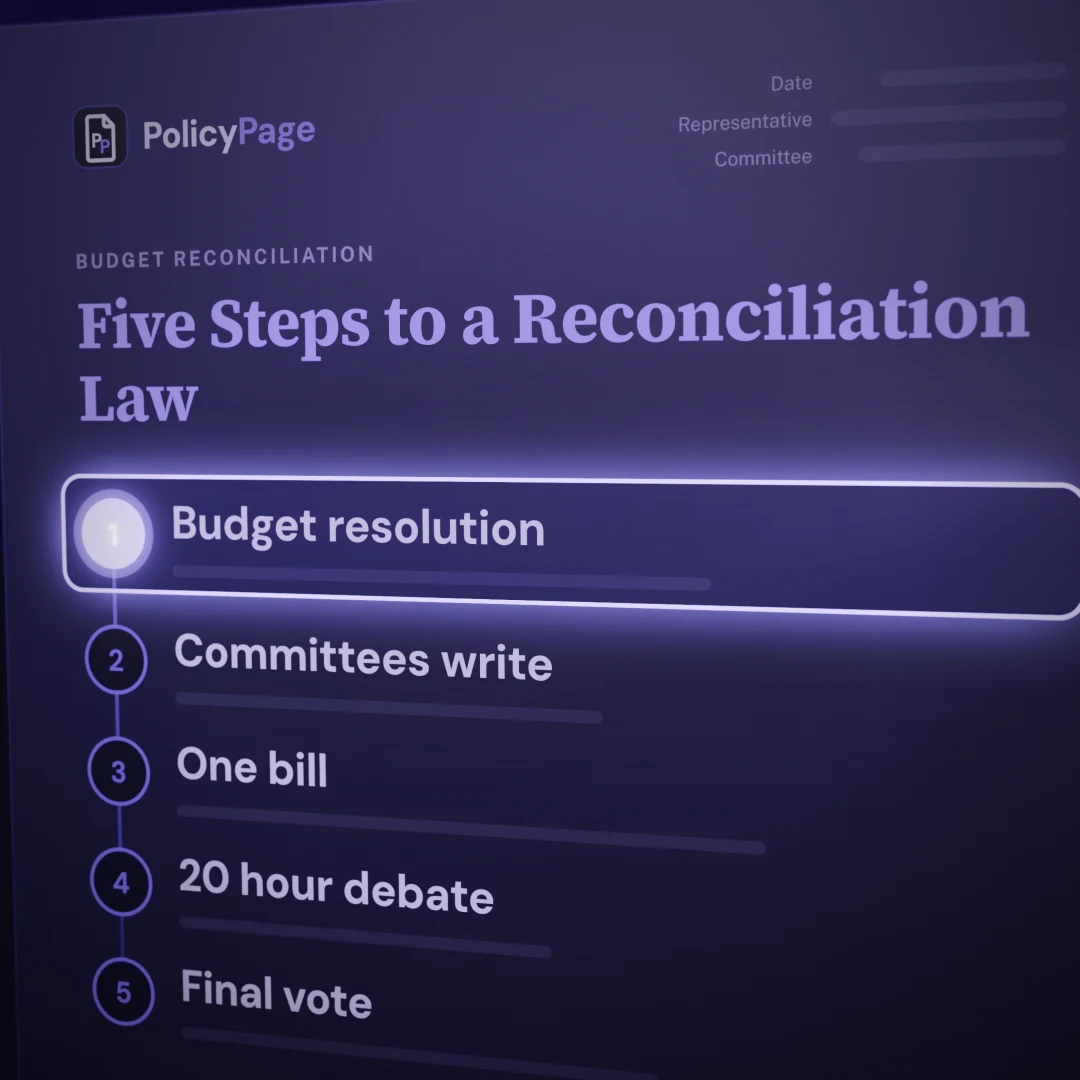
CRS describes the budget resolution, in its Introduction to the Federal Budget Process, as an annual plan that sets total federal revenue, spending, and the deficit for at least the next five years. Because it is not a law, no money can be raised or spent under it alone. It is a plan, not a paycheck.
To unlock reconciliation, the budget resolution must include what are called reconciliation instructions, or directives. According to CRS, each instruction names a committee and gives it a type of change to make, a dollar target, a time period, and a deadline to report back. The law behind this, 2 U.S.C. 641, lists what instructions can cover:
- changes in spending under laws a committee oversees,
- changes in revenues, such as taxes,
- changes in the statutory debt limit, or
- any combination of these, including a target for reducing the deficit.
What is a budget resolution, in one sentence?
A budget resolution is the yearly spending and revenue blueprint that both chambers of Congress adopt without the President, which sets totals for the budget and, when it includes instructions, opens the door to reconciliation.
Step 2: Committees write their parts of the bill
Once the budget resolution is adopted, each committee named in it writes the law changes needed to hit its target. CRS notes that only the House Ways and Means Committee and the Senate Finance Committee can receive instructions on revenue or the debt limit, since those are the committees that handle taxes and borrowing.
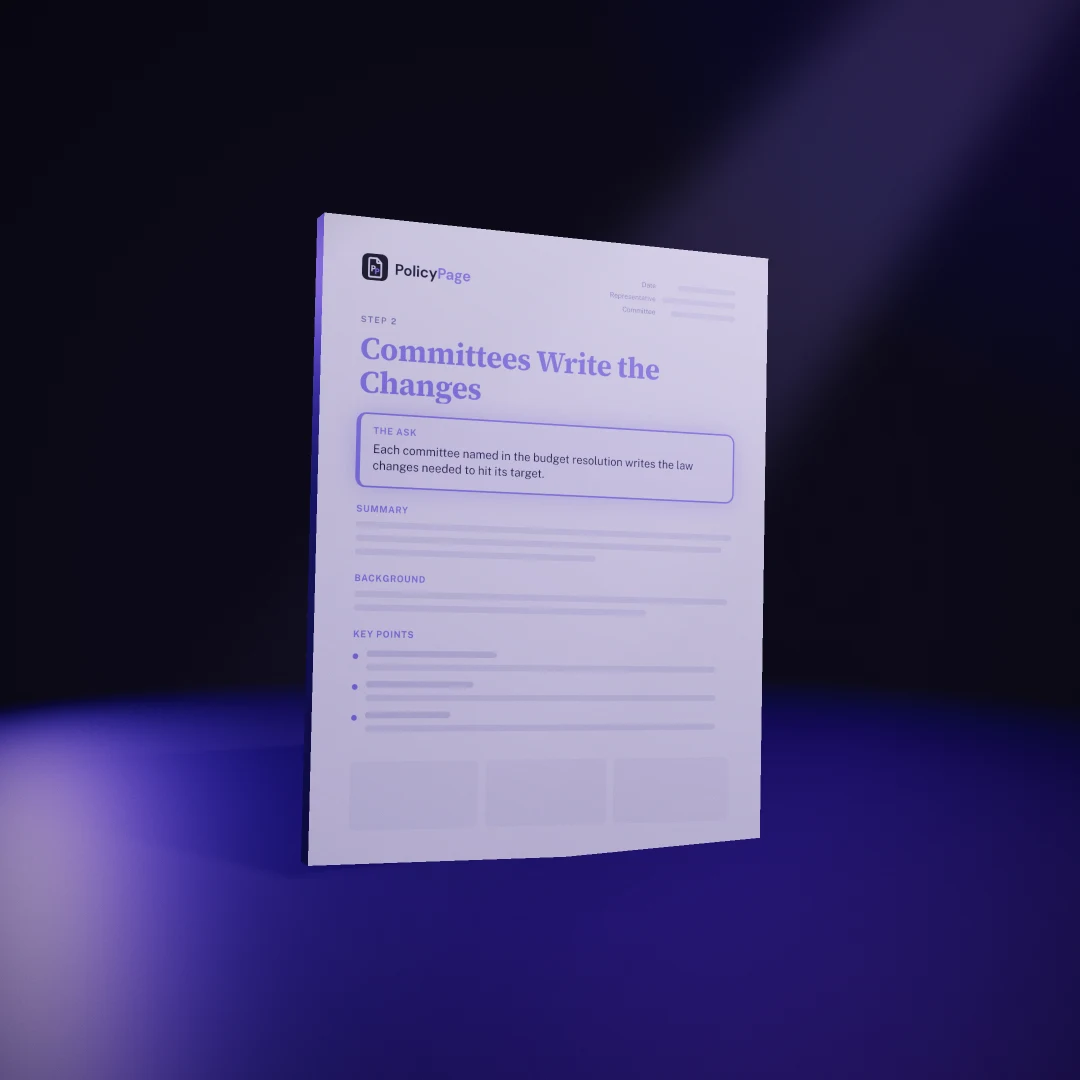
Committees decide how to hit their numbers. A committee told to cut spending by a certain amount over ten years chooses which programs to change. A committee told to change revenue chooses which tax rules to change. Each committee then votes on its piece in a markup and sends it on.
Reconciliation mostly deals with mandatory spending, meaning programs like Medicare or farm supports that run under permanent law. BPC notes that discretionary spending, the money Congress sets each year through appropriations, is traditionally not included. That is one reason reconciliation is not a way to avoid a government shutdown.
Step 3: The Budget Committees combine the pieces into one bill
When several committees are involved, their pieces are first assembled by the Budget Committees before each full chamber takes them up, the Peterson Foundation explains. If only one committee received instructions, its bill can go straight to the floor.
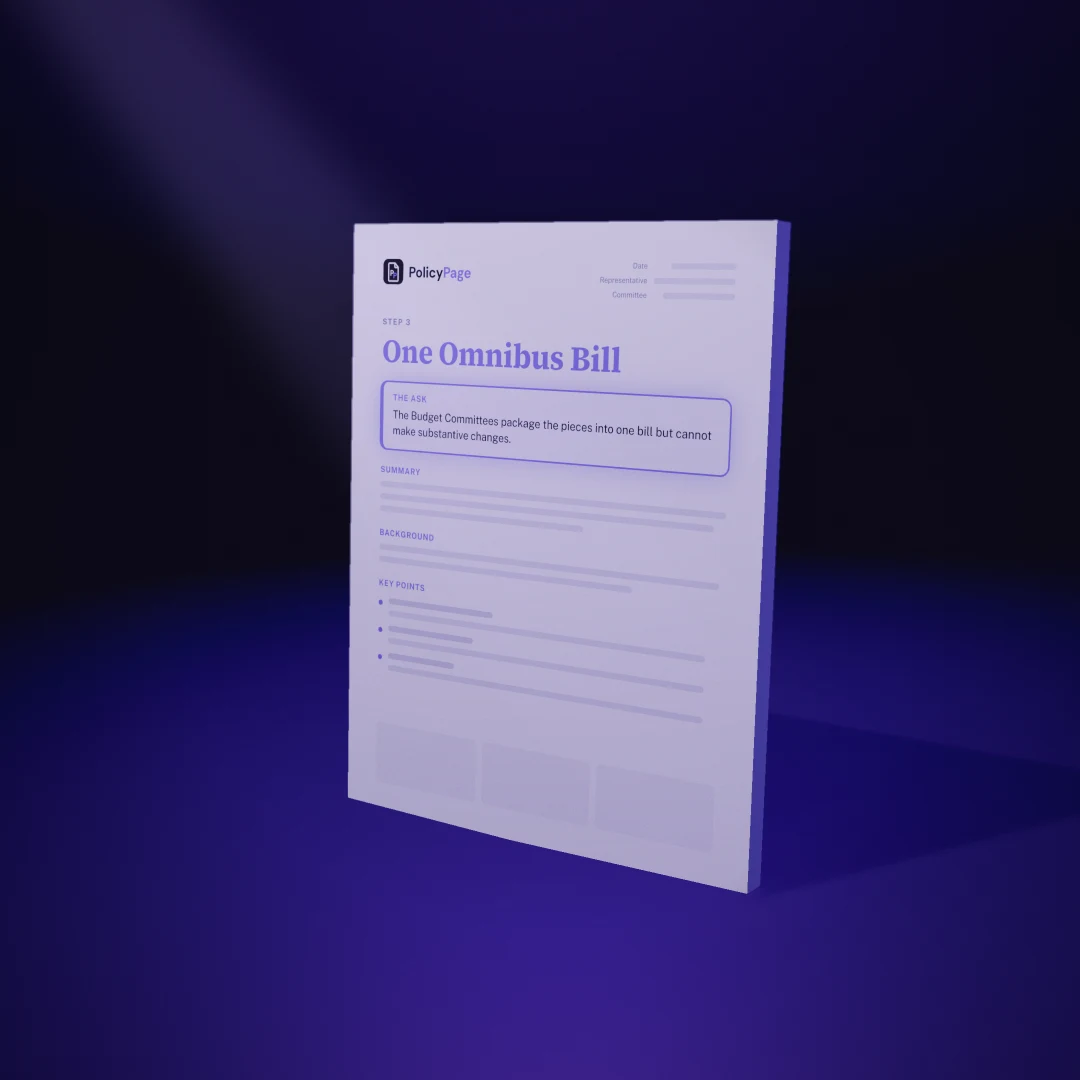
The Center on Budget and Policy Priorities (CBPP) adds an important detail: the Budget Committees assemble the parts into one omnibus bill but cannot make substantive changes. They are packagers, not editors.
In theory, Congress could pass several reconciliation bills from one budget resolution. CRS explains that no more than one bill may respond to each type of instruction (spending, revenue, or debt limit) in one budget resolution, for a maximum of three. In practice, CRS says, Congress has generally combined everything into a single omnibus reconciliation measure. Revenue changes must start in the House, because the Constitution requires tax bills to begin there.
Step 4: The Senate debates for up to 20 hours, then holds a vote-a-rama
This is the step that makes reconciliation special. Under the Budget Act, Senate debate on a reconciliation bill, including all amendments and motions, is limited to not more than 20 hours, according to 2 U.S.C. 641. CRS adds that the time is split equally between the majority and the minority, and that debate on a final compromise version from a conference is limited to 10 hours.

Senators can offer as many amendments as they want, but CRS notes they must be germane, meaning closely related to the bill. Each first degree amendment gets no more than two hours of debate.
What happens when the 20 hours run out but senators still have amendments? The Senate keeps voting on them, one after another, with almost no debate. CRS says this Senate practice is known as a vote-a-rama. It usually runs under a unanimous consent agreement that gives each side about two minutes to explain an amendment before the vote. A vote-a-rama can stretch through the night. (For more on how those agreements work, see what is unanimous consent.)
Step 5: Final passage by simple majority, then the President
After the amendments are done, each chamber votes on final passage. In the Senate this takes a simple majority, not 60. If the House and Senate pass different versions, they must agree on one text, either through a conference committee or by one chamber passing the other's version. CBPP describes the last step as an up or down vote in both chambers.
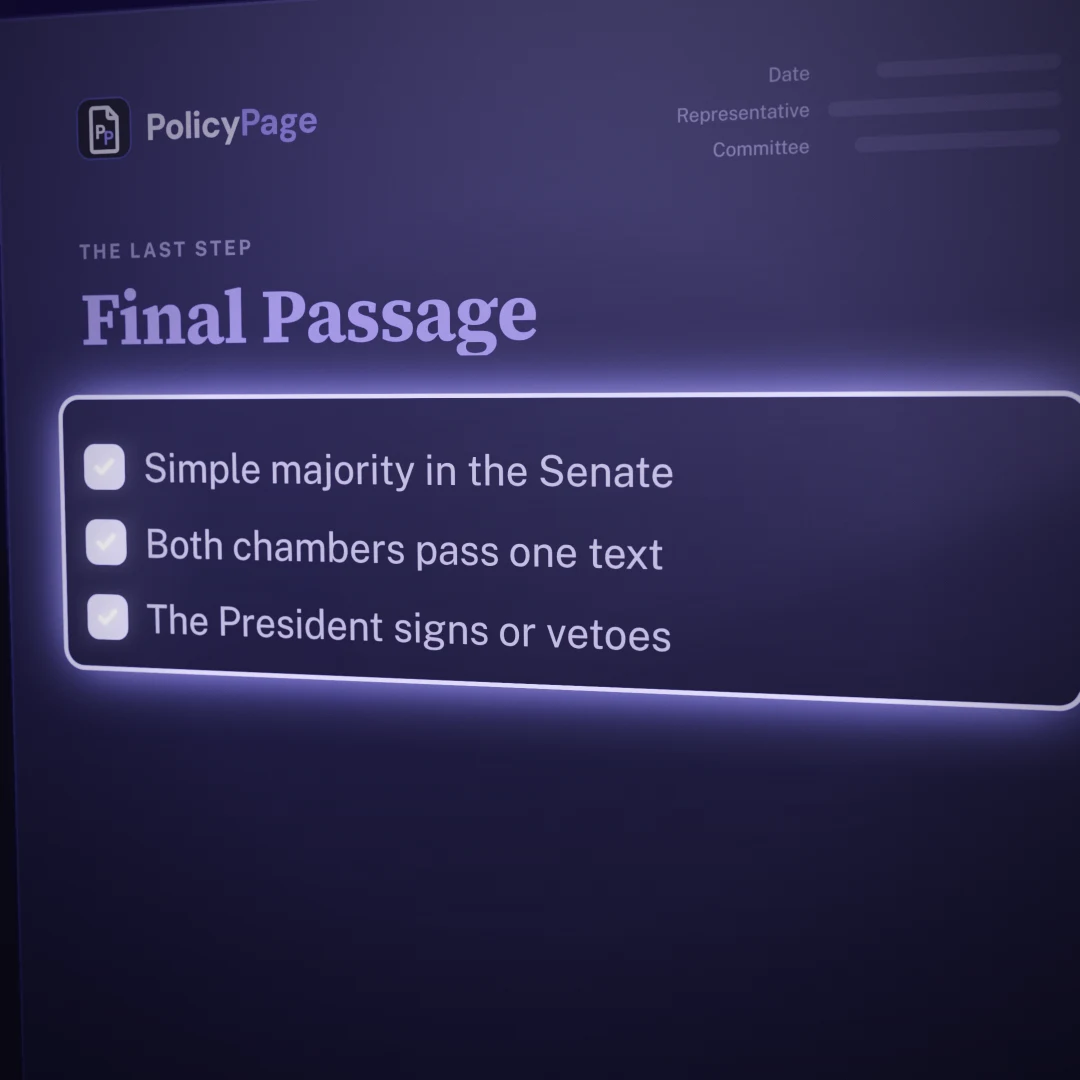
Then the bill goes to the President, like any other bill. Reconciliation does not take away the veto. CRS counts four reconciliation bills that were vetoed, including the Marriage Tax Relief Reconciliation Act of 2000, vetoed on August 5, 2000, and H.R. 3762 in the 114th Congress, vetoed on January 8, 2016.
How long does all this take? CRS found that the time it took to enact reconciliation bills ranged from 28 to 385 days, with an average of 148 days.
What is the Byrd rule?
The Byrd rule is the main limit on what can go in a reconciliation bill. It is Section 313 of the Congressional Budget Act, written into law at 2 U.S.C. 644, and named after Senator Robert Byrd of West Virginia, according to CBPP. It lets any senator object to "extraneous" matter, meaning anything that does not belong in a budget bill.
The law lists six tests. A provision is extraneous if it:
- does not change federal spending or revenue at all,
- increases spending or cuts revenue when the committee that wrote it missed its instruction,
- is outside the jurisdiction of the committee that wrote it,
- changes spending or revenue only in a way that is "merely incidental" to a policy goal,
- increases the deficit in a year after the period the budget covers, which BPC notes is usually 10 years, or
- changes Social Security.
CRS calls the Byrd rule "surgical." If an objection is upheld, only the offending words are struck, and the rest of the bill stays. The rule is not automatic. A senator has to raise it. Before the bill reaches the floor, the Senate Parliamentarian, the chamber's nonpartisan rules expert, reviews it in what staff call a "Byrd bath." To keep a provision that breaks the rule, CRS says, supporters need the votes of three fifths of senators duly chosen and sworn, which is 60 senators when there is no more than one vacancy.
A real example from CBPP: in 2021, a proposal to raise the federal minimum wage was ruled merely incidental to the budget and could not stay in a reconciliation bill, even though it had budget effects. The point was the policy, not the budget.
Budget reconciliation vs a regular bill vs a continuing resolution
People often search for "budget reconciliation vs filibuster" or "budget reconciliation vs continuing resolution." The table below puts the three side by side.
| Regular bill | Budget reconciliation | Continuing resolution | |
|---|---|---|---|
| What it does | Anything Congress can legislate | Changes mandatory spending, revenue or the debt limit | Keeps agencies funded at set levels for a period |
| Senate votes to pass | Usually 60 to end debate, then a majority | Simple majority (51, or 50 plus the Vice President) | Usually 60 to end debate, then a majority |
| Can it be filibustered? | Yes | No, debate is capped at 20 hours | Yes |
| What must come first | Nothing | A budget resolution with instructions | Nothing |
| Main limits | None special | Byrd rule, one bill per type of instruction | Only covers the time and funding it states |
| Needs the President | Yes | Yes | Yes |
The key difference: reconciliation is the only one of the three that the Senate can pass without first getting 60 votes to end debate. A continuing resolution cannot be done through reconciliation, because annual agency funding is discretionary spending.
How many times can Congress use budget reconciliation?
Congress can use reconciliation once per type of instruction for each budget resolution, which CRS describes as a maximum of three bills: one for spending, one for revenue, and one for the debt limit. CRS also notes that the House and Senate may consider more than one budget resolution during the two years of a Congress, which can open the door to more reconciliation bills.
In practice, use has been steady but not constant. CRS counts that since 1980, Congress has considered 29 reconciliation bills and enacted 24. Four were vetoed and one did not pass the Senate. The sources count a bit differently depending on the start date and what they include. BPC, in its explainer updated in August 2026, says 25 reconciliation bills have been enacted, and lists the 2026 Secure America Act as the most recent.
Which laws were passed through budget reconciliation?
Some of the biggest tax and spending laws of the past 45 years went through reconciliation. Examples named by BPC, CBPP and the Peterson Foundation include:
- the welfare changes of 1996,
- the tax cuts of 2001 and 2003,
- the Affordable Care Act amendments and student loan changes of 2010,
- the Tax Cuts and Jobs Act of 2017,
- the American Rescue Plan Act of 2021,
- the Inflation Reduction Act of 2022, and
- the 2025 law known as the One Big Beautiful Bill Act.
That 2025 law shows how reconciliation looks on paper. Its official title, as published on govinfo, is "An Act to provide for reconciliation pursuant to title II of H. Con. Res. 14." It became Public Law 119-21 on July 4, 2025. H. Con. Res. 14 was the budget resolution that carried the instructions. CRS notes that its short title was itself struck under the Byrd rule before passage, because a title has no budget effect.
Both parties have used the process when they held the majority. Reconciliation is a tool in the rules, not a policy, and the same steps apply no matter who is using it.
What reconciliation means for your meeting with Congress
If you work on an issue tied to taxes, health care, benefits, farm programs or the debt limit, reconciliation can move your issue faster than anything else in Congress. A few things are worth knowing before a meeting with a congressional office:
- Watch the budget resolution. If it includes reconciliation instructions, a large bill is likely coming. The instructions tell you which committees will write it and how much they need to change.
- Know the committee. Your issue will be shaped by the committee that got the instruction. Staff who work for members on that committee matter most.
- Ask about the Byrd rule. If your proposal has no direct budget effect, it may not survive in a reconciliation bill. Staff will appreciate that you know this.
- Keep it short. During a reconciliation push, staff are busy. A clear ask and the numbers that matter will get read.
When you are getting ready for that meeting, one clear page beats a stack of handouts. PolicyPage writes a free, cited, one page brief for the member you are meeting, so staff can see your issue, the latest numbers and your ask at a glance. For more on how bills move, see how a bill becomes law.
Save this guide
Frequently asked questions
What is budget reconciliation?
Budget reconciliation is a fast track process that lets Congress change mandatory spending, revenue and the debt limit with a simple majority in the Senate. Debate is capped at 20 hours, so it cannot be filibustered.
What is a budget resolution?
A budget resolution is the yearly spending and revenue blueprint that the House and Senate both adopt. It does not need the President's signature and is not a law, but when it includes reconciliation instructions it opens the door to a reconciliation bill.
What does bill reconciliation mean in Congress?
In Congress, a reconciliation bill changes existing laws on taxes, spending or the debt limit so they match the targets in the budget resolution. It is not the accounting meaning of reconciling records.
How many votes does a reconciliation bill need in the Senate?
A simple majority: 51 votes, or 50 plus the Vice President breaking a tie. It does not need 60 votes to end debate, because debate is limited to 20 hours.
What is the Byrd rule?
The Byrd rule, Section 313 of the Congressional Budget Act, lets any senator object to provisions in a reconciliation bill that are extraneous to the budget, such as items with no spending or revenue effect or changes to Social Security. Keeping such a provision takes 60 votes.
What is a vote-a-rama?
A vote-a-rama is the run of back to back amendment votes, with little debate, that the Senate usually holds after the 20 hours of debate on a reconciliation bill run out.
How many times can Congress use budget reconciliation?
One budget resolution can produce up to three reconciliation bills, one each for spending, revenue and the debt limit. CRS counts 24 reconciliation bills enacted out of 29 considered since 1980.
Can a reconciliation bill prevent a government shutdown?
Usually not. Shutdowns are about annual discretionary funding, which is set through appropriations bills or a continuing resolution and is traditionally left out of reconciliation.
Terms in this article
Sources
- 1.The Reconciliation Process: Frequently Asked Questions (R48444), updated February 23, 2026, Congressional Research Service
- 2.Introduction to the Federal Budget Process (98-721), Congressional Research Service
- 3.2 U.S.C. 641, Reconciliation (Section 310 of the Congressional Budget Act), Legal Information Institute, Cornell Law School
- 4.2 U.S.C. 644, Extraneous matter in reconciliation legislation (the Byrd rule), Legal Information Institute, Cornell Law School
- 5.Public Law 119-21, U.S. Government Publishing Office, govinfo
- 6.Budget Reconciliation, Simplified, updated August 5, 2026, Bipartisan Policy Center
- 7.What Is Budget Reconciliation?, updated September 11, 2025, Peter G. Peterson Foundation
- 8.Introduction to Budget Reconciliation, Center on Budget and Policy Priorities
New to some of the terms here? The advocacy glossary defines them in plain English.