
What Is a Discharge Petition? How 218 Signatures Force a House Vote
A discharge petition lets 218 House members force a floor vote on a bill stuck in committee. Here is how it works, step by step, and why so few succeed.
12 minute read8 sources
In this article
- What is a discharge petition?
- Why does the discharge petition exist?
- How does a discharge petition work?
- Step 1: The bill sits in committee for 30 legislative days
- Step 2: A member files the petition with the Clerk
- Step 3: 218 members sign
- Step 4: Seven legislative days on the discharge calendar
- Step 5: The House votes on the motion to discharge
- How many signatures are needed for a discharge petition?
- Why are discharge petitions rarely used?
- Why most petitions now target a special rule
- What happens after a discharge petition is signed?
- Is there a discharge petition in the Senate?
- Discharge petition vs suspension vs the Consensus Calendar
- What a discharge petition tells you before a meeting with a House office
- Save this guide

A discharge petition is a way for a majority of the U.S. House of Representatives to force a vote on a bill that a committee will not release. If 218 members sign the petition, they can take the bill away from the committee and bring it to the House floor without the support of committee chairs or party leaders.
The process is slow on purpose. A bill must sit in committee for 30 legislative days before anyone can file. Then 218 members must sign, the petition waits seven more legislative days, and the House votes on a motion to discharge. This guide walks through each step in plain English, explains why so few petitions succeed, and shows what a discharge petition means for anyone preparing to meet with a House office.
People ask about this in many ways: "discharge petition definition," "what is a discharge petition in Congress," "how does a discharge petition work," and "why are discharge petitions rarely used." Each one is answered below.
What is a discharge petition?
Most bills in the House never get a vote. When a bill is introduced, it is sent to a committee, and the committee decides whether to act on it. A committee can stop a bill simply by doing nothing. The Congressional Research Service (CRS), the nonpartisan research office that serves Congress, calls this the committee's "gatekeeping" role in its report The Discharge Rule in the House: Principal Features and Uses.
A discharge petition is the main way around that gate. The name can be confusing. It is the committee that gets "discharged," not the bill. CRS explains that the procedure takes the measure away from the committee "charged" with it. Once the committee is discharged, the full House can take up the bill.
Think of a bill as a package in a mailroom. Normally only the mailroom staff decide when it ships. A discharge petition is a request signed by more than half the building that says, "Ship it now."
Discharge petition definition (short version)
If you need one line: a discharge petition is a House procedure that lets 218 members force a committee to give up a bill so the full House can vote on it. The discharge petition glossary entry uses nearly the same words. The rule itself is Rule XV, clause 2 of the Rules of the House of Representatives.
Why does the discharge petition exist?
The discharge rule grew out of a fight over who controls the House. The House Office of the Historian explains in Who Controls the House? that the House adopted its first discharge rule in 1910, in response to the Speakership of Joseph G. Cannon, whose critics called him a "czar" because he controlled the floor so tightly.
The signature count has changed over time. In 1924 the House required 150 signatures. In the next Congress it raised the number to 218. In 1931 it lowered the bar to 145, and on the opening day of the 74th Congress in January 1935 it raised it back to 218, where it has stayed.
CRS describes the design plainly in its current report, Discharge Procedure in the House, updated February 12, 2026: discharge is "designed to be time-consuming to execute and difficult to accomplish." It is generally the only procedure that lets members bring a measure to the floor without help from the committee, the majority leadership, or the Rules Committee.
How does a discharge petition work?
The process has five steps, each with a firm rule behind it and each taking time. The timing is counted in legislative days. A legislative day starts when the House meets after an adjournment and ends when it next adjourns, so it usually matches a day the House is in session, not a calendar day.
Step 1: The bill sits in committee for 30 legislative days
A discharge petition cannot be filed the day a bill is introduced. Under Rule XV, clause 2, a member may file only on a public bill or resolution that has been referred to a committee for 30 legislative days. CRS notes that private bills cannot be discharged.
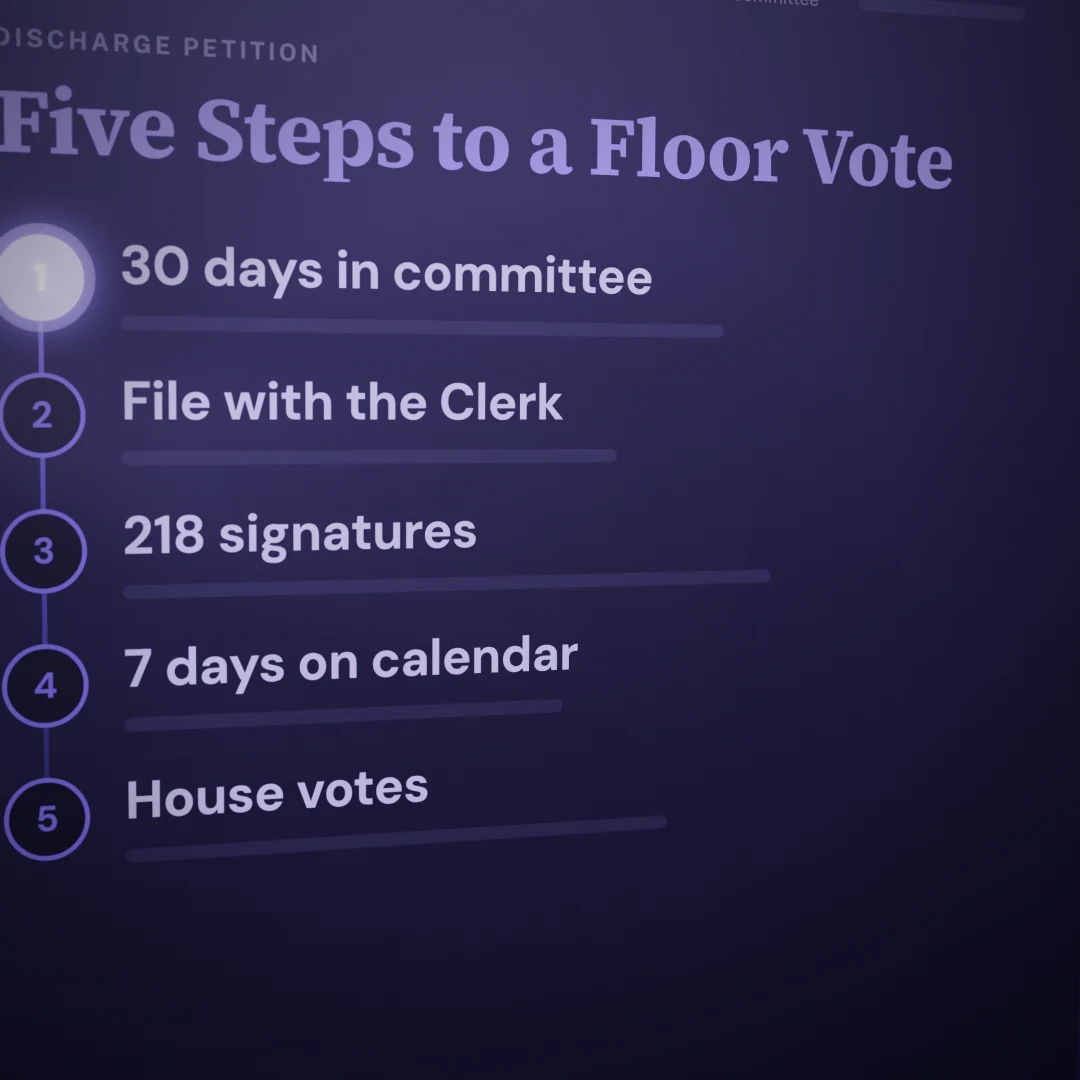
CRS notes that members seldom file this early. They usually wait until it is clear the committee does not plan to act.
Step 2: A member files the petition with the Clerk
Any member can start the process by filing a written motion to discharge with the Clerk of the House. This motion is the discharge petition. The Clerk keeps it at the rostrum in the House chamber, and members sign it there in person while the House is in session. The rule does not allow signing by proxy.
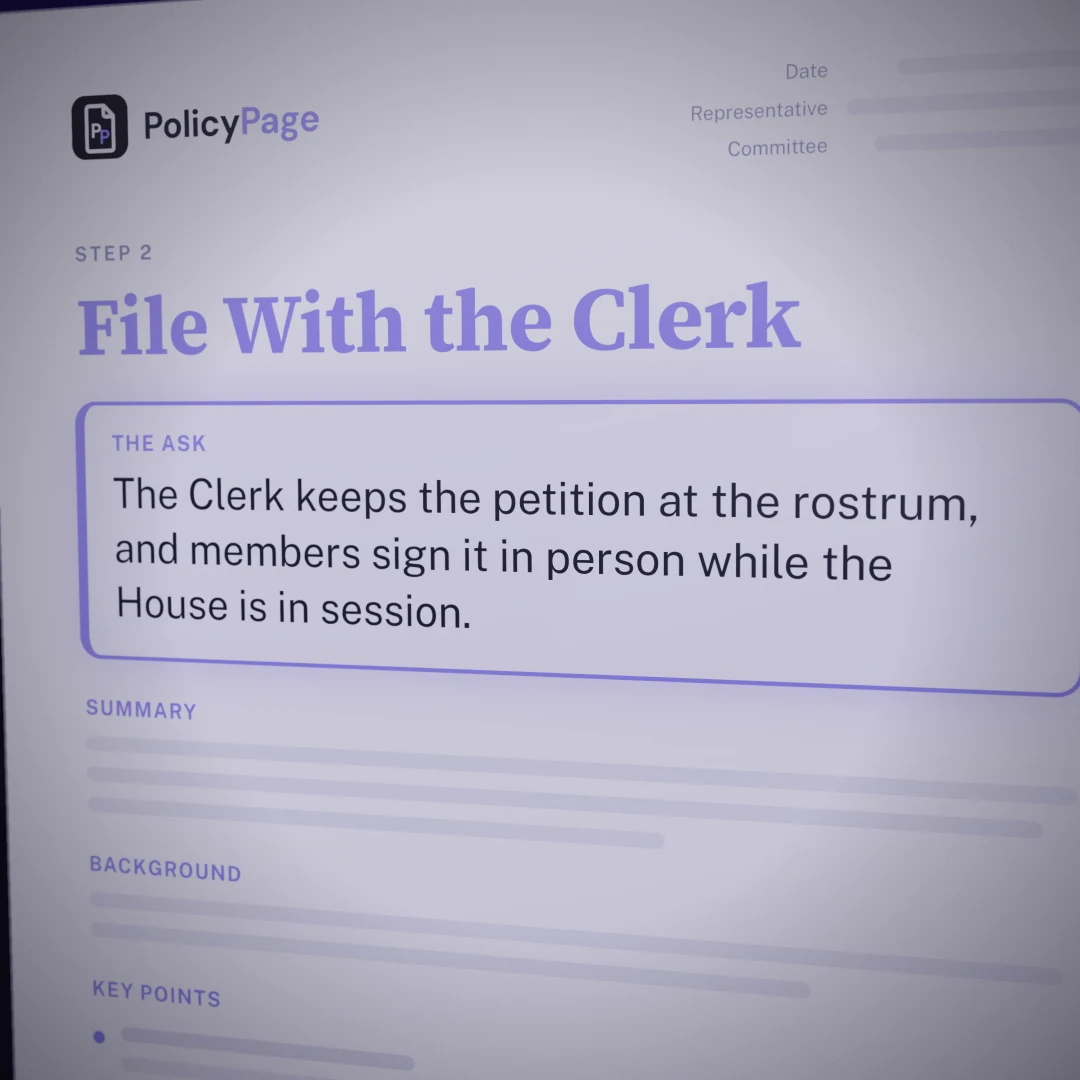
Signatures are public. The Clerk posts each petition and its signers at clerk.house.gov, and the last Congressional Record of each week lists who added or removed a name that week. This was not always true. CRS notes that until 1993, signatures were made public only once a petition reached 218.
Only one petition may be filed for a bill or resolution. The Clerk's list for the current 119th Congress showed 30 discharge petitions when this guide was written.
Step 3: 218 members sign
The petition needs signatures from a majority of the total membership of the House. The rules manual says that phrase has been read to mean 218 members. CRS describes the 218 requirement as fixed, so it does not drop when seats are vacant. Delegates and the Resident Commissioner cannot sign.
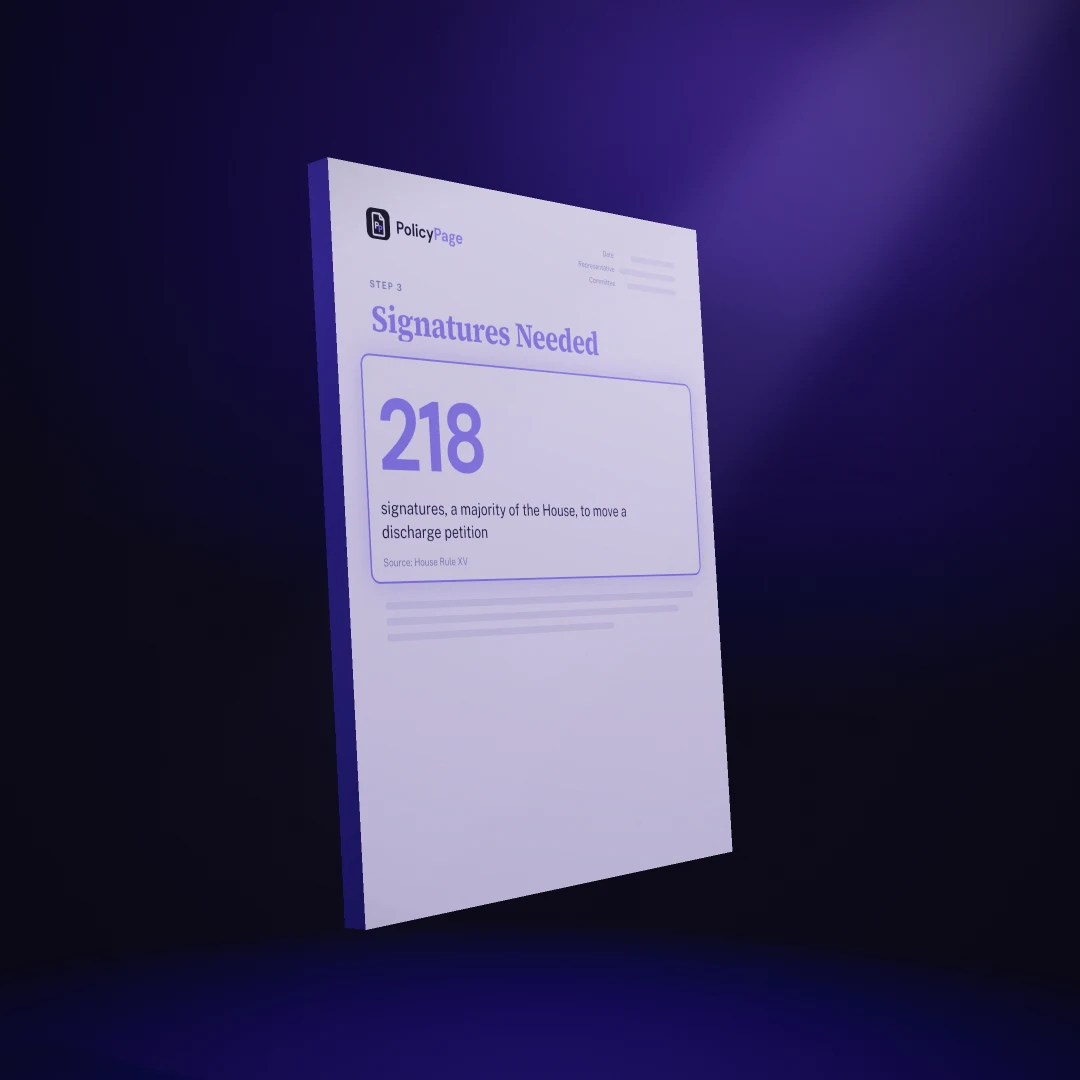
Until the petition reaches 218, members may add or remove their names. Once it reaches 218, the list is frozen. The motion is entered in the House Journal, printed with the names in the Congressional Record, and placed on the Calendar of Motions to Discharge Committees. CRS notes that, for the few petitions that get this far, the process usually takes months.
Step 4: Seven legislative days on the discharge calendar
Reaching 218 does not bring an immediate vote. The motion must sit on the discharge calendar for at least seven legislative days. After that, any member who signed may announce on the floor an intention to offer the motion. The Speaker must then schedule it within two legislative days.
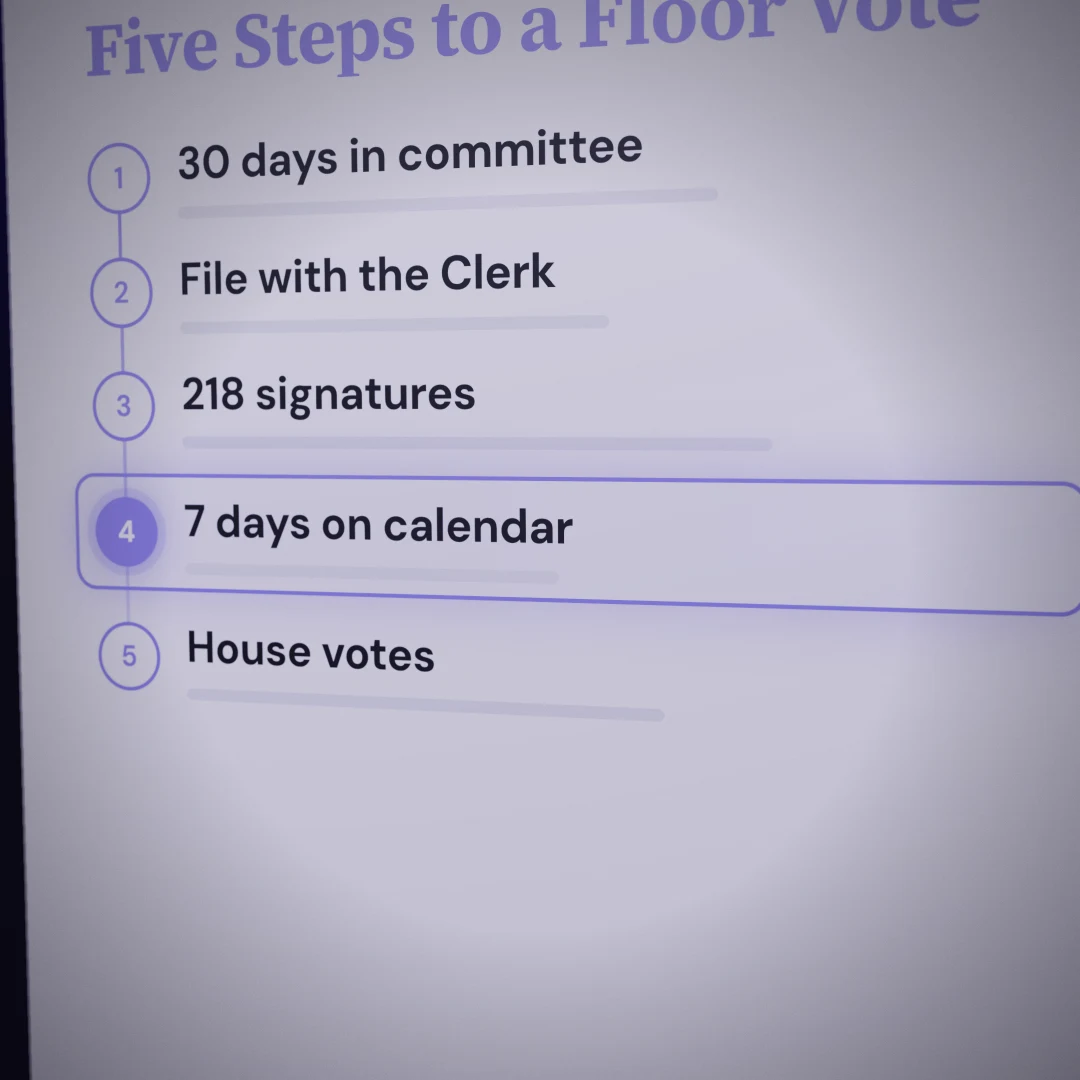
This notice rule is fairly new. Before 2019, a discharge motion could be called up only on the second or fourth Monday of a month. The House changed the rule at the start of the 116th Congress. A discharge motion is also not in order during the last six days of a session.
Step 5: The House votes on the motion to discharge
When the scheduled time comes, a signer offers the motion. The rule allows 20 minutes of debate, split evenly between supporters and opponents. Then the House votes. A simple majority of those voting decides it.
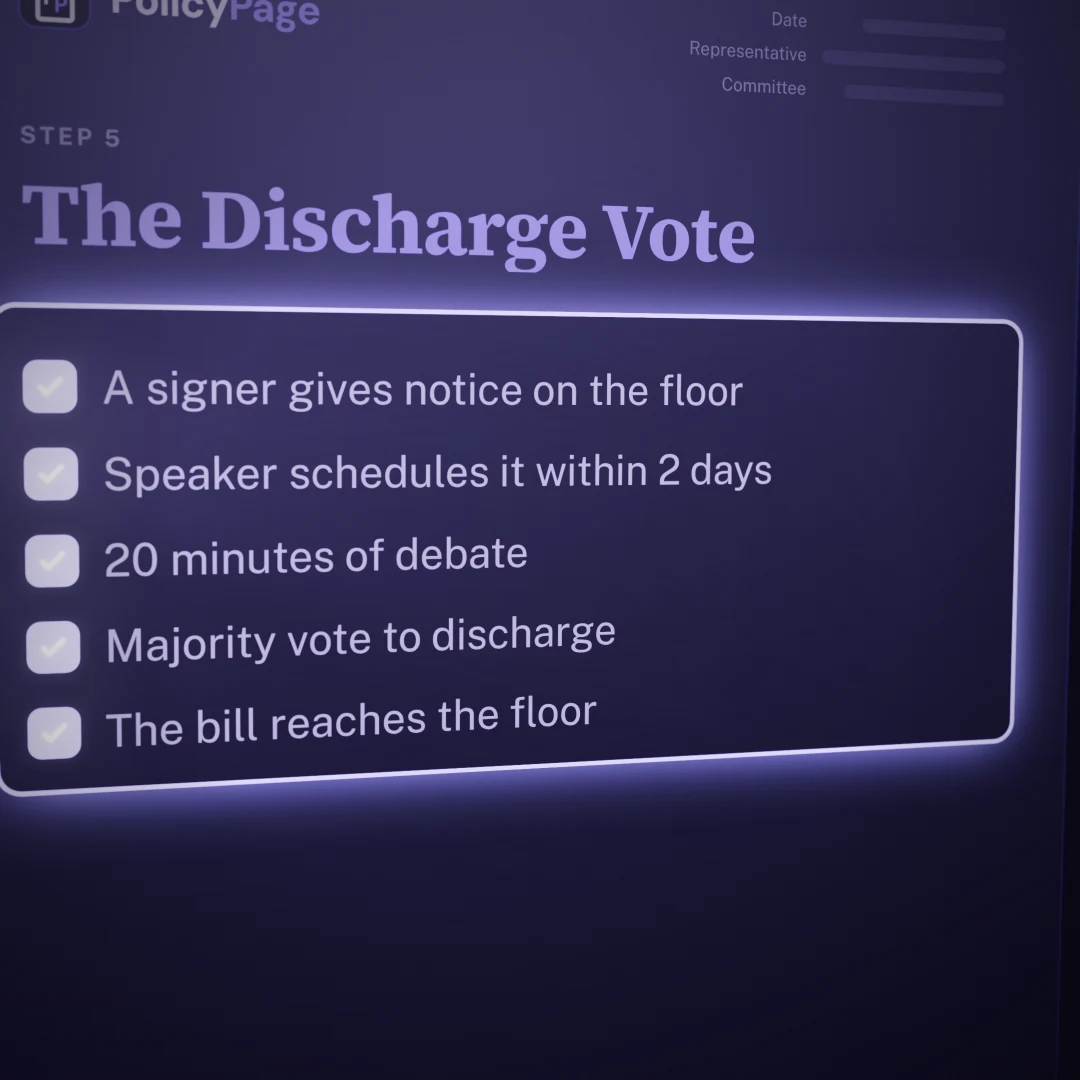
If the motion passes, the committee is discharged. A signer can then move to take up the bill right away, and the bill comes to the floor in the form it was introduced, with no committee changes and no committee report. If the petition targeted a special rule instead of the bill, the House goes straight to debating that rule. Either way, the bill still needs its own floor vote to pass.
How many signatures are needed for a discharge petition?
The answer is 218. That number is a majority of the House's 435 seats. CRS explains that the number is fixed, so vacancies do not lower it. Every signature must come from a member. CRS notes that Delegates and the Resident Commissioner may be given time to speak in the debate, but they may not file, sign, or vote on the motion.
Signing gets the motion onto the calendar. The motion itself then needs a majority of those voting.
Why are discharge petitions rarely used?
Discharge petitions are filed often but rarely succeed. A 2023 analysis from the Brookings Institution found that members had successfully discharged less than four percent of the 639 discharge petitions filed since 1935. CRS adds that, since the 218 rule began in 1935, rarely do more than two measures facing a discharge attempt reach the floor in a single Congress, and only a few have ever become law.
There are four main reasons:
- The rule is built to discourage it. CRS explains that the procedure is designed to be difficult so members do not routinely take control of the floor agenda away from the committee and leaders who normally hold it.
- The waiting periods give leaders time. The 30 legislative days, the time to gather signatures, and the seven day wait all give the committee and leadership room to respond.
- The committee can make it moot. If the petition targets the bill itself, the committee can report the bill before the motion is offered. CRS explains that a committee cannot be discharged from a bill it no longer holds.
- Leaders can offer their own path. As a petition nears 218, the Rules Committee may report its own rule for the bill, on its own terms. CRS notes that almost all measures that have reached the floor through discharge efforts in recent decades got there this way, rather than through the discharge vote itself.
So a petition can work without ever reaching a vote: a credible threat can push leaders to schedule the bill themselves.
Why most petitions now target a special rule
There are two ways to file. A member can file on the bill itself, or on a special rule: a short House resolution that sets the terms for debating one bill. CRS explains that the special rule route has become more common in recent Congresses.
The reason is control. When supporters write their own special rule, they set the terms for debate and amendments, and the committee cannot end the effort just by reporting the bill. The rule must cover only one bill and must sit with the Rules Committee for seven legislative days before a petition can be filed on it.
What happens after a discharge petition is signed?
After the 218th signature, three things can happen:
- The discharge vote goes forward. A signer gives notice, the Speaker schedules the motion, and the House votes after 20 minutes of debate.
- Leaders take another path. The Rules Committee may bring up its own rule for the same bill, or the bill may come up under suspension of the rules. In both cases the bill reaches the floor, but on leadership's terms.
- The House sets the petition aside. The House can vote to table the discharged rule or to adopt a different arrangement.
Recent Congresses show all three. According to CRS, two petitions reached 218 in the 118th Congress (2023 to 2024). In both cases the House set aside the rule, but the underlying bills, the Federal Disaster Tax Relief Act of 2023 and the Social Security Fairness Act of 2023, passed under suspension and became law.
In the first session of the 119th Congress (2025), CRS counts four petitions that reached 218. Two were brought up under the discharge rule and adopted, and the House then passed the bills they made in order. A third was set aside in favor of a different arrangement on paired votes. For the fourth, part of its text was turned into a separate bill that passed the House under suspension and became law. CRS calls the recent rise in filings and successes "pronounced."
Is there a discharge petition in the Senate?
Not in the same form. The Senate has no 218 style petition. For nominations, Senate Rule XVII lets a senator move or submit a resolution to discharge a committee, but that resolution can be debated without limit. CRS explains in Discharging a Senate Committee from Consideration of a Nomination that ending that debate may require cloture, which takes three-fifths of senators, or 60, on such a resolution.
In practice the Senate routinely discharges committees from nominations by unanimous consent, which one objection can stop. Forcing it over objection is very rare. CRS found only four times since 1916 that a committee was discharged by motion or resolution outside of special power sharing rules, most recently in 1947.
Discharge petition vs suspension vs the Consensus Calendar
The House has a few ways to move a bill that leaders have not scheduled through the normal process. Each works differently.
| Discharge petition | Suspension of the rules | Consensus Calendar | |
|---|---|---|---|
| Who starts it | Any member files with the Clerk | The Speaker decides whether to recognize the motion | The bill's sponsor files with the Clerk |
| Support needed | 218 signatures, then a majority vote | Two-thirds of members voting | 290 cosponsors kept for 25 legislative days |
| Waiting period | 30 legislative days in committee, then 7 on the calendar | None set by the rule | 25 legislative days with 290 cosponsors |
| Debate | 20 minutes on the motion | 40 minutes on the bill | Not set by this rule |
| Main use | Getting around the committee and leadership | Fast passage of bills with broad support | Bills with very broad cosponsor support that a committee has not reported |
All three come from Rule XV of the House rules. The Consensus Calendar, added in 2019, requires the House to take up a measure from that calendar at least once in each week it meets, outside the start and end of each Congress. Suspension is covered in depth in our guide to suspension of the rules.
What about discharge petition vs cloture? A discharge petition gets a bill out of a House committee. Cloture ends debate on a question already before the Senate.
What a discharge petition tells you before a meeting with a House office
For advocates, a discharge petition is one of the clearest public signals in the House. Every signature is posted. Before a meeting with a House office about a stalled bill, it is worth checking:
- Is there a petition on the bill, or on a rule for it? The Clerk's discharge petition page lists every petition this Congress with links to the signers.
- Has the member signed? Signing is a different step from a cosponsorship. It is a public request to bring the bill to the floor without the committee's or leadership's approval.
- How close is it to 218? A petition near the threshold changes the conversation. Leaders may be looking for another way to bring the bill up, and staff will be tracking every name. The House's Calendar of Motions to Discharge Committees lists the motions that reached 218 and went on the calendar.
A good ask is specific. "Please sign the discharge petition on this bill" is a clear request staff can answer with a yes, a no, or a reason. A short, cited one page brief that shows where the petition stands, whether the member has signed, and what you are asking for is easier for staff to use than a stack of handouts. PolicyPage writes a free, cited, one page brief tailored to the member you are meeting.
For the bigger picture of where discharge fits among committees, rules, the Senate, and the veto, see our guide to how a bill becomes law.
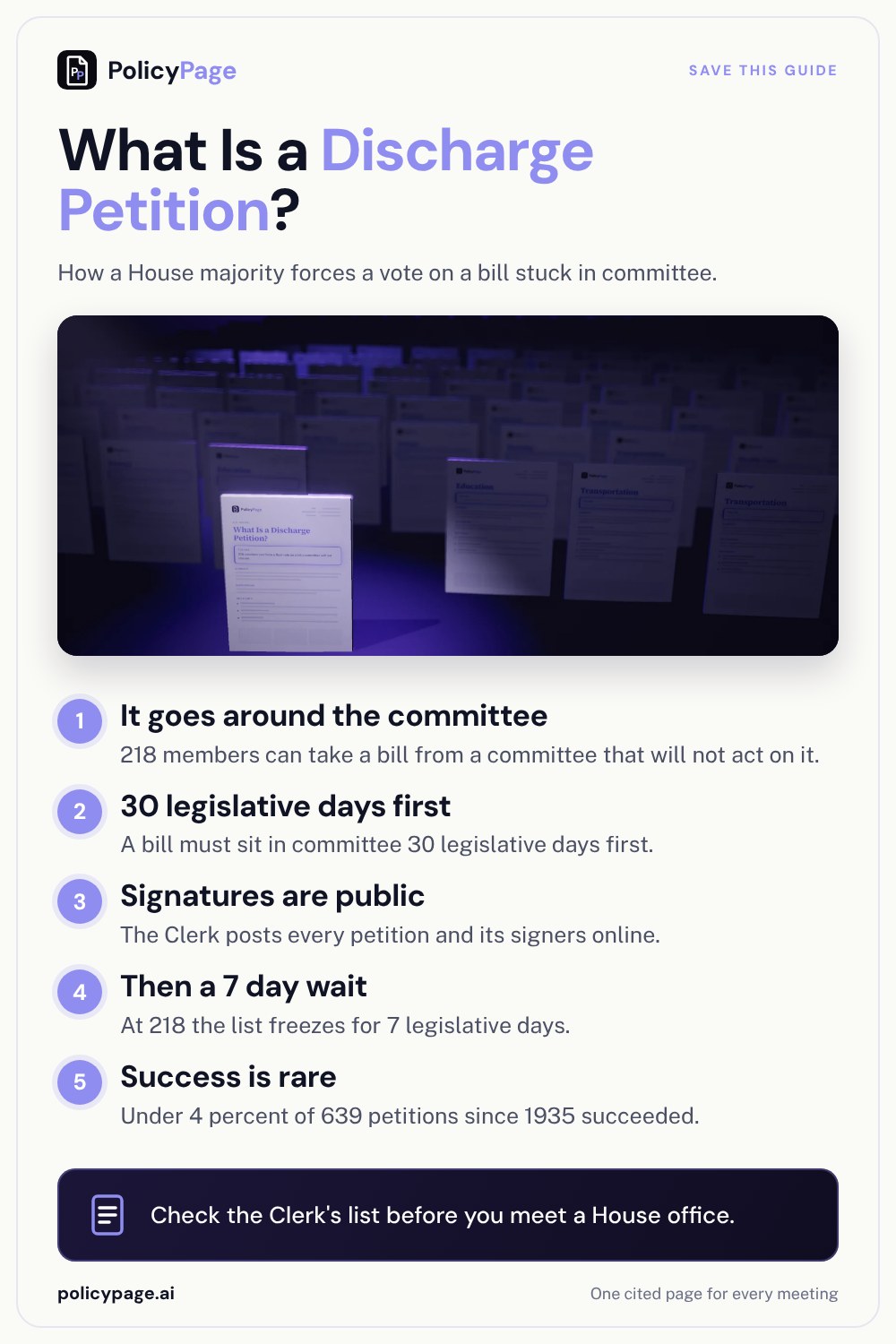
Save this guide
Frequently asked questions
What is a discharge petition in simple terms?
It is a House procedure that lets a majority of members, 218, force a committee to give up a bill so the full House can vote on it, even if committee chairs and party leaders do not want a vote.
How many signatures are needed for a discharge petition?
218, a majority of the House's 435 seats. CRS describes the number as fixed, so vacancies do not lower it, and Delegates and the Resident Commissioner cannot sign.
How does a discharge petition work?
A bill must sit in committee for 30 legislative days. A member files a petition with the Clerk, 218 members sign it, it waits seven legislative days on the discharge calendar, and then the House votes on a motion to discharge after 20 minutes of debate.
Why are discharge petitions rare?
Signing means going around party leaders, the waiting periods give leaders time to respond, and committees or the Rules Committee can take over the bill on their own terms. A 2023 Brookings analysis found less than four percent of the 639 petitions filed since 1935 succeeded.
What happens after a discharge petition is signed by 218 members?
It goes on the Calendar of Motions to Discharge Committees. After seven legislative days, a signer can give notice and the Speaker must schedule a vote within two legislative days. Leaders sometimes bring the bill up another way first.
Does the Senate have discharge petitions?
Not like the House. A senator can move to discharge a committee, but the motion can be debated without limit and may need 60 votes for cloture, so the Senate usually discharges committees by unanimous consent instead.
Can a member remove their name from a discharge petition?
Yes, until the petition reaches 218 signatures. After that the list is frozen and printed in the Congressional Record.
Terms in this article
Sources
- 1.Discharge Procedure in the House (R45920), updated February 12, 2026, Congressional Research Service, via EveryCRSReport
- 2.The Discharge Rule in the House: Principal Features and Uses (97-552), Congressional Research Service, via EveryCRSReport
- 3.Rules of the House of Representatives, 119th Congress, Rule XV, U.S. Government Publishing Office (govinfo)
- 4.Discharge Petitions, Office of the Clerk, U.S. House of Representatives
- 5.House Calendars, 119th Congress, 1st Session: Calendar of Motions to Discharge Committees, U.S. Government Publishing Office (govinfo)
- 6.Who Controls the House?: The Discharge Petition and Legislative Power in the New Deal Congress, U.S. House of Representatives, History, Art and Archives
- 7.Discharging a Senate Committee from Consideration of a Nomination (IF12915), Congressional Research Service, via EveryCRSReport
- 8.Don't count on the House discharge rule to raise the debt limit, Brookings Institution
New to some of the terms here? The advocacy glossary defines them in plain English.