
What Is Cloture? How the Senate Ends a Filibuster, Step by Step
Cloture is the Senate vote that ends debate so a bill or nomination can move to a final vote. Most bills need 60 votes. Here is how cloture works, step by step.
11 minute read8 sources
In this article
- What is cloture in the Senate?
- How does cloture work?
- Step 1: Sixteen senators sign a cloture motion
- Step 2: The motion waits two days
- Step 3: The Senate votes, and most matters need 60
- Step 4: Up to 30 more hours, then the final vote
- Filibuster vs cloture: what is the difference?
- Where did cloture come from?
- How often does the Senate vote on cloture?
- What happens if cloture fails?
- Cloture vs unanimous consent vs budget reconciliation
- What a cloture vote tells you before a meeting with a Senate office
- Save this guide

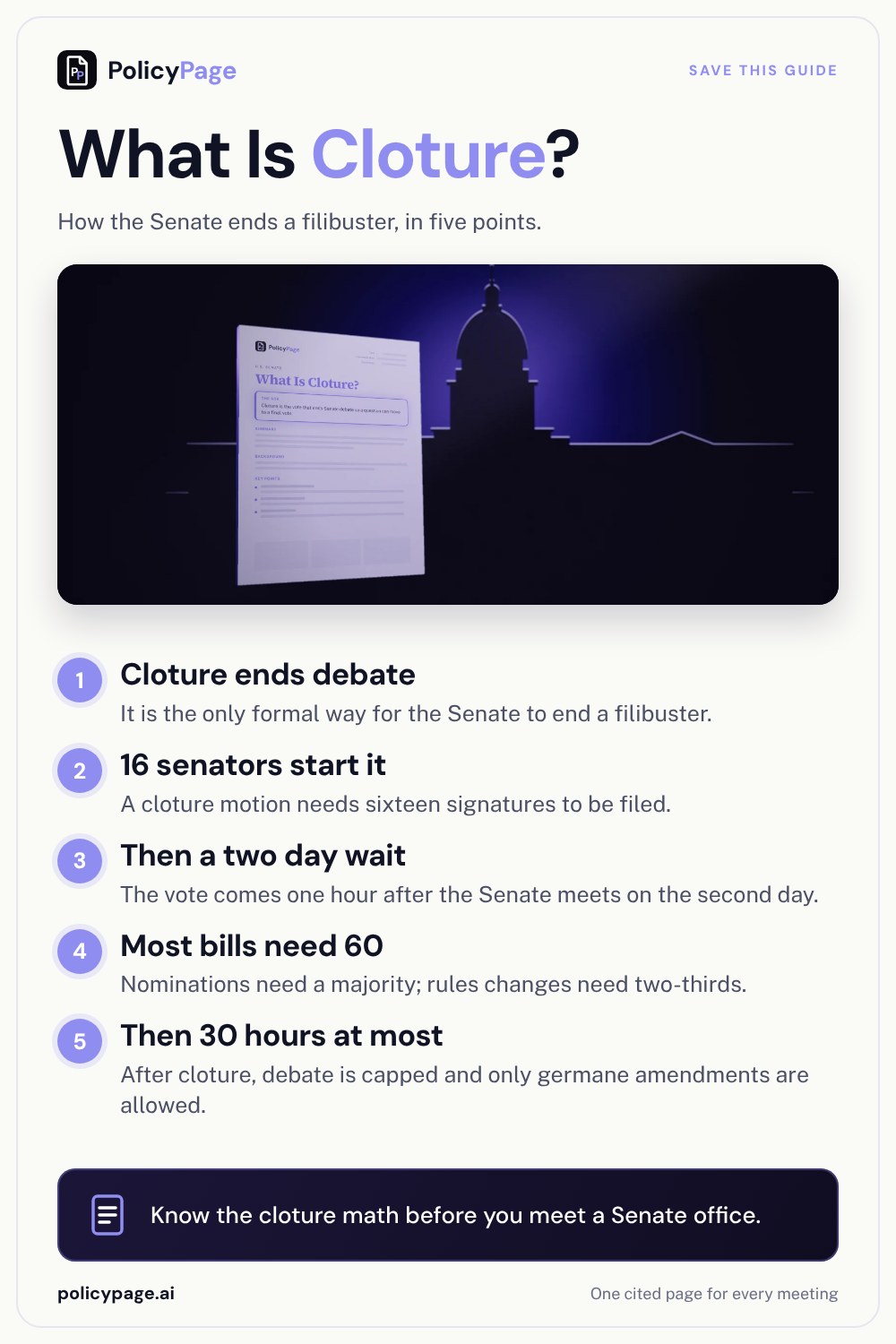
Cloture is the vote the U.S. Senate uses to end debate on a bill, a nomination or another question so it can move to a final vote. On most bills it takes three-fifths of the Senate, which is 60 votes when every seat is filled, and it is the only formal way to end a filibuster.
The process has four parts. Sixteen senators sign a cloture motion. The motion waits two days. The Senate votes on it. If cloture wins, debate is capped at 30 more hours before the final vote. This guide walks through each step in plain English, explains how cloture differs from a filibuster, and shows what a cloture vote tells you before a meeting with a Senate office.
People search for this in many ways: "cloture short definition," "what is cloture in the Senate," "cloture vote meaning," "cloture motion presented in Senate," and "difference between filibuster and cloture." Each one is answered below.
What is cloture in the Senate?
Cloture is a rule for closing debate. The Senate has a long tradition of unlimited debate, which means a senator can keep talking, or keep a question open, for as long as the rules allow. The Senate's own history pages explain that before 1917 the rules gave the chamber no way to end debate and force a vote. Cloture is the tool that fills that gap.
The rule lives in Rule XXII of the Standing Rules of the Senate. When the Senate votes on cloture, the presiding officer puts this question to the chamber: "Is it the sense of the Senate that the debate shall be brought to a close?" A yes vote by enough senators closes debate. It does not pass the bill. It only clears the way for a later vote on the bill itself.
Here is a simple way to picture it. Think of a long town meeting where anyone may keep speaking as long as they like. Cloture is the vote the group takes to say, "We have heard enough. Let's set a time limit and then decide." The final decision still comes later, by a separate vote.
Cloture short definition
If you need one line: cloture is the Senate procedure that ends debate on a question so it can reach a vote, and on most matters it needs 60 votes. The cloture entry in the PolicyPage glossary uses nearly the same words. The Legal Information Institute at Cornell Law School calls it the formal process of ending debate on a legislative proposal and proceeding to a vote.
How does cloture work?
The Congressional Research Service (CRS), the nonpartisan research office that serves Congress, describes the full procedure in its report Invoking Cloture in the Senate. Stripped down, it comes in four steps. Each one has a firm rule behind it, and each one takes time, which is why cloture shapes the Senate's whole schedule.
Step 1: Sixteen senators sign a cloture motion
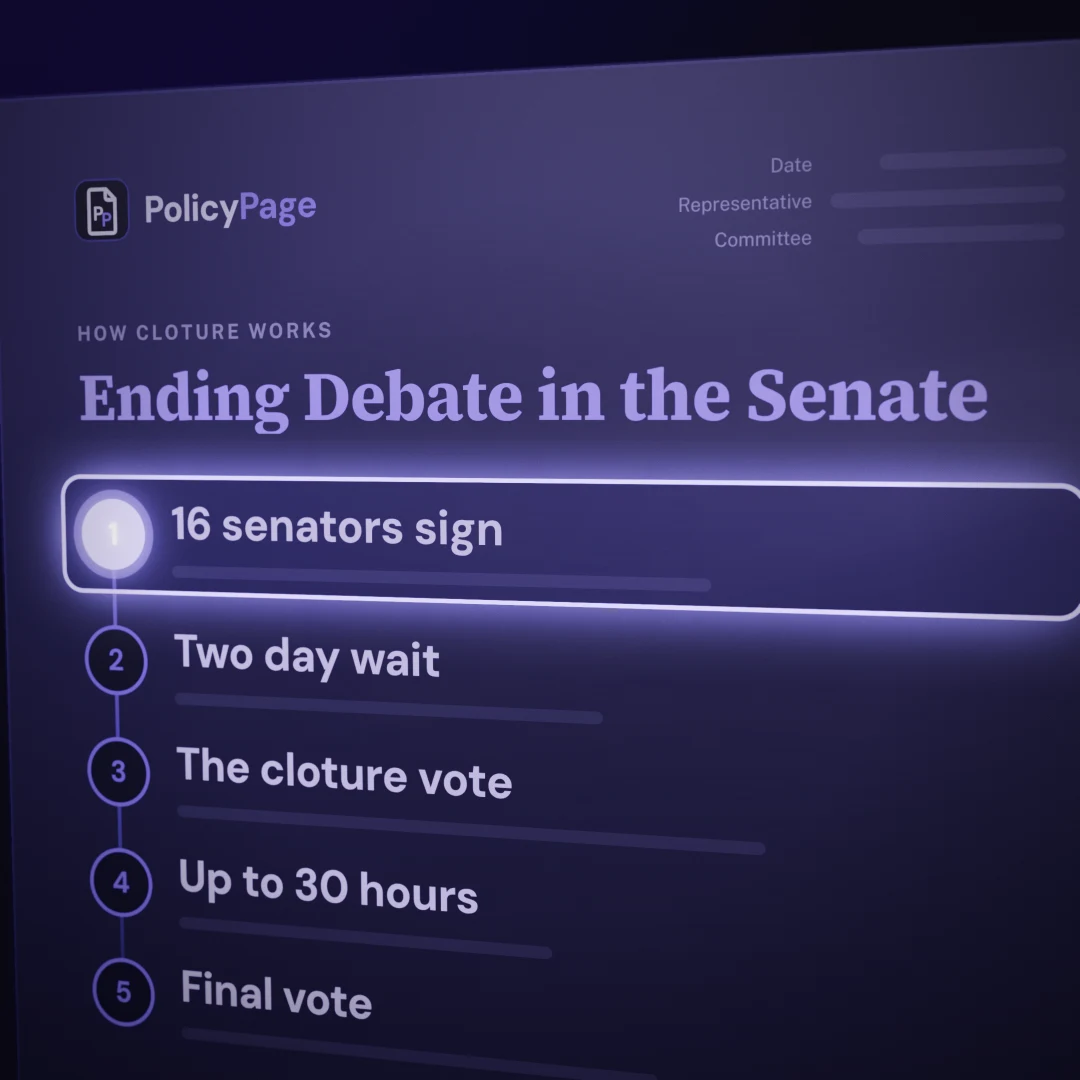
Cloture starts on paper. Rule XXII says the process begins with a motion signed by sixteen senators asking to bring debate to a close on the pending question. When you hear a news report say a "cloture motion was presented in the Senate," or see that phrase in the Senate's daily record, this is the step it means.
The motion can be filed on almost anything the Senate is debating: a bill, an amendment, a nomination, or a motion to proceed. A motion to proceed is the vote to start debating a bill in the first place. That detail matters. CRS explains in Filibusters and Cloture in the Senate that most bills can face at least two filibusters: one on the motion to proceed and one on the bill itself. So a single bill can need two or more cloture votes before it passes.
Cloture is also used when no one is visibly stalling. CRS notes that Senate leaders have increasingly used cloture as a normal tool for managing the floor, even when no filibuster has yet happened. Filing early simply starts the clock.
Step 2: The motion waits two days
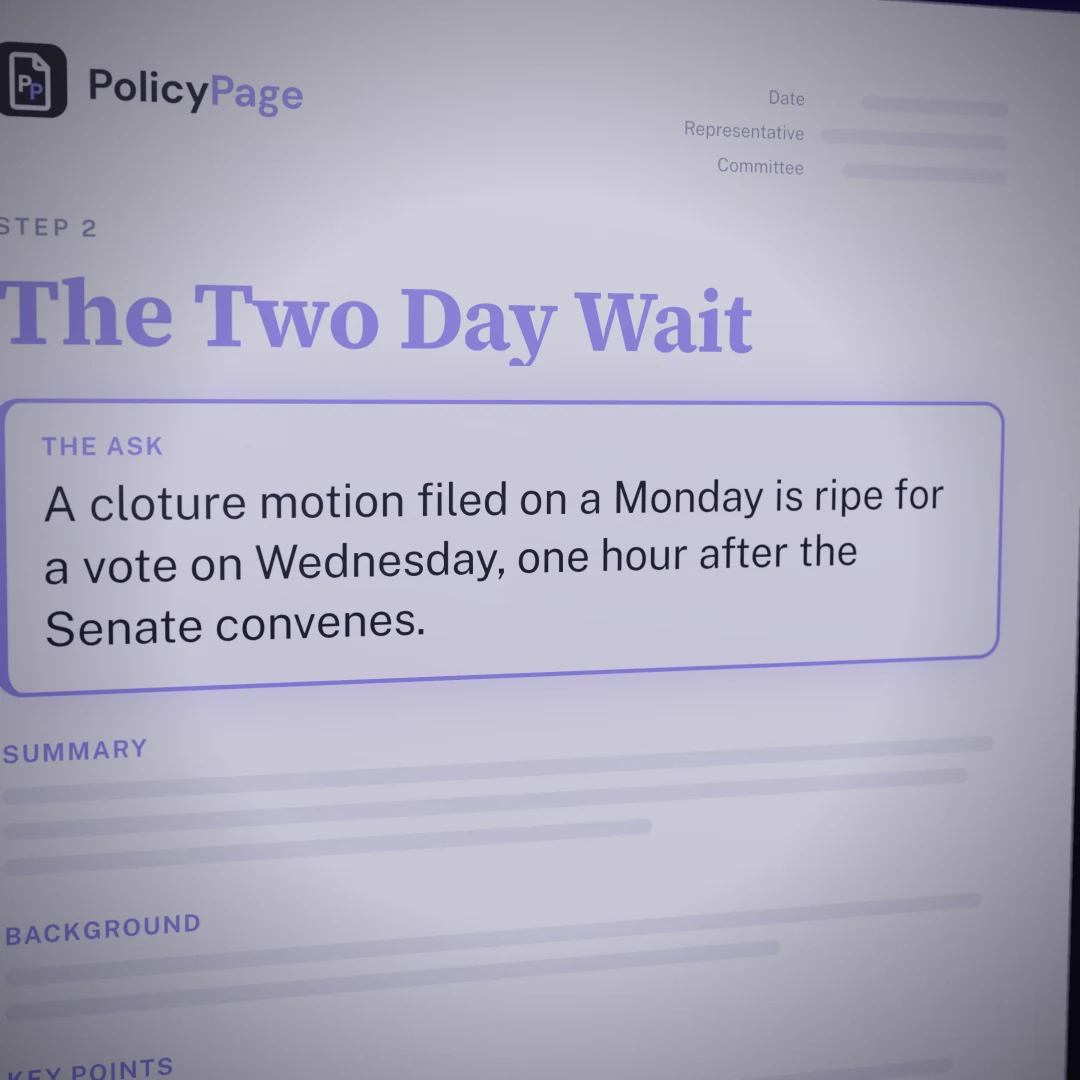
A cloture motion does not get a vote right away. Under Rule XXII, the vote happens one hour after the Senate meets on "the following calendar day but one." In plain terms, a motion filed on a Monday is ripe for a vote on Wednesday, one hour after the Senate convenes. Senators often agree by unanimous consent to hold the vote at a different time.
Before the vote, the rule calls for a quorum call to make sure enough senators are present. CRS says this live quorum call is routinely waived by unanimous consent, so you will rarely see it happen.
The waiting period also sets deadlines for amendments. According to CRS, senators who want to offer a first-degree amendment after cloture must file it in writing by 1:00 p.m. on the day after the cloture motion is filed. Second-degree amendments, which change a pending amendment, are due at least one hour before the cloture vote. Staff who track a bill watch these deadlines closely, because an amendment that misses them cannot be offered once cloture is invoked.
Step 3: The Senate votes, and most matters need 60
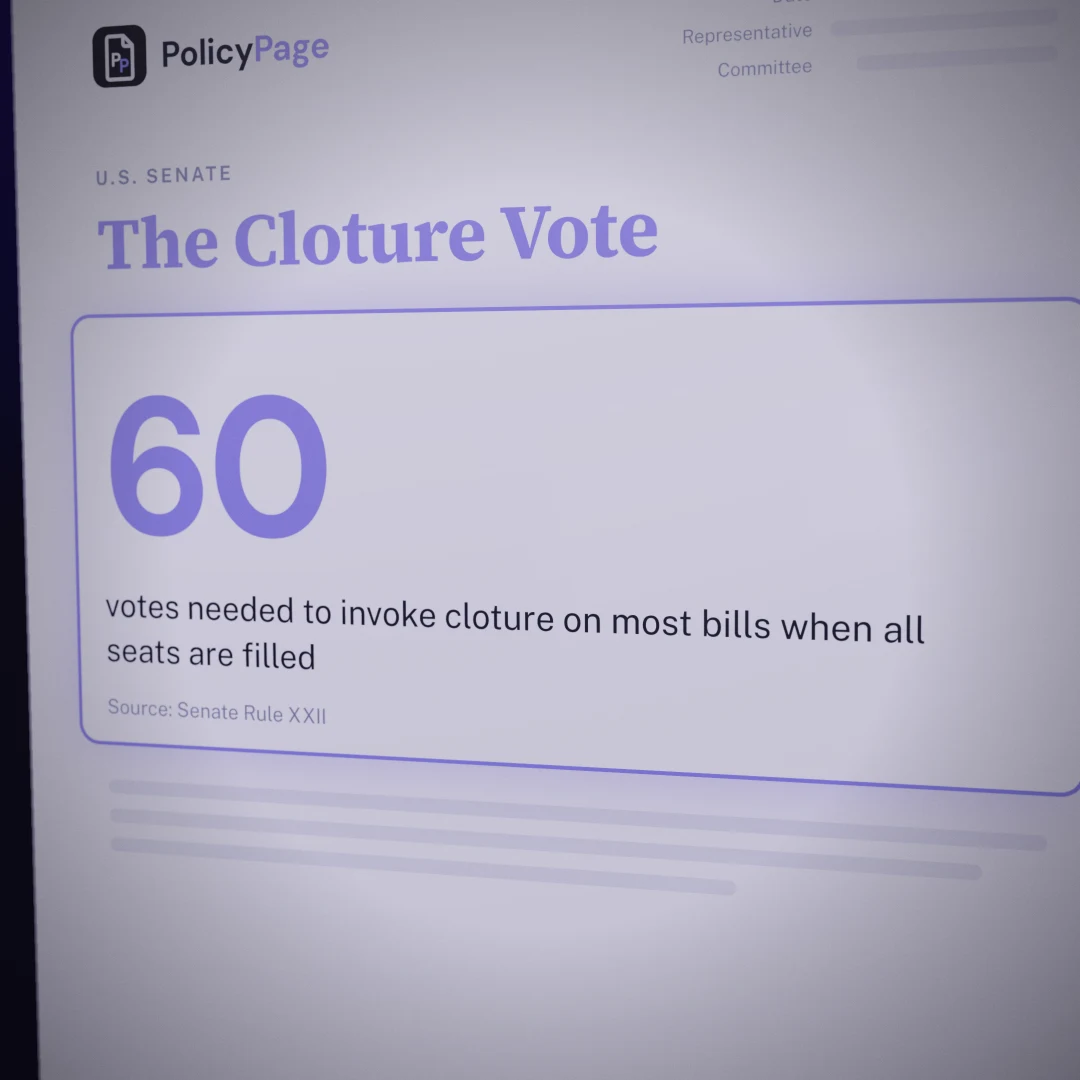
On the cloture vote itself, the number needed depends on what is being debated. For most bills and other matters, Rule XXII requires three-fifths of the senators "duly chosen and sworn." With all 100 seats filled, that is 60.
There are two big exceptions:
- Changes to the Senate's rules. Cloture on a measure to amend the Senate rules takes two-thirds of the senators present and voting, which is 67 if all 100 vote.
- Nominations. CRS explains that a November 21, 2013 precedent let the Senate end debate on most nominations by a majority of those voting, and an April 6, 2017 precedent extended that to Supreme Court nominations. Its report Senate Proceedings Establishing Majority Cloture for Supreme Court Nominations says the Senate can now invoke cloture on any nomination by a majority vote.
If cloture gets the votes, the Senate says cloture is "invoked." If it falls short, debate simply goes on.
Step 4: Up to 30 more hours, then the final vote
Invoking cloture does not end debate on the spot. It puts a ceiling on it. Rule XXII says that after cloture is invoked, the Senate gets no more than thirty hours of further consideration of the question. That 30 hours includes speeches, quorum calls and roll call votes. The Senate can lengthen the 30 hours by a three-fifths vote, and senators often agree to use less time by unanimous consent.

The rule also sets limits on what can happen during those hours:
- One hour per senator. No senator may speak for more than one hour in total on the question.
- Germane amendments only. No dilatory motion or amendment, and no amendment that is not germane, is in order. Germane means closely tied to the subject of the bill.
- No new stalling. The purpose of the rule is to move the question to a vote, so delaying tactics are out.
When the time runs out or is yielded back, the Senate votes on the bill, amendment or nomination itself. For most bills, that final vote takes only a simple majority. This is why people say a bill needs 60 votes in the Senate: the 60 is usually needed to end debate, not to pass the bill.
Filibuster vs cloture: what is the difference?
A filibuster and cloture are two sides of the same rule. The Senate defines a filibuster as a loosely defined term for action designed to prolong debate and delay or prevent a vote on a bill, resolution, amendment or other debatable question. CRS puts it this way: filibustering includes any use of delaying or blocking tactics to keep a measure from coming to a vote. Cloture is the way the Senate ends it.
| Filibuster | Cloture | |
|---|---|---|
| What it is | Using debate or delay to block a vote | A vote to close debate |
| Who uses it | Any senator or group of senators | A motion signed by 16 senators |
| Votes needed | None; it lasts as long as debate stays open | Three-fifths of senators sworn (60) on most matters |
| What it does | Keeps a question from reaching a vote | Caps further debate at 30 hours, then a final vote |
| Written in | Senate tradition of unlimited debate | Senate Rule XXII |
The Senate's historical office notes that the marathon speech is the type of filibuster most Americans picture, but under CRS's definition any delaying tactic counts. Because Senate leaders now file cloture as a matter of routine, the 60 vote test often decides a bill's fate without anyone holding the floor for hours.
Where did cloture come from?
The Senate Historical Office tells the story in its historical overview of filibusters and cloture. Long speeches to delay bills appeared as early as the first session of the Senate in 1789, and the word "filibuster" came into use in the 1850s. For more than a century, the Senate had no formal way for a majority to end debate.
In 1917 the Senate adopted Rule 22, which let two-thirds of the senators voting invoke cloture. It was first used successfully in 1919, to end debate on the Treaty of Versailles. Because two-thirds was hard to reach, the Senate invoked cloture only five times in the next four decades, according to the historical office.
In 1975 the Senate lowered the bar from two-thirds of senators voting to three-fifths of all senators duly chosen and sworn, or 60 of 100. The 2013 and 2017 precedents described above then set a simple majority for nominations. Legislation still needs 60.
How often does the Senate vote on cloture?
Far more often than it used to. The Senate keeps an official table, Senate Action on Cloture Motions, going back to 1917. A few numbers from it, as shown when this guide was written:
- In the 65th Congress (1917 to 1918), senators filed 2 cloture motions, and cloture was not invoked on either.
- In the 103rd Congress (1993 to 1994), there were 80 motions filed, 46 votes and 14 times cloture was invoked.
- In the current 119th Congress (2025 to 2026), the table shows 301 motions filed, 298 votes on cloture and 251 times cloture was invoked.
- Since 1917 the total is 3,189 motions filed, 2,627 votes and 1,863 times cloture was invoked.
The rise reflects both more filibusters and the habit, noted by CRS, of filing cloture as a routine way to schedule votes.
What happens if cloture fails?
If a cloture vote falls short, debate stays open and the bill does not get its final vote. The majority leader then has a few choices: try again, change the bill to win more votes, or move on to other business. CRS notes there is no limit on the number of times the Senate can vote on cloture for the same question, so a failed vote is not always the end.
A failed cloture vote is still useful information. It shows exactly how many senators are ready to move forward and how many more are needed. Staff and advocates read these votes as a public whip count, much like the private tallies a party whip keeps.
Cloture vs unanimous consent vs budget reconciliation
Cloture is one of three common ways the Senate gets to a vote. Each fits a different situation.
| Cloture | Unanimous consent | Budget reconciliation | |
|---|---|---|---|
| How it limits debate | A vote caps debate at 30 more hours | Every senator agrees to a time limit | The law caps debate at 20 hours |
| Votes needed | 60 on most bills; a majority on nominations | No objection from any senator | Simple majority to pass |
| How long it takes | About two days of waiting, then up to 30 hours | As fast as senators agree | Up to 20 hours of debate, then votes |
| Can one senator block it? | No, if enough senators vote yes | Yes, one objection stops it | No |
| Used for | Most contested bills and nominations | Routine business and agreed schedules | Certain tax, spending and debt limit bills |
Most Senate business moves by unanimous consent. When one senator objects, often through a Senate hold, cloture is how leaders push past the objection. The Legal Information Institute notes that some measures under special procedures, such as budget reconciliation bills and certain trade agreements, are not subject to the 60 vote threshold.
What a cloture vote tells you before a meeting with a Senate office
If you are meeting with a senator's office about a bill, the cloture math is often the real story. A bill with majority support can still stall if it is short of 60. A few things to check before the meeting:
- Has cloture been filed? If a cloture motion is pending, a vote is likely within days. Staff will be focused on it.
- How did the senator vote on cloture before? A cloture vote is often the most important vote on a bill, because it decides whether the bill gets a floor vote at all.
- Is there an amendment deadline? If your issue needs an amendment, the deadlines in Step 2 come fast.
- Is this a nomination? If so, the bar is a majority, and the math is different.
A one page brief that lays out where the votes stand, what the senator did on earlier cloture votes, and what you are asking for is easier for staff to use than a stack of handouts. PolicyPage writes a free, cited, one page brief for the member you are meeting, so the cloture math and your ask fit on a single sheet. For the bigger picture of how bills move, see how a bill becomes law.
Save this guide
Frequently asked questions
What is cloture in simple terms?
Cloture is the Senate vote that ends debate on a bill, nomination or other question so it can move to a final vote. On most bills it takes 60 votes.
What is the difference between filibuster and cloture?
A filibuster uses extended debate or delay to keep a question from reaching a vote. Cloture is the vote that ends that debate, and it is the only formal way to stop a filibuster.
Does cloture require 60 votes?
On most bills, yes: Senate Rule XXII requires three-fifths of the senators duly chosen and sworn, which is 60 when all seats are filled. Nominations need only a majority of those voting, and changes to the Senate rules need two-thirds of those present and voting.
What happens after a cloture vote?
If cloture is invoked, the Senate has no more than 30 more hours to consider the question. Each senator may speak for one hour in total, only germane amendments are allowed, and then the Senate holds the final vote.
What happens if cloture fails?
Debate stays open and the bill does not get a final vote. Leaders can try again, change the bill, or move on, since there is no limit on how many times the Senate can vote on cloture.
What does cloture motion presented in Senate mean?
It means sixteen senators have signed and filed a motion to end debate on a pending question. The Senate votes on that motion one hour after it meets on the second day after filing, unless senators agree to another time.
When was cloture created?
The Senate adopted its cloture rule in 1917, with a two-thirds threshold, and first used it in 1919. In 1975 the threshold was lowered to three-fifths of all senators, or 60.
Terms in this article
Sources
- 1.About Filibusters and Cloture, U.S. Senate
- 2.About Filibusters and Cloture: Historical Overview, U.S. Senate, Historical Office
- 3.Senate Action on Cloture Motions, U.S. Senate
- 4.Standing Rules of the Senate, Rule XXII (Senate Document 117-9), U.S. Senate Committee on Rules and Administration
- 5.Invoking Cloture in the Senate (98-425), Congressional Research Service, via EveryCRSReport
- 6.Filibusters and Cloture in the Senate (RL30360), Congressional Research Service, via EveryCRSReport
- 7.Senate Proceedings Establishing Majority Cloture for Supreme Court Nominations: In Brief (R44819), Congressional Research Service, via EveryCRSReport
- 8.Cloture, Legal Information Institute, Cornell Law School
New to some of the terms here? The advocacy glossary defines them in plain English.