
What Is a Senate Hold? Meaning, How It Works, and How Long It Lasts
A Senate hold is a senator's notice to party leaders that they will object to moving a bill or nominee by unanimous consent. Here is how holds work and end.
10 minute read12 sources
In this article
- What is a hold in Congress?
- How does a Senate hold work?
- Why do leaders honor holds?
- Senate hold vs filibuster: what is the difference?
- How long can a senator put a hold on a nomination?
- Can a hold be secret?
- How can a hold be overcome?
- What changed for holds in 2025?
- Why does a Senate hold matter for advocates?
- Save this guide

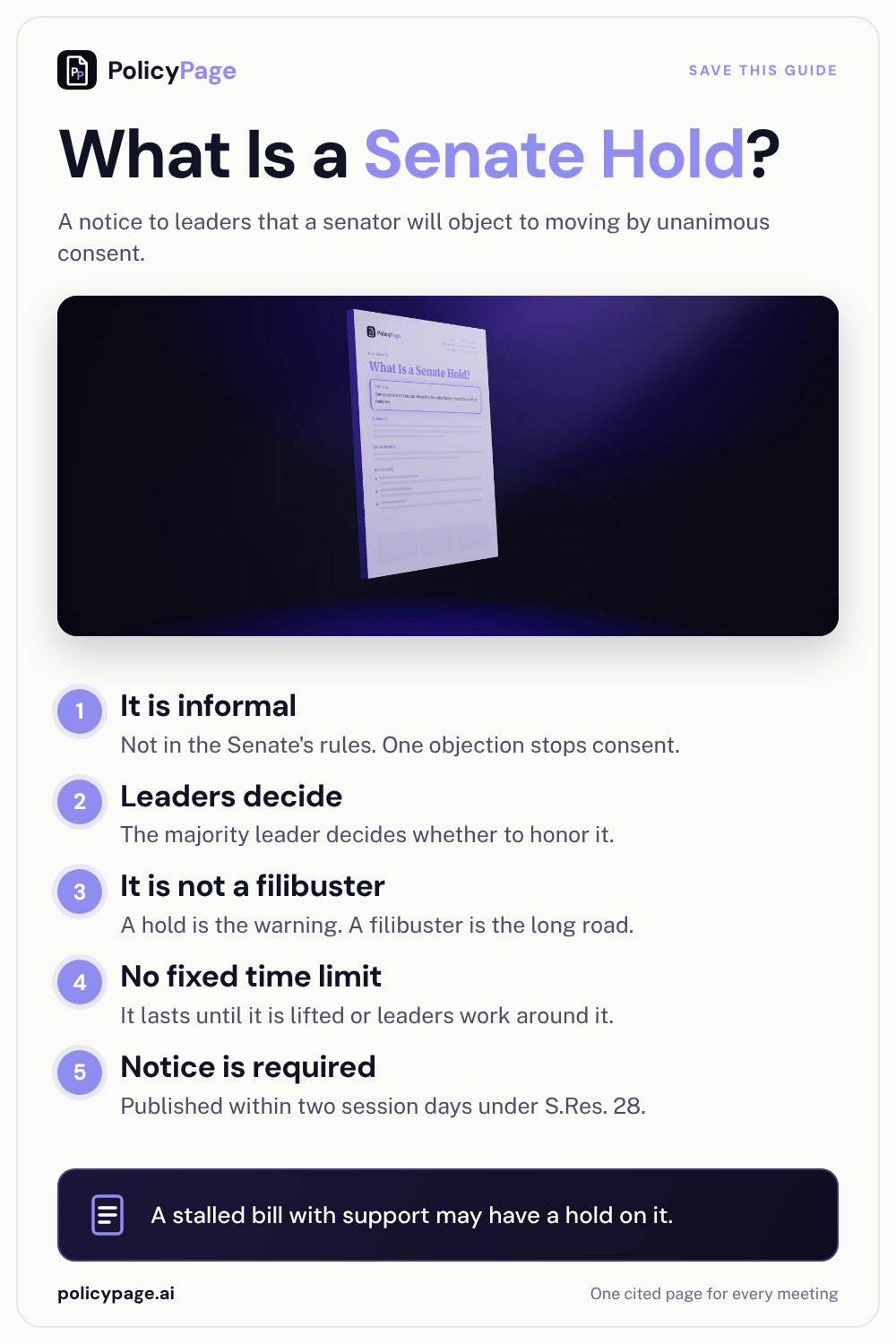
A Senate hold is a message from a senator to party leaders saying the senator plans to object if a bill or nomination is brought up by unanimous consent. It is not a formal veto, and it is not written into the Senate's rules. It works because one objection can stop the Senate's fastest way of doing business. Leaders then have to choose between negotiating and spending scarce floor time. In short, a hold is a warning that turns a quick step into a slow one.
What is a hold in Congress?
When people search for a hold in Congress, they almost always mean this Senate practice. The Congressional Research Service (CRS), which writes nonpartisan reports for Congress, calls the hold an informal practice in which senators tell their leaders about their views and scheduling preferences. A hold often takes the form of a letter.
Here is a simple way to picture it. Imagine a group of 100 people who can skip a long meeting only if every single person agrees. One person says, "If you ask to skip it, I will say no." That person has not cancelled anything. They have told the group that the easy route is closed.
As a definition for government class, try this: a senatorial hold is a senator's notice to leadership of an intent to object to a request for unanimous consent on a measure or nomination.
How does a Senate hold work?
The whole practice rests on unanimous consent. Much of the Senate's daily business moves by agreement, because that is far quicker than using the full procedures. But as CRS explains, any senator may object to a consent request, and if someone does, the request does not take effect. Our guide to how unanimous consent works in Congress explains that process in both chambers.
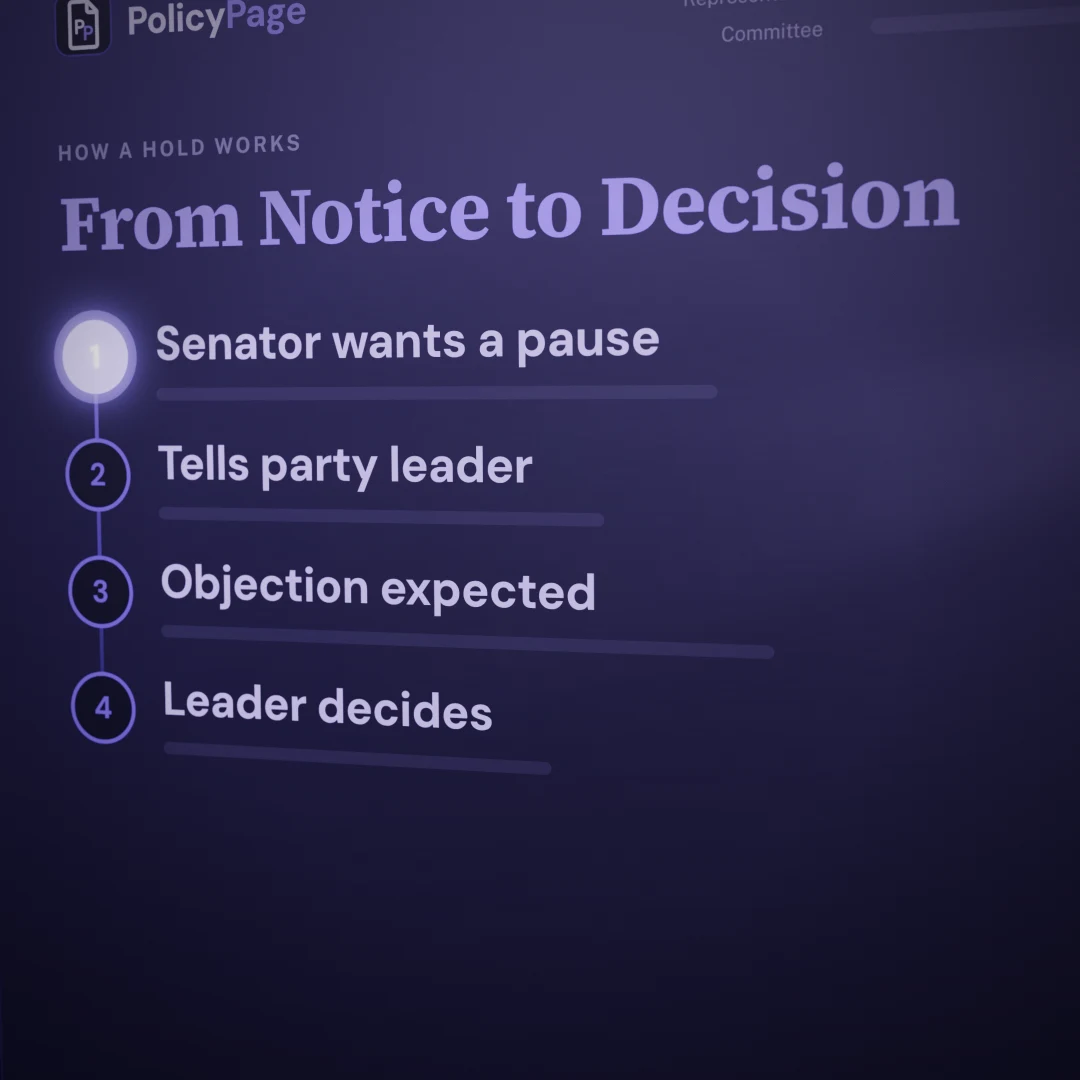
A typical hold follows these steps:
- A senator wants to slow or stop an item, or wants something related to it, such as information or a chance to weigh in.
- The senator tells the party leader, often in writing.
- When the item comes up, the leader knows a consent request will meet an objection.
- The leader decides what to do: wait, negotiate, or use the longer procedures.
The final step matters most. CRS says the decision on whether to honor a hold rests with the majority leader, who typically consults the minority leader. So a hold is really a request. Its power comes from what the senator could do next.
Why do leaders honor holds?
Leaders usually respect holds for a practical reason: ignoring one could bring a filibuster, and floor time is limited. Every day spent overcoming an objection on one item is a day not spent on something else. When the majority leader has a long list of priorities, a bill that cannot move by consent may simply slide down the list.
CRS has described several forms of the practice. These are the ones its reports describe most clearly:
- Informational holds mainly share a senator's views with leaders, in line with what CRS calls information-sharing devices.
- Choke holds contain an explicit threat to filibuster, which makes them far harder for a leader to ignore.
- Blanket holds cover a whole category, such as all nominations to one agency.
- Rolling holds pass from one senator to another. One senator removes a hold and a colleague places a new one, which resets the clock on disclosure.
Senators can use holds for reasons that have nothing to do with the item itself. A senator might hold a nominee to press an agency for answers on a separate issue. CRS has also noted that holds can serve as a silent filibuster, in the words of one of its reports. People disagree about whether this is healthy. Some see holds as a way for one state's senator to be heard. Others see them as letting one person delay work that most of the chamber supports.
Senate hold vs filibuster: what is the difference?
The two are related, but they are not the same thing.

A filibuster is, in the Senate's own words, a loosely defined term for action designed to prolong debate. It happens on the floor, or at least depends on the floor rules. Ending one takes cloture. Since 1975, that has generally meant three-fifths of all senators, or 60 of 100 on legislation.
A hold happens before any of that, mostly off the floor. It is a private or semi-private message to leadership. No debate has to take place. Nothing has to be voted on. Often the public sees nothing at all except that a bill or nominee is not moving.
Think of the hold as the warning and the filibuster as the thing being warned about. A hold says, "Do not try the shortcut, because I will make you take the long road." The filibuster is part of that long road.
How long can a senator put a hold on a nomination?
There is no fixed time limit, since a hold is not a formal rule. It lasts until the senator lifts it, the leader decides to work around it, or the nomination is no longer pending. The longest practical pressure point is the calendar.
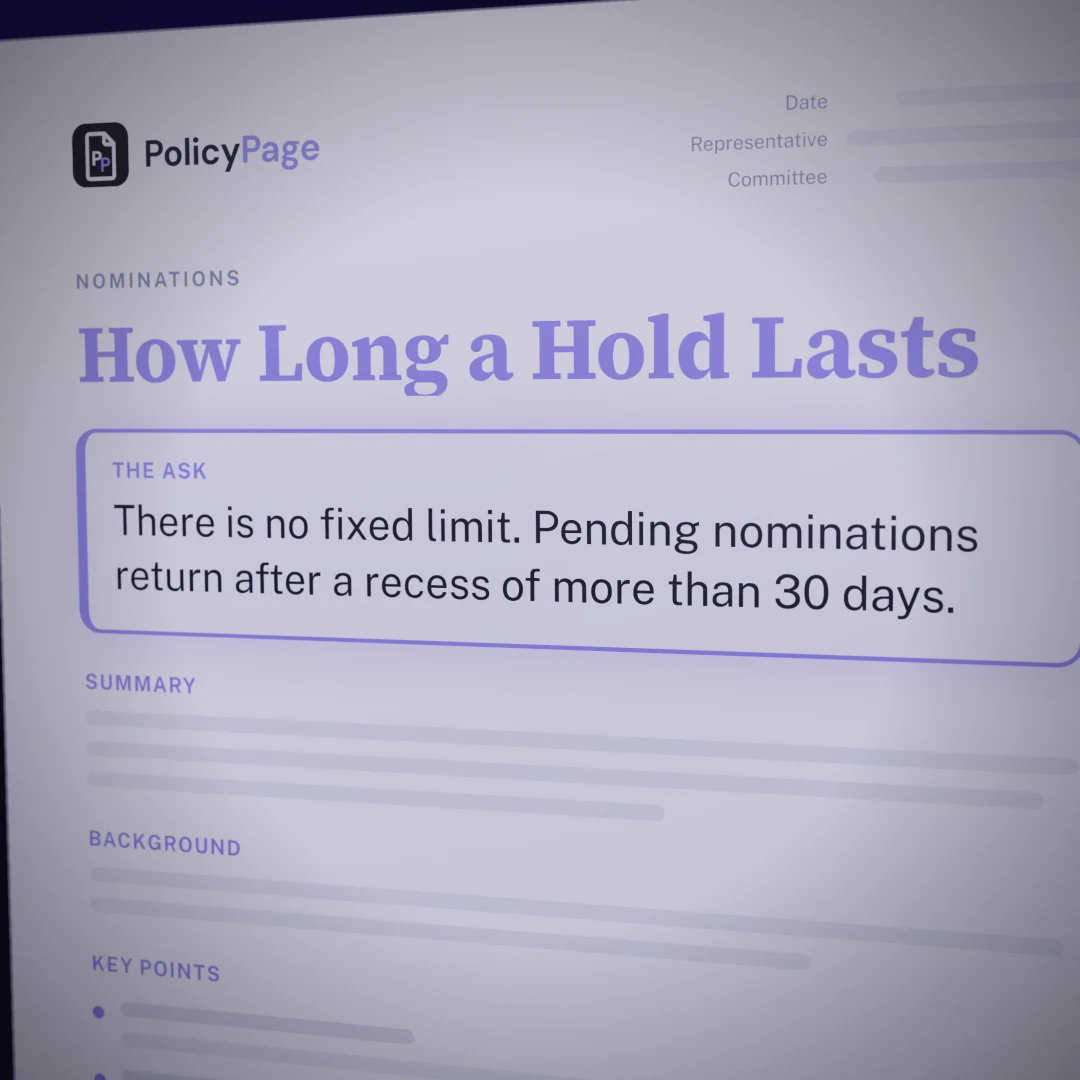
Senate Rule XXXI says that pending nominations are returned to the President when the Senate adjourns or recesses for more than 30 days. CRS explains that sine die adjournment, the end of a session, also triggers a return. The Senate can keep nominations alive through such a break only by unanimous consent. That gives each senator another point of leverage, because the objection of any senator can defeat the request. On December 30, 2013, one objection led to 281 nominations going back.
A returned nomination is not dead for good, but the President must send a new one, and it goes back to committee even if the person is the same.
One hold from recent years shows how long the pressure can run. In 2023, one senator placed a blanket hold on senior military promotions over a Defense Department policy on leave and travel reimbursement for reproductive care. It lasted almost 10 months. When it was lifted for most nominees on December 5, 2023, the Senate quickly confirmed more than 425 of them, USNI News reported. Roll Call reported that 11 four-star nominees remained subject to individual votes.
Can a hold be secret?
For a long time, yes, and the rules on this have changed more than once. CRS says the exact origin of holds is unknown, though written holds emerged in the late 1950s. By the late 1970s, CRS writes, holds had become a serious obstacle to moving measures to the floor. Reform proposals appeared in several decades.
A disclosure law came in 2007. Section 512 of the Honest Leadership and Open Government Act, Public Law 110-81, was signed on September 14 of that year. The Congressional Record from that month shows senators discussing how it would handle so-called secret holds. Under the law, a senator's notice of intent to object had to be submitted in writing and printed within six session days.
CRS listed gaps in the law:
- Disclosure was required only after a colleague objected on the senator's behalf, so a hold could stay secret for a long time before that.
- Rolling holds could reset the clock.
- There was no enforcement method to ensure compliance.
In 2011, the Senate tried again. S.Res. 28, adopted by a 92 to 4 vote on January 27, 2011, shortened the deadline to two session days. Published notices rose afterward, from 5 in the 110th Congress and 12 in the 111th to 24 in the 112th, 9 in the 113th, and 34 in the 114th, according to CRS. Those figures come from a report last updated in 2017, and they count only formal notices, not every hold.
How can a hold be overcome?
A hold can be beaten. It just costs time. CRS says the most practical course is often to set the item aside and negotiate. The senator may want an answer from an agency, a change to the bill, or a commitment on something else. A hold can end this way, with a deal the public may never see.
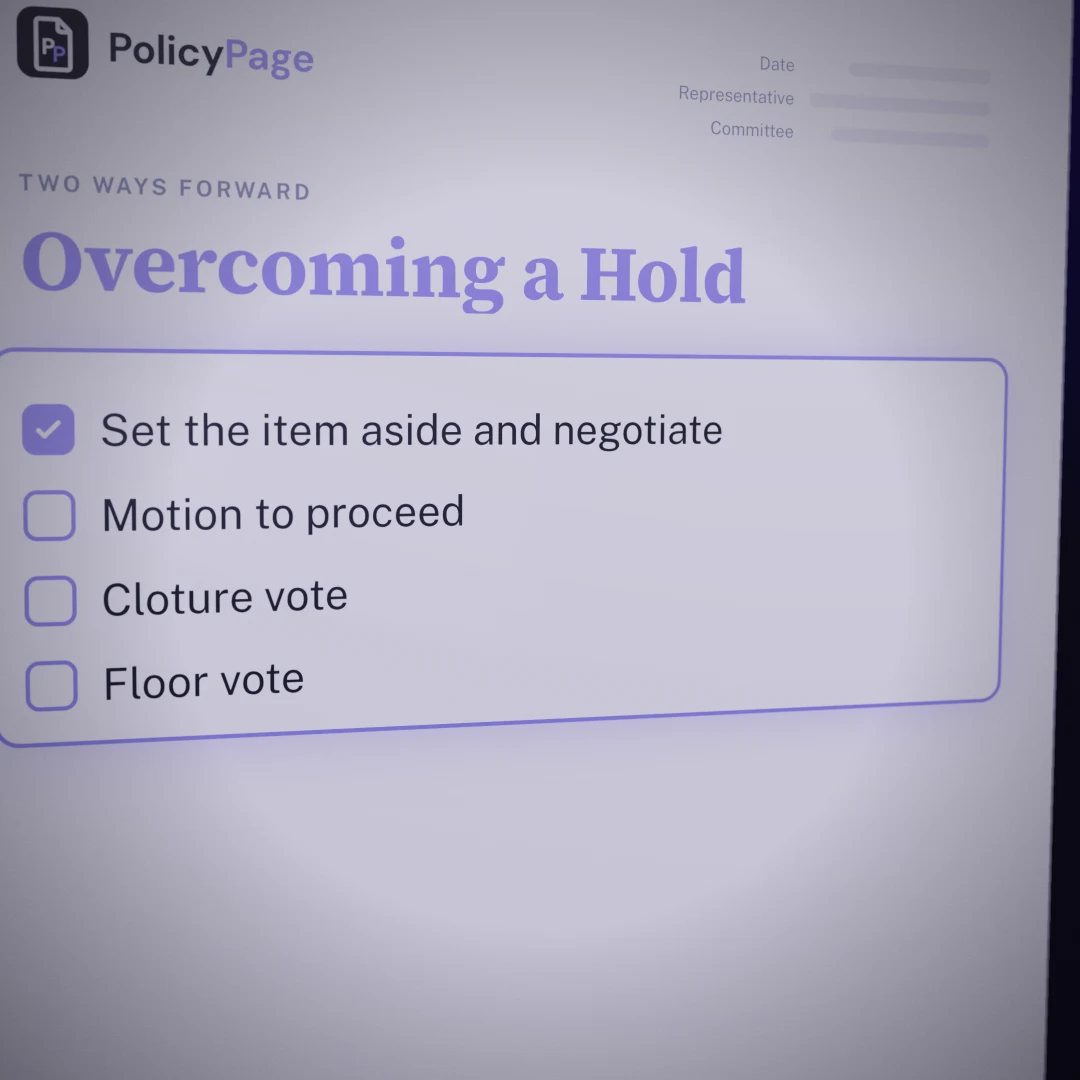
If talks fail, the majority leader can use the full procedures. On legislation, that means a motion to proceed and possibly a cloture vote, which usually takes 60 votes. Then the item needs its own floor vote. For the full process, see how cloture works in the Senate, step by step.
Nominations follow a different path. A 2023 CRS report lays out the steps:
- The Senate votes to proceed to executive session, by simple majority.
- The majority leader files cloture on the nomination.
- The Senate waits two session days, then holds a roll call on cloture, decided by a majority of senators voting.
- Up to two hours of debate follow for all but the highest-ranking posts.
- The Senate votes on confirmation by simple majority.
CRS notes that unanimous consent is not needed to approve a nomination, but it makes approval quick. So a hold on one nominee costs the Senate limited time. A hold on hundreds is different, because each can mean two roll calls and up to two hours of debate.
What changed for holds in 2025?
In September 2025, the Senate changed how it can handle groups of nominees. Before then, considering nominations as a group, called en bloc, required unanimous consent. One objection was enough to prevent it. Through a series of votes on procedure, the Senate set up a way to take up a package of eligible nominations using a simple majority at each stage. The first package held 48 nominations, and S.Res. 377 was adopted 51 to 44 on September 15, 2025.
Limits apply. CRS says the process does not cover most judicial nominations, the 21 top positions that include all 15 department secretaries, or military promotions on the Secretary's Desk. It can also take a lot of floor time, with four procedural votes potentially spread over upwards of 10 days.
Both sides made their case. Roll Call reported that supporters described the change as breaking a procedural logjam, while opponents warned it would turn the chamber into a conveyor belt for nominees. CBS News reported that opponents urged senators to think carefully, and that supporters pointed to a 2023 proposal for a similar idea from the other party.
For holds, the effect is narrow but real. CRS notes that negotiations on these nominees no longer need agreement from all 100 senators. A hold still counts for legislation and for positions outside the process, but it has less force over the eligible nominations covered by it.
Why does a Senate hold matter for advocates?
If your issue is stuck in the Senate, a hold can be the hidden reason. A bill can clear a markup, win majority support, and still sit for months. Our guide on how a bill becomes law covers the official path, and how a bill really dies covers the quieter ways a bill stalls.

A few practical questions help:
- Is a hold in place? Check the Congressional Record and the Senate calendar for formal notices. Remember that not every hold shows up there.
- What does the senator want? A hold on one bill may have nothing to do with that bill. The solution may sit in another committee or agency.
- Is the item important enough for floor time? If leaders would not spend days on it, a hold may be enough to stop it for good.
- Is the calendar a factor? CRS has warned of a possible surge of secret holds in the final days of a session, when time is shortest.
If you are preparing to meet a senator's office about a stalled item, it helps to walk in with the status on one sheet. PolicyPage writes a free, cited, one-page brief for the member you are meeting, so staff can see your ask at a glance.
Save this guide
Frequently asked questions
What is a hold in Congress?
It is a Senate practice in which a senator tells party leaders they plan to object to moving a bill or nomination by unanimous consent. It is informal and is not written into the Senate's rules.
What is the definition of a senatorial hold in government?
A senatorial hold is a senator's notice to leadership of an intent to object to a unanimous consent request on a measure or nomination. Its force comes from the threat of slowing the item on the floor.
What is the difference between a Senate hold and a filibuster?
A hold is a notice to leaders, usually off the floor, that a senator will object. A filibuster is action to prolong debate, and ending one on legislation generally takes 60 votes.
How long can a senator put a hold on a nomination?
There is no fixed limit. A hold lasts until it is lifted, leaders work around it, or the nomination is no longer pending. Under Senate Rule XXXI, pending nominations are returned when the Senate adjourns or recesses for more than 30 days unless senators unanimously agree otherwise.
Are Senate holds secret?
They can be. A 2007 law and a 2011 Senate resolution require written notice to be published, now within two session days, but CRS has noted gaps in how those rules apply.
How can a Senate hold be overcome?
Leaders can negotiate with the senator or use the full procedures, such as a motion to proceed and cloture. That takes floor time, which is why many holds are settled by talks.
Terms in this article
Sources
- 1."Holds" in the Senate (R43563), Congressional Research Service, via EveryCRSReport
- 2.Holds on Nominations (IN12200), Congressional Research Service, via EveryCRSReport
- 3.Senate Policy on "Holds": Action in the 110th Congress (RL34255), Congressional Research Service, via EveryCRSReport
- 4.Proposals to Reform "Holds" in the Senate (RL31685), Congressional Research Service, via EveryCRSReport
- 5.Consideration of Nominations En Bloc: Reinterpretation of Senate Rules (R48729), Congressional Research Service, via EveryCRSReport
- 6.Return of Nominations to the President Under Senate Rule XXXI (R46664), Congressional Research Service, via EveryCRSReport
- 7.About Filibusters and Cloture, U.S. Senate
- 8.Congressional Record, September 19, 2007, Senate pages S11744 to S11745, GovInfo
- 9.Senate Confirms Hundreds of Military Noms After Holds Released, USNI News
- 10.Holds lifted on almost all military promotions, Roll Call
- 11.Senate moves forward on rules change for certain nominees, Roll Call
- 12.Senate confirmations rule change, CBS News
New to some of the terms here? The advocacy glossary defines them in plain English.