
What Is Unanimous Consent? How It Works in the Senate and House
Unanimous consent lets Congress skip its normal rules as long as no member objects. Here is how it works in the Senate and House, and what one objection does.
11 minute read8 sources
In this article
- What is unanimous consent in Congress?
- How does unanimous consent work in the Senate?
- What is a unanimous consent agreement?
- How does unanimous consent work in the House?
- What happens when a member objects?
- Unanimous consent vs a voice vote, a majority vote, and cloture
- Why unanimous consent matters for your meeting
- The short version
- Save this guide

Unanimous consent is a way for the House or Senate to set aside its normal rules and act right away, as long as no member objects. If even one member says "I object," the request fails and the chamber has to use its regular, slower procedures instead.
That simple idea runs a surprising amount of Congress. The Senate's own glossary defines unanimous consent as an agreement on any question before the Senate "that sets aside a rule of procedure to expedite proceedings." Scheduling a vote, limiting debate, skipping a quorum call, and passing bills nobody opposes can all happen this way in a matter of seconds.
People search for this in many ways: "what is unanimous consent," "unanimous consent procedures," "what is unanimous consent in the Senate," "how does unanimous consent work in the House," and "unanimous consent vs voice vote." This guide answers each one in plain English, puts the Senate and the House side by side, and explains why a single objection carries so much weight.
What is unanimous consent in Congress?
Think of a group of friends planning dinner. Instead of holding a formal vote on every detail, someone says, "Pizza at seven, unless anyone minds." If nobody speaks up, the plan is set. If one person objects, the group has to talk it through. Unanimous consent works the same way, with one big difference: in Congress, the rules being skipped are formal rules, and the objection has real procedural force.
Unanimous consent is not the same as everyone voting yes. No vote is taken at all. A member asks for something, the presiding officer asks whether there is any objection, and if no one objects, the request takes effect. Members who dislike the request but choose not to object are simply letting it go forward.
Both chambers use it, but in different ways and to different degrees. The Senate leans on it for nearly everything, including how long it debates a bill. The House uses it mostly for routine and noncontroversial business, and its leaders keep tighter control over who can even ask. The sections below explain each chamber in turn.
How does unanimous consent work in the Senate?
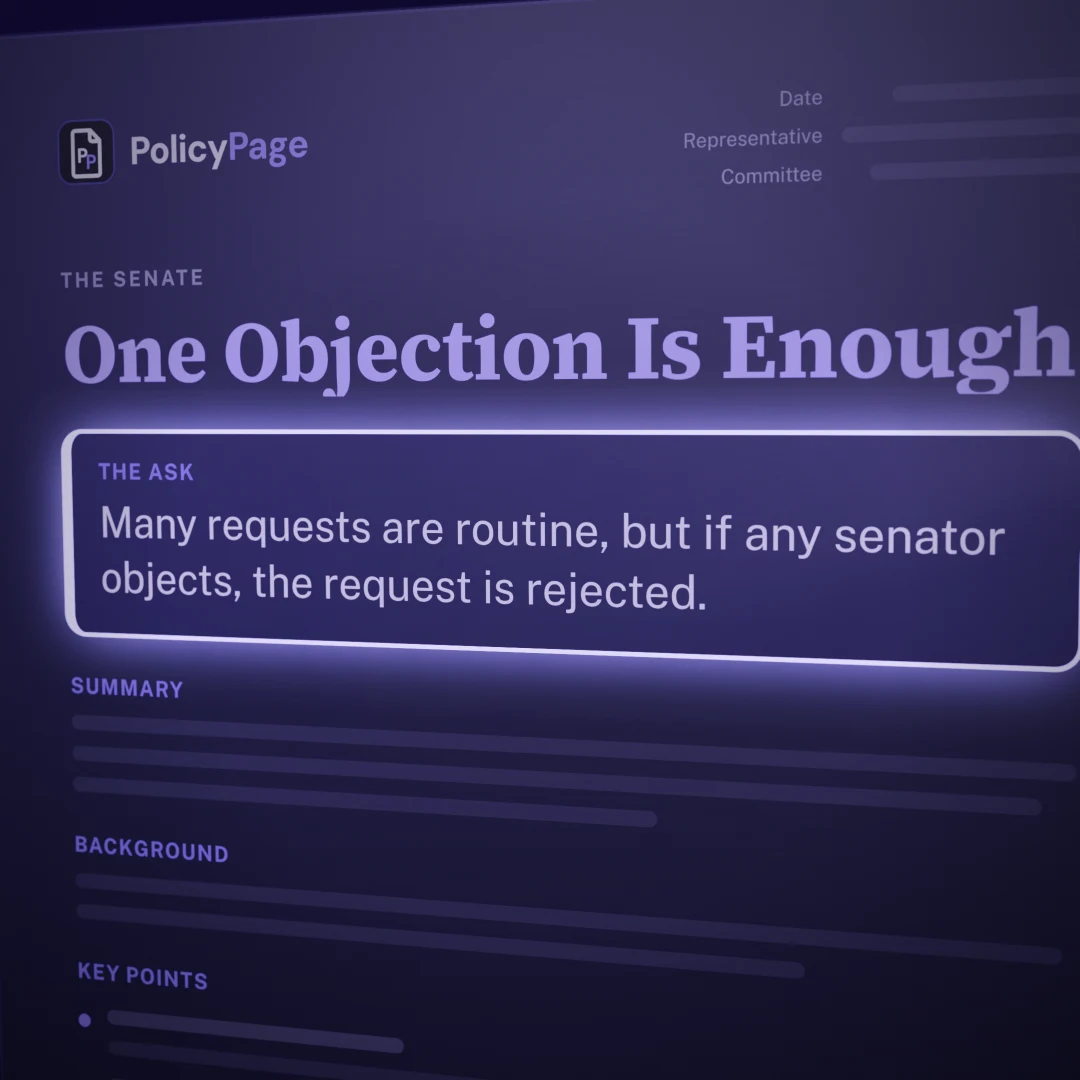
In the Senate, unanimous consent is part of daily life. The Senate glossary notes that many requests for unanimous consent are routine, "but if any senator objects, the request is rejected." That one sentence explains much of how the Senate works.
The Senate's rules allow long debate, and the chamber has no general limit on how long a senator may speak on most questions. If the Senate followed its written rules to the letter on every step, simple business could take days. Unanimous consent is the shortcut. A senator, usually the majority leader or a bill manager, asks for consent to do something, such as take up a bill, hold a vote at a set time, or dispense with a quorum call. If no senator objects, it is done.
Before a request reaches the floor, it is usually checked in advance. The Congressional Research Service (CRS), the nonpartisan research office that serves Congress, describes this in its report on "Holds" in the Senate. It explains that party leaders use a "hotline," a telephone and email system linking Senate offices to the party cloakrooms, to send out proposed unanimous consent requests. Offices that have a problem can say so before the request is ever made in public.
The habit is old. The Senate Historical Office notes in its account of the first unanimous consent agreement that senators have handled routine business by unanimous consent since 1789. It also describes the range of requests, from something as simple as dispensing with a quorum call to something as complicated as a binding agreement reached after long debate.
What is a unanimous consent agreement?
A unanimous consent agreement is a bigger, more detailed version of a simple request. Instead of asking for one small thing, the Senate agrees by consent to a full plan for how a bill will be handled. The Senate glossary says these agreements set terms for considering a specific bill or other measure, reflecting negotiations among the senators interested in it. Typical terms include limits on debate time and a list of the only amendments that may be offered.
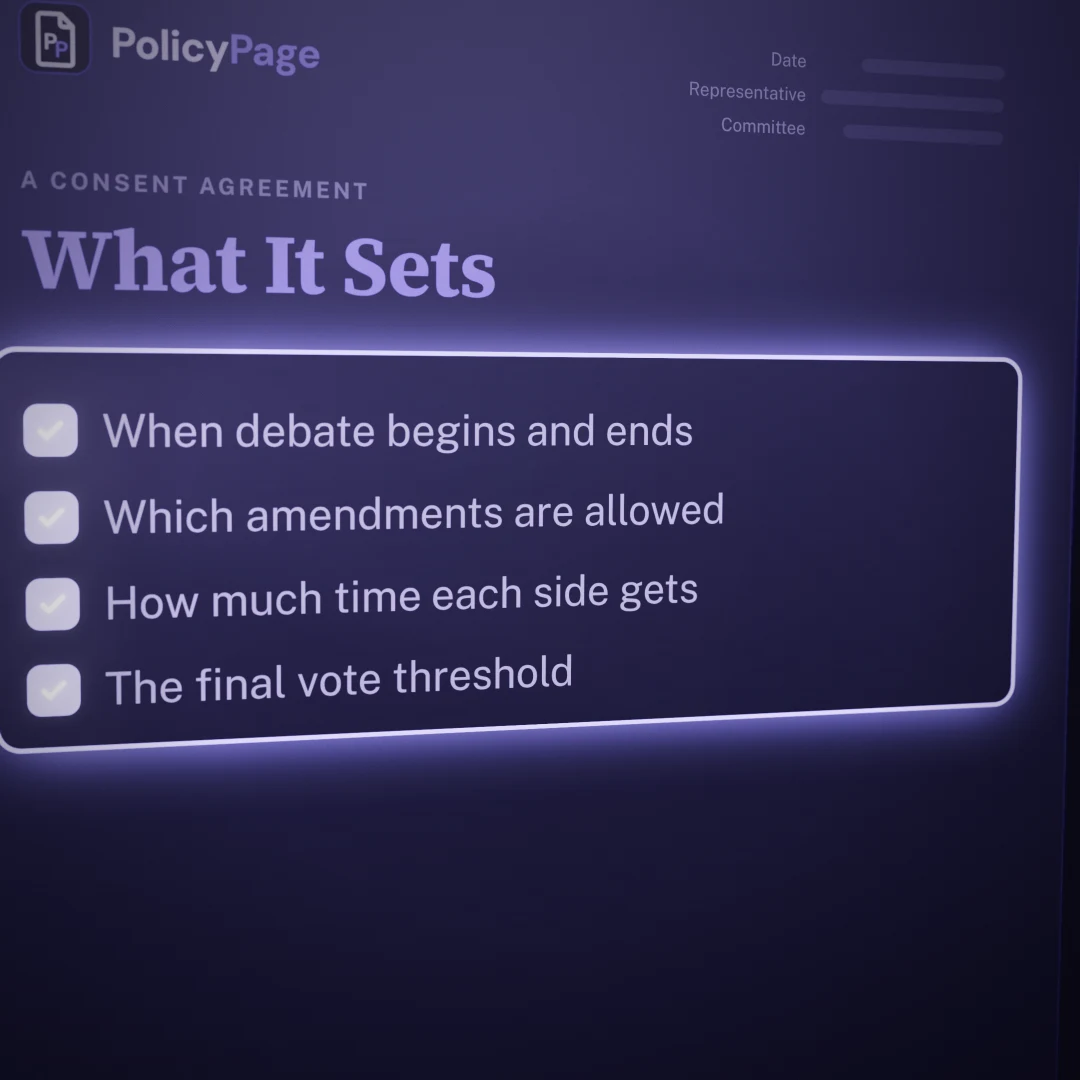
CRS explains the details in How Unanimous Consent Agreements Regulate Senate Floor Action. It says a consent agreement typically covers six things:
- How consideration of the measure begins.
- Which amendments may be offered.
- How much time is allowed for debate.
- Which motions are allowed.
- How consideration ends, including the final vote.
- What happens afterward, such as sending the bill to conference.
CRS adds that consent agreements that limit debate time are also called "time agreements." The time is usually divided equally and controlled by the majority and minority managers of the bill. While a time agreement is in effect, no vote can happen on the question until the time has been used or given back.
These agreements have also changed how the Senate handles its biggest votes. CRS notes that in recent years, agreements often require a measure or amendment to get 60 votes to pass, which can effectively replace the cloture process. In another report, Senate Unanimous Consent Agreements: Potential Effects on the Amendment Process, CRS points to examples from 2025, including an October 10, 2025 agreement on the annual defense authorization bill that set 60 vote thresholds for amendments.
Once the Senate agrees to one of these plans, it is binding. CRS says an agreement can be changed only by further unanimous consent. The Senate Historical Office explains how that came to be. The first formal agreement is believed to date to April 1846, when senators agreed on a day to vote on the Oregon Treaty after nearly four months of debate. For decades afterward, these deals were treated like a gentlemen's agreement. In January 1914, the Senate adopted a rule making them an order of the Senate that could be changed only by another unanimous consent agreement.
How does unanimous consent work in the House?
The House also uses unanimous consent, but on a shorter leash. The House's official guide to its procedures, House Practice, published by the Government Publishing Office, describes a request for unanimous consent as "in effect a motion to suspend the order of business temporarily." It adds that "an objection by any Member terminates the request."
The Congressional Institute's House Floor Procedures Manual says the House does much of its noncontroversial work this way. A member asks that something be done by unanimous consent, and if no one objects, the presiding officer usually answers, "Without objection, so ordered."
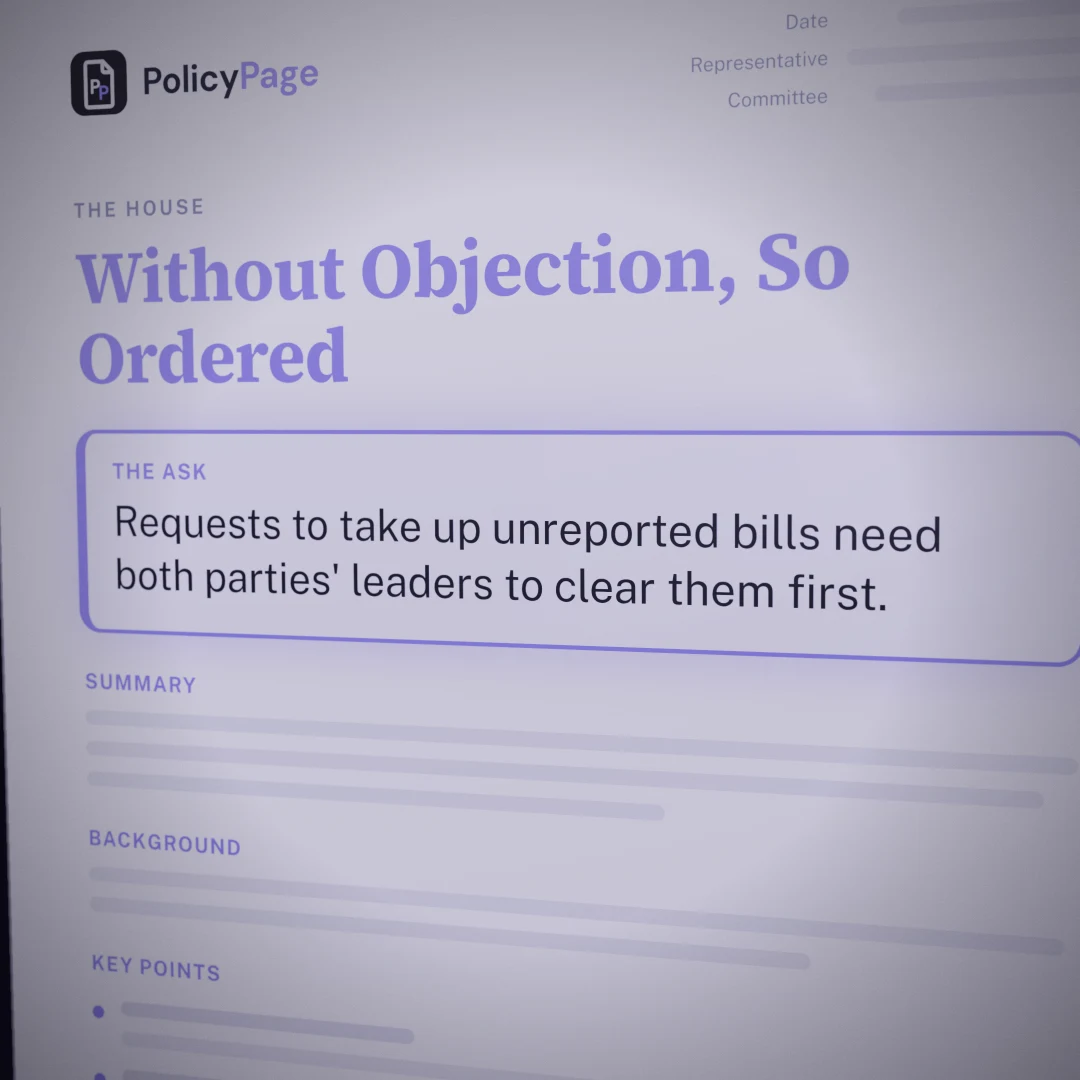
The big difference from the Senate is control. Under the Speaker's guidelines described in House Practice, the Speaker recognizes members to ask unanimous consent to take up an unreported bill only when assured that the majority and minority floor and committee leaders have no objection. House Practice says the Speaker's enforcement of this policy is not subject to appeal. The Congressional Institute manual describes the same rule of thumb: requests must be cleared with both parties' leaders and the relevant committee leaders before the chair will recognize a member to make one.
House Practice lists several other features worth knowing:
- Reserving the right to object. A member can "reserve the right to object" and, by doing so, get the floor to ask questions about the request before deciding.
- Regular order. Any member can demand "the regular order," which forces the request to be dealt with right away. The member reserving the right to object must then object or step back.
- Timing. It is ordinarily too late to object after the chair has asked for objections and announced that it hears none.
- No take backs. An objection ends the request, even if the member who objected later tries to withdraw the objection.
- Limits. House Practice says it cannot be assumed that the House can waive any rule by unanimous consent. Some requests, such as admitting unauthorized people to the floor, are barred by rule.
The House also uses consent for scheduling, such as setting up special orders or extending the time for debate on a motion to suspend the rules. Still, House Practice notes that the Speaker prefers to keep the scheduling of legislation in the hands of the majority leadership, so big bills usually reach the House floor through a special rule from the Rules Committee or through suspension of the rules. Our guide to suspension of the rules explains that fast track.
What happens when a member objects?
In both chambers, an objection kills the request on the spot. What happens next is where the Senate and the House differ most.

In the House, leaders have other tools. They can bring the measure up under a special rule passed by majority vote, or under suspension of the rules. An objection to a unanimous consent request is usually a delay, not the end of the road.
In the Senate, an objection can be far more costly. CRS explains in its report on holds that when a unanimous consent request is proposed on the floor, any senator may object, and if objection is heard, the request does not take effect. The majority leader can still make a motion to proceed to a bill, but CRS notes that this motion may itself need cloture to end debate. The Senate's historical overview of filibusters and cloture says cloture requires three fifths of all senators duly chosen and sworn, or 60 of the current 100. That process takes time and floor days.
This is where the Senate hold comes from. The Senate glossary describes a hold as an informal practice by which a senator tells party leaders that he or she does not wish a measure or nomination to reach the floor. CRS says the decision to honor a hold, and for how long, rests with the majority leader. Leaders usually honor holds because ignoring one could lead to an objection and a long procedural fight. In other words, a hold is a signal that a senator is ready to object to unanimous consent.
The Senate has tried to make holds more public. CRS says a 2007 law gave senators six session days to publish a notice of intent to object in the Congressional Record in certain cases. In January 2011, the Senate adopted S.Res. 28 by a vote of 92 to 4, which shortened that window to two session days. CRS counts 34 such published notices in the 114th Congress, up from 5 in the 110th. Our guide to what a Senate hold is covers this in more depth.
Unanimous consent vs a voice vote, a majority vote, and cloture
People often mix these up, because all of them can end with a bill moving forward. Here is how they compare:
| Method | Is a vote taken? | What it takes | What stops it |
|---|---|---|---|
| Unanimous consent | No | No member objects | One objection |
| Voice vote | Yes, out loud | More members say aye than no, as judged by the chair | Losing the vote, or a demand for a recorded vote |
| Majority vote | Yes | More yes votes than no votes | Losing the vote |
| Cloture (Senate) | Yes | Three fifths of senators, usually 60 | Fewer than 60 votes |
The key point is that unanimous consent is not a vote at all. A voice vote still asks members to say aye or no, and it can be turned into a recorded roll call. Our guide to floor votes explains how voice votes and roll calls work in each chamber. Unanimous consent skips the vote entirely, which is why it is so fast and why it is so easy to stop.
It also helps to separate unanimous consent from a unanimous vote. A unanimous vote means every member who voted said yes. Unanimous consent means no member objected. A bill can pass by unanimous consent even though some members dislike it, as long as none of them chooses to object.
Why unanimous consent matters for your meeting
If you are meeting with a Senate office about a bill, unanimous consent is often the quiet path to passage. Many noncontroversial bills and resolutions clear the Senate this way without a recorded vote. That means a single office can matter a great deal. One objection, or one hold, can stop a bill that would otherwise pass in seconds.
That changes what you might ask for. If your bill is likely to move by consent, the useful ask may be for the senator not to object, or for the office to help clear the bill through the hotline process. If a hold is blocking it, staff will want to know who is affected and what the concerns are. In the House, the ask is more often about getting the bill into the leadership's plans, since consent requests need leadership clearance there.
When you are getting ready for that meeting, one clear page beats a stack of handouts. PolicyPage writes a free, cited, one-page brief for the member you are meeting, so staff can see where your bill stands and what you are asking them to do.
The short version
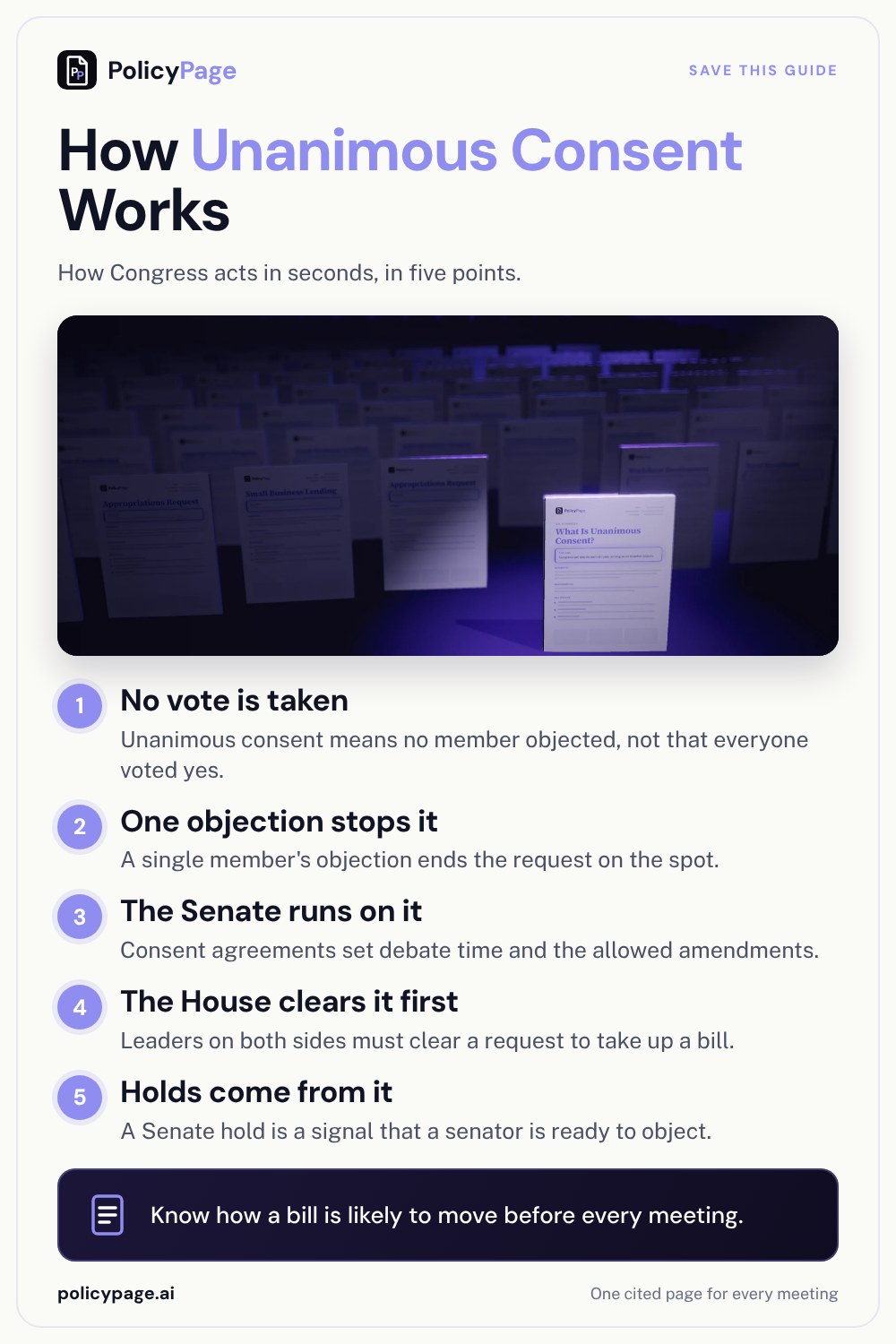
Unanimous consent lets the House or Senate skip its normal rules as long as no member objects. In the Senate, it runs much of the daily schedule, and detailed unanimous consent agreements set debate time, list the allowed amendments, and often set 60 vote thresholds. Once agreed to, those agreements can be changed only by further consent. In the House, any member's objection ends a request, and the Speaker only recognizes requests to take up unreported bills when leaders on both sides have cleared them. A single objection is the reason Senate holds carry so much power.
Save this guide
Frequently asked questions
What is unanimous consent?
Unanimous consent is a way for the House or Senate to skip its normal rules and act right away, as long as no member objects. If one member objects, the request fails.
What is unanimous consent in the Senate?
In the Senate, unanimous consent is an agreement that sets aside a rule of procedure to speed things up. Many requests are routine, but if any senator objects, the request is rejected.
What is a unanimous consent agreement?
It is a detailed plan for handling a bill, agreed to by unanimous consent. It typically sets how debate begins and ends, which amendments are allowed, and how much time each side gets.
How does unanimous consent work in the House?
A member asks to do something by unanimous consent, and if no one objects, the chair says without objection, so ordered. Under the Speaker's guidelines, requests to take up unreported bills must first be cleared by both parties' floor and committee leaders.
Is unanimous consent the same as a unanimous vote?
No. A unanimous vote means every member who voted said yes. Unanimous consent means no vote was taken and no member objected.
What happens if a senator objects to unanimous consent?
The request does not take effect. The majority leader can still move to proceed to the bill, but that motion may need cloture, which usually takes 60 votes.
How is unanimous consent related to a Senate hold?
A hold is an informal signal to party leaders that a senator does not want a measure or nomination to reach the floor. Leaders usually honor it because the senator could object to unanimous consent.
Terms in this article
Sources
- 1.Glossary, U.S. Senate
- 2.The First Unanimous Consent Agreement, U.S. Senate Historical Office
- 3.About Filibusters and Cloture: Historical Overview, U.S. Senate
- 4.How Unanimous Consent Agreements Regulate Senate Floor Action (RS20594), March 2, 2022, Congressional Research Service
- 5.Senate Unanimous Consent Agreements: Potential Effects on the Amendment Process (98-310), November 25, 2025, Congressional Research Service
- 6."Holds" in the Senate (R43563), January 24, 2017, Congressional Research Service
- 7.House Practice, Chapter 54: Unanimous-Consent Agreements, U.S. Government Publishing Office
- 8.House Floor Procedures Manual, VII. Unanimous Consent Requests, Congressional Institute
New to some of the terms here? The advocacy glossary defines them in plain English.