
What Is a Veto Override? How Congress and States Override a Veto
A veto override is a two-thirds vote in each chamber that makes a vetoed bill law anyway. Here is how it works in Congress and Florida, and how rare it is.
11 minute read12 sources
In this article

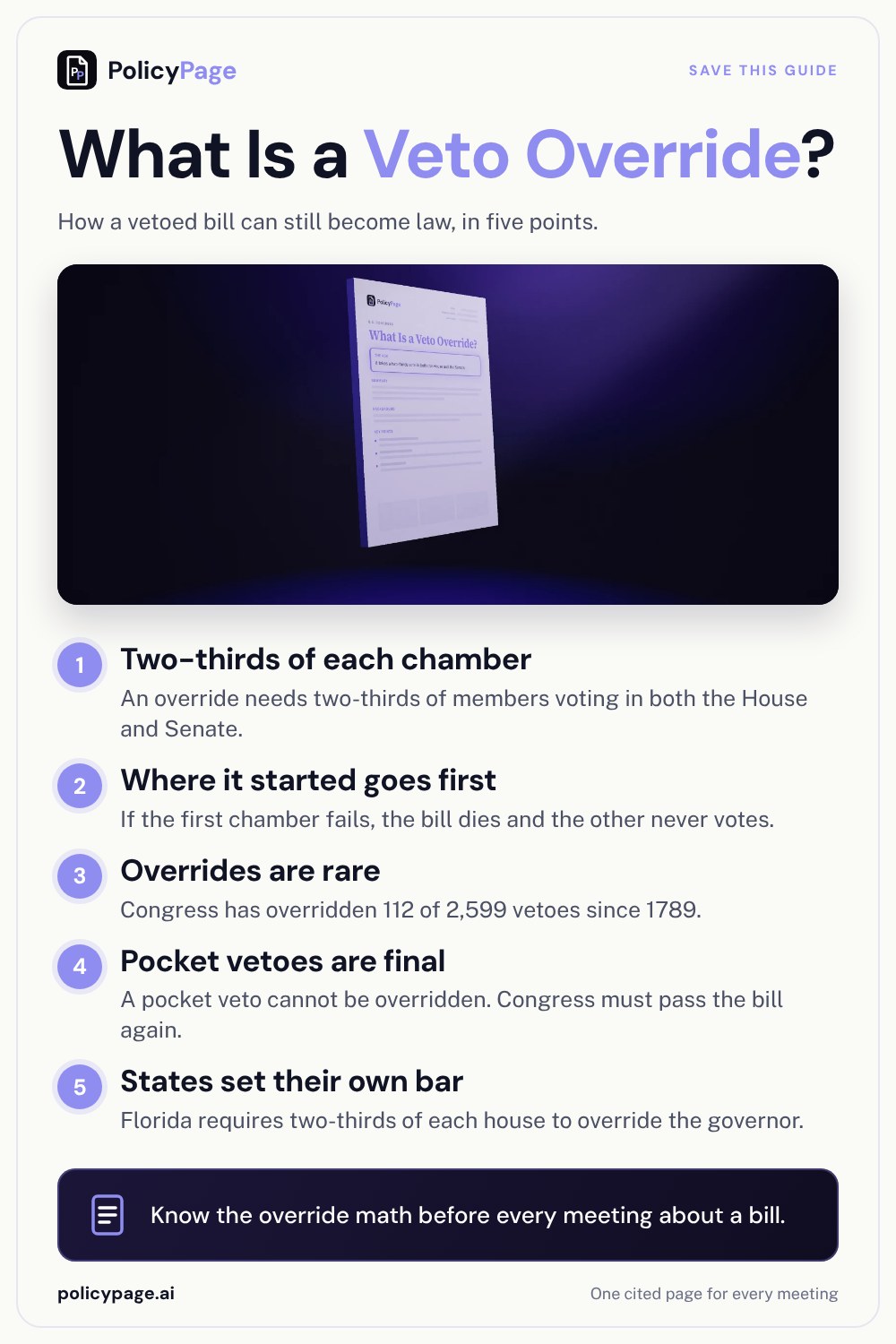
A veto override is a vote by a legislature to make a bill law even though the President or a governor vetoed it. In Congress, it takes a two-thirds vote in both the House and the Senate. If both chambers reach that bar, the bill becomes law without the President's signature. If either chamber falls short, the veto stands and the bill dies. Overrides are rare: Congress has overridden 112 of the 2,599 vetoes issued since 1789.
People search for this term in many ways: "veto override definition," "override a veto meaning," "how many votes to override a veto," and "what is a veto and how can Congress override it." This guide answers all of them in plain English. It covers what the Constitution says, how an override vote works step by step, how many votes it takes, how often it happens, why a pocket veto cannot be overridden, and how state legislatures like Florida's handle it.
What is a veto override?
To understand an override, start with the veto. After both chambers of Congress pass the same bill, it goes to the President. The House explains that the President may sign the measure into law, veto it and return it to Congress, let it become law without a signature, or, at the end of a session, pocket veto it.
A veto is the President's "no." But it is not always the final word. The Constitution gives Congress a way to answer back. Article I, Section 7 says that when the President rejects a bill, the President must return it, with his Objections to that House in which it shall have originated. That chamber then reconsiders the bill. If two-thirds of that chamber agree to pass it again, it goes to the other chamber, and if two-thirds there agree too, it becomes law.
That second vote is the veto override. Think of it like a referee's call that can be overturned on review, but only if a large majority of the review panel agrees. A simple majority passed the bill the first time. A supermajority is needed to pass it over the President's objection.
The override is one of the clearest examples of checks and balances. The President can block a bill that both chambers passed, and Congress can block that block, but only with broad agreement. That is why the phrase "veto-proof majority" comes up so often. It describes a group of lawmakers large enough to override a veto on its own.
How does a veto override work in Congress?
The Constitution sets the outline, and each chamber's rules fill in the details. The Congressional Research Service (CRS), the nonpartisan research office that serves members of Congress, describes the process in its report on veto override procedure in the House and Senate. Here is how it works, one step at a time.
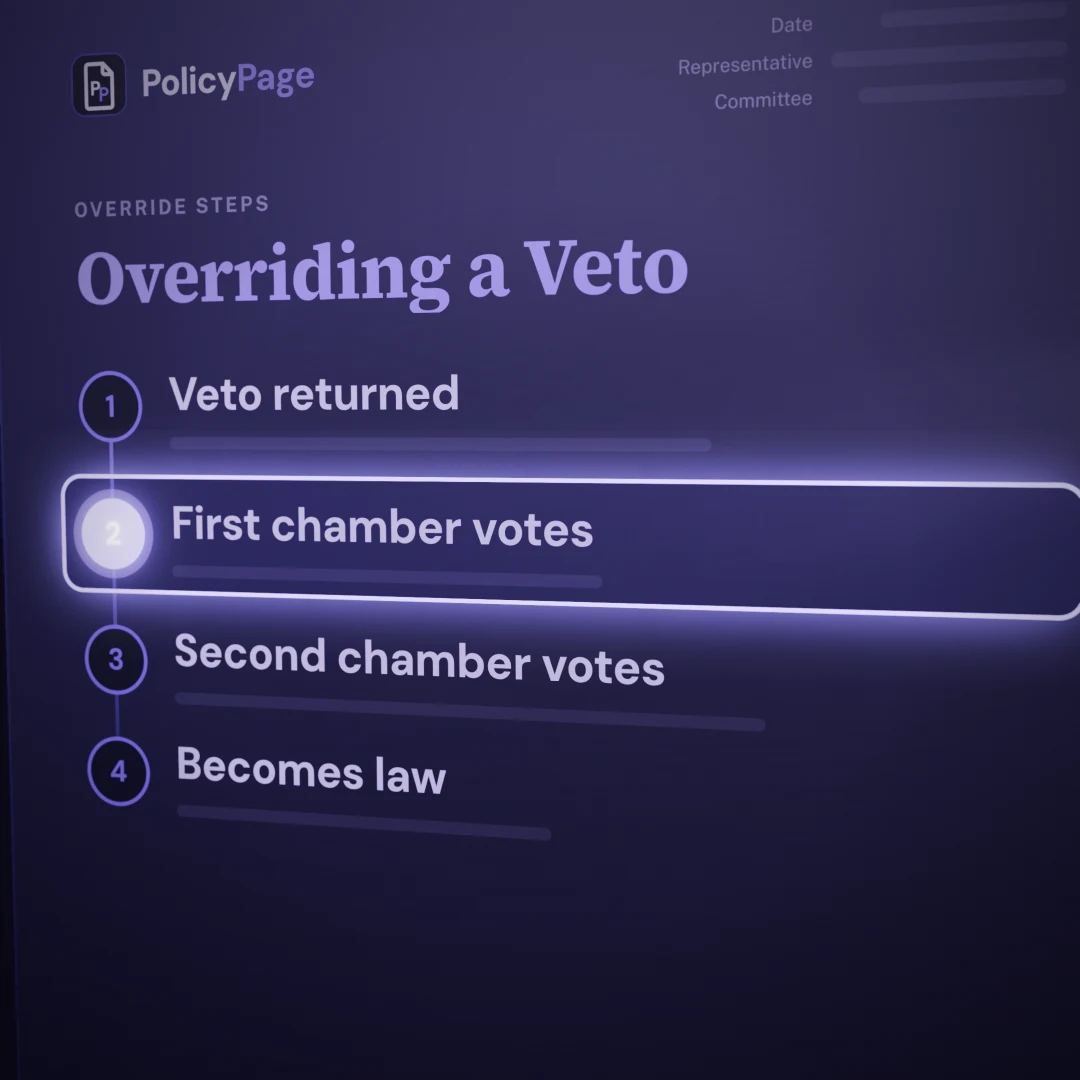
- The President returns the bill. A vetoed bill goes back with a veto message to the chamber where it started. CRS explains that the House acts first on vetoed bills labeled "H.R." or "H.J. Res.," and the Senate acts first on bills labeled "S." or "S.J. Res."
- The first chamber votes. In the House, considering a vetoed bill is a matter of high privilege, and CRS says the House generally votes shortly after the message arrives. The House can also vote to postpone the question to a named day or send the bill to committee. Nothing in the Constitution forces a direct vote.
- The second chamber votes, if the first succeeded. If the first chamber repasses the bill, the bill and the veto message go to the other chamber. If the first chamber fails, CRS explains, the measure dies, and the other chamber never gets a vote on it.
- The bill becomes law. If both chambers reach two-thirds, the bill becomes law, the veto notwithstanding. No signature from the President is needed.
Every override vote is on the record. The Constitution requires that the votes of both chambers shall be determined by yeas and Nays, and the names of members voting for and against must be entered in each chamber's journal. In the Senate, CRS notes, the vote must be taken by roll call. In the House, votes are recorded electronically.
The vetoed bill is the same enrolled bill that both chambers already passed. Congress cannot change the text during an override vote. It is a yes or no question on the bill exactly as the President received it. To learn how a bill reaches that final enrolled form, see our guide to engrossed vs. enrolled bills.
Can the Senate filibuster a veto override?
Yes, in principle. CRS explains that the question of overriding a veto is debatable under the regular rules of the Senate. That means a senator could keep debate going, just as with a filibuster on a bill. Debate can be limited by unanimous consent or ended through cloture, which CRS says requires three-fifths of senators duly chosen and sworn, or 60 senators when there is no more than one vacancy. But CRS adds that cloture is rarely used to end debate on overriding a presidential veto. In practice, the Senate usually agrees by consent on when the vote will happen.
How many votes does it take to override a veto?
It takes two-thirds of the members voting in each chamber, with a quorum present. CRS puts it this way: a vetoed bill can become law if two-thirds of the members voting in each chamber agree, by recorded vote, a quorum being present, to repass the bill.
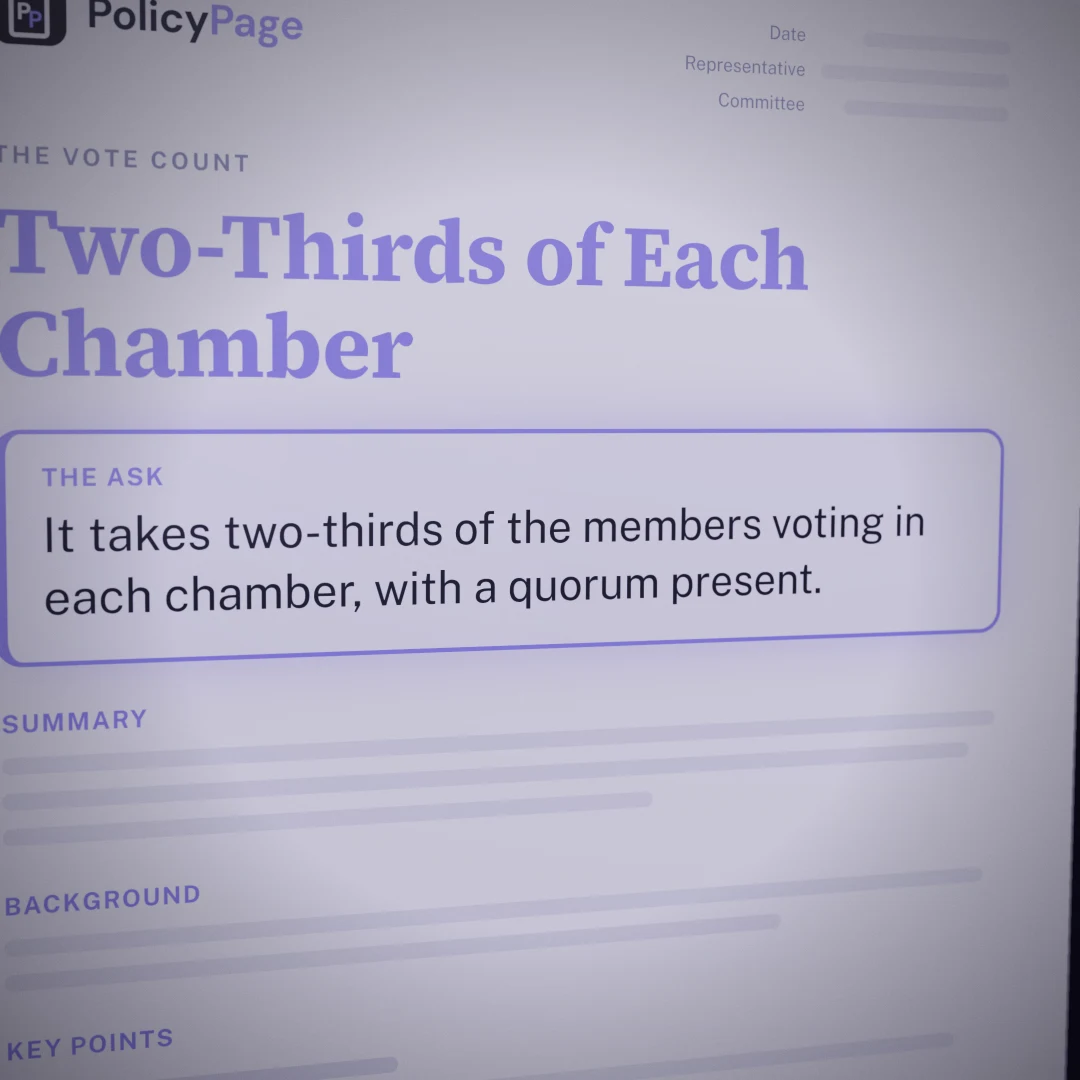
The key words are "members voting." The bar is two-thirds of those who actually vote, not two-thirds of every seat. Here is what that means in practice, if every member is present and votes:
- House: 290 of 435 members.
- Senate: 67 of 100 senators.
If some members are absent or do not vote, the number goes down with them. For example, if only 99 senators vote, two-thirds is 66. That is why the attendance of a few members can decide whether an override succeeds.
Two-thirds is a much higher bar than the one most bills face. A regular bill needs a simple majority, which in the House is 218 of 435 members when every seat is filled. Two-thirds usually means support from both parties. When one party holds two-thirds of a chamber on its own, it is said to have a veto-proof majority.
If this two-thirds math sounds familiar, it is the same threshold the House uses for its fast track. Our guide to suspension of the rules explains how that works.
How many times has Congress overridden a veto?
Not many. According to the Senate's official count of vetoes from 1789 to the present, presidents have issued 2,599 vetoes. Of those, 1,533 were regular vetoes and 1,066 were pocket vetoes. Congress has overridden 112. That is about 4 percent of all vetoes, and a bit more than 7 percent of regular vetoes, since pocket vetoes cannot be overridden at all.

The same Senate table shows how this plays out across recent presidencies:
- Barack Obama (2009 to 2017): 12 vetoes, 1 overridden.
- Donald J. Trump (2017 to 2021): 10 vetoes, 1 overridden.
- Joseph R. Biden Jr. (2021 to 2025): 13 vetoes, none overridden.
- Donald J. Trump (2025 to present): 2 vetoes so far in the table, none overridden.
Some earlier presidents saw far more. The Senate table lists Andrew Johnson, who served from 1865 to 1869, with 15 vetoes overridden, the most of any President. Gerald R. Ford and Harry S. Truman each had 12, and Ronald Reagan and Franklin D. Roosevelt each had 9.
Why are overrides so rare? Partly because the bar is high. But it is also because the threat of a veto shapes bills long before they reach the President's desk. When a President signals opposition, lawmakers often change the bill, drop it, or wait. A veto that seems likely to be overridden is a veto many presidents choose not to issue. For more on how bills move and stall, see our guide to how a bill becomes law.
Can a pocket veto be overridden?
No. A pocket veto happens when the President does not sign a bill and Congress has adjourned, so the bill cannot be returned. The Constitution says that if the President does not return a bill within ten days, Sundays excepted, it becomes law as if signed, unless the Congress by their Adjournment prevent its Return, in which case it shall not be a law.
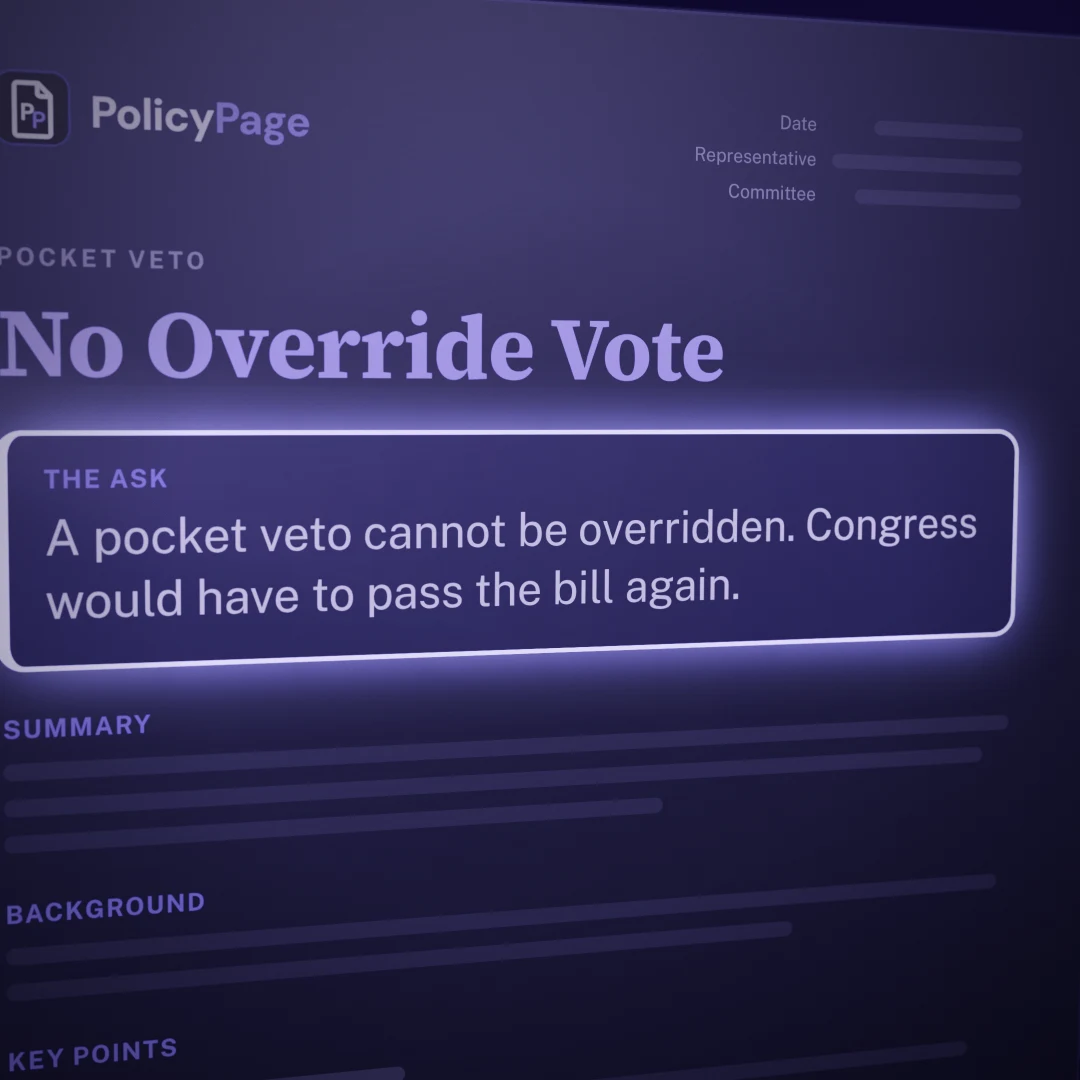
Because the bill is never returned with objections, there is nothing for Congress to vote on. There is no override vote for a pocket veto. Congress would have to pass the bill again from the start in a new session. The House describes the pocket veto as something that happens at the end of a session.
Here is a quick way to tell the two apart:
- Regular veto: the President sends the bill back with a message. Congress can override it with two-thirds of each chamber.
- Pocket veto: the President holds the bill while Congress is adjourned. Congress cannot override it.
Of the 2,599 vetoes in the Senate table, 1,066 were pocket vetoes, so this is not a small footnote in history. In recent decades it has faded, though: the Senate table lists no pocket vetoes for the last four presidencies.
How do veto overrides work in state legislatures?
Every state governor has a veto, and every state legislature can override one, but the rules differ. The National Conference of State Legislatures (NCSL) explains that the number of votes it takes to override a veto varies from a simple majority in each chamber to two-thirds of elected members in each chamber. In a state with a simple majority rule, an override is much easier than in Congress. In a state that counts two-thirds of all elected members, absences make it harder, not easier.

Some governors, including Florida's, also have a power the President does not: the line-item veto. It lets a governor strike individual spending lines from a budget while signing the rest. That means a state override fight can be about one budget item, not a whole bill.
How does a veto override work in Florida?
Florida's rules are in Article III, Section 8 of the Florida Constitution. While the Legislature is in session, the governor has seven consecutive days after a bill is presented to act on it. If the Legislature adjourns sine die, its final adjournment for the session, or takes a recess of more than 30 days, the governor gets fifteen consecutive days. The governor may also veto any specific appropriation in a general appropriations bill. For every other kind of bill, the veto covers the entire bill.
To override, each chamber must re-enact the bill or reinstate the vetoed item by a two-thirds vote. The Florida Senate's frequently asked questions page puts it simply: if two-thirds of the members of each house vote to override the governor's veto, the act becomes a law.
In Florida, overrides have been rare in recent years. In January 2025, the Legislature voted to override Governor Ron DeSantis's veto of $57 million for its own legislative support services. WUSF reported that House members voted unanimously and the Senate voted 35 to 1. Florida Politics reported the House vote as 111 to 0 and called it the first time the Legislature had overridden the governor in his two terms. In March 2025, the News Service of Florida reported, via WMNF, that the House voted unanimously to override four more vetoes totaling $4.74 million. That article noted the Senate had not said whether it would take them up, and the Senate's leader had said in February that it was not planning overrides in the near term.
The Florida example shows a basic rule that applies everywhere: an override needs both chambers. One chamber voting to override is a statement, but it does not change the law until the other chamber agrees.
Why veto overrides matter before a meeting
If you are meeting a legislative office about a bill, the possibility of a veto should be part of your plan. A bill can pass both chambers and still never become law. Knowing the override math helps you understand where your bill really stands and what to ask for.
A few practical points help:
- Count the margin. If the bill passed each chamber with two-thirds support, an override may be realistic. If it passed narrowly, it probably is not.
- Watch for veto signals. A statement from the executive branch opposing a bill is a sign that changes may be needed before final passage.
- Know the calendar. A bill sent to the President right before Congress adjourns can be pocket vetoed, which cannot be overridden. In Florida, the governor's time limit depends on whether the Legislature is still in session.
- Ask about the override vote itself. If a veto has happened, the question for each member is simple: will they vote to override or to sustain? That is a clear, specific ask for a meeting.
When you are getting ready to meet a member's office, one clear page beats a stack of handouts. PolicyPage writes a free, cited, one-page brief for the member you are meeting, so staff can see where your bill stands and what you are asking them to do.
Save this guide
Frequently asked questions
What is a veto override?
A veto override is a vote by a legislature to make a bill law even though the President or a governor vetoed it. In Congress, it takes a two-thirds vote in both the House and the Senate.
How many votes does it take to override a presidential veto?
Two-thirds of the members voting in each chamber, with a quorum present. If every member votes, that is 290 in the House and 67 in the Senate.
How many times has Congress overridden a veto?
Congress has overridden 112 of the 2,599 presidential vetoes issued since 1789, according to the U.S. Senate.
What happens if the first chamber fails to override a veto?
The bill dies. The Congressional Research Service explains that the other chamber does not get a vote on overriding it.
Can Congress override a pocket veto?
No. A pocket veto happens when Congress has adjourned and the bill cannot be returned, so there is no override vote. Congress would have to pass the bill again.
Does it take the same vote to override a governor's veto?
It depends on the state. NCSL says the vote needed ranges from a simple majority in each chamber to two-thirds of elected members.
How does a veto override work in Florida?
Each chamber of the Florida Legislature must vote by two-thirds to re-enact the bill or reinstate a vetoed budget item. Then it becomes law despite the governor's veto.
Terms in this article
Sources
- 1.The Constitution of the United States: A Transcription, National Archives
- 2.Vetoes, 1789 to Present, U.S. Senate
- 3.Veto Override Procedure in the House and Senate (RS22654), updated February 25, 2015, Congressional Research Service
- 4.To the President, U.S. House of Representatives
- 5.The Legislative Process, U.S. House of Representatives
- 6.At Least Half of Legislatures Set to Have Veto-Proof Majorities, National Conference of State Legislatures
- 7.The Florida Constitution, Article III, Section 8: Executive approval and veto, The Florida Senate
- 8.Frequently Asked Questions, The Florida Senate
- 9.Florida Legislature rebukes DeSantis, calls its own special session on immigration (January 27, 2025), WUSF
- 10.Legislature restores $56M in support services vetoed by Gov. DeSantis, Florida Politics
- 11.DeSantis targets veto overrides by the Florida Legislature (March 27, 2025), News Service of Florida, via WMNF
- 12.Senate doesn't plan overrides (February 11, 2025), News Service of Florida, via The Capitolist
New to some of the terms here? The advocacy glossary defines them in plain English.