
What Is the Federal Register? How It Works and How to Use It
The Federal Register is the U.S. government's official daily journal of rules, proposed rules, notices, and presidential documents. Here is how it works.
12 minute read12 sources
In this article
- What is the Federal Register?
- What is in the Federal Register?
- How does the Federal Register work?
- Federal Register vs. Code of Federal Regulations (CFR)
- How to comment on a proposed rule in the Federal Register
- How to search the Federal Register
- Why the Federal Register matters before a meeting
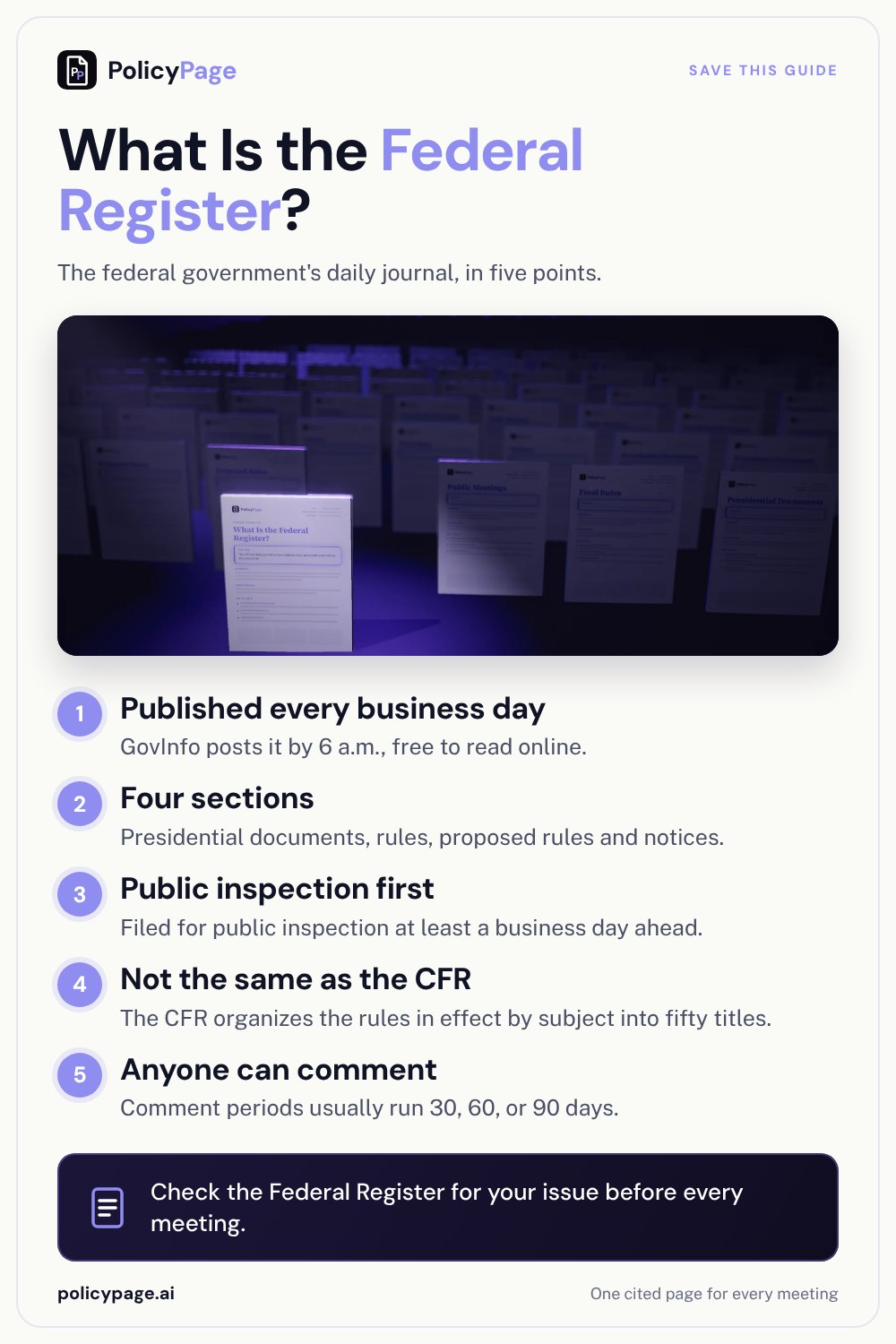
- Save this guide

The Federal Register is the official daily journal of the United States government. It is where federal agencies publish new rules, proposed rules, and public notices, and where executive orders, proclamations, and other presidential documents are printed. The National Archives' Office of the Federal Register publishes it every business day, and anyone can read it for free online. If a federal agency wants to change a regulation, the Federal Register is usually where the public sees it first.
People search for this in many ways: "federal register," "what is the federal register used for," "federal register definition government," "federal register vs code of federal regulations," and even "federal registration" when they mean the same thing. This guide answers all of them in plain English. It covers what the Federal Register is, what is inside it, how a document gets published, how it differs from the Code of Federal Regulations, how to comment on a proposed rule, and how to use it to prepare for a meeting with a government office.
What is the Federal Register?
The National Archives describes the Federal Register as the daily journal of the Federal government. It is published every business day by the Office of the Federal Register (OFR), part of the National Archives and Records Administration (NARA), in partnership with the Government Publishing Office (GPO). GovInfo, the GPO's official site, says it is updated daily by 6 a.m. and published Monday through Friday, except federal holidays.
A simple way to think about it: Congress writes laws, and federal agencies write the detailed rules that carry those laws out. The Federal Register is the public bulletin board where those rules are posted. Before a rule takes effect, and usually before it is even final, it shows up here.
The Federal Register is not new. It was created by the Federal Register Act, which the U.S. Code's historical notes date to July 26, 1935. The Office of the Federal Register's own statistics page notes that the first Federal Register was issued on March 14, 1936. That first year filled 2,620 pages.
The Federal Register also carries legal weight. Under federal law, the contents of the Federal Register shall be judicially noticed, which means courts accept what it says without needing separate proof. Publication also gives the public legal notice of a document. In plain terms, once something is in the Federal Register, the government treats everyone as having been told about it.
What is the Federal Register used for?
The National Archives says the Federal Register informs citizens of their rights and obligations and gives access to a wide range of federal benefits and funding opportunities. It lists who uses it: anyone who needs to know about the day-to-day operations of the federal government, anyone whose business is regulated by a federal agency, attorneys who practice before agencies, people who attend public hearings or apply for grants, and anyone concerned with government actions on issues like the environment, health care, financial services, exports, or education.
The law spells out what must be published. Section 1505 of Title 44 of the U.S. Code requires presidential proclamations and executive orders (except those that only apply to federal agencies or employees) and documents that have general applicability and legal effect, along with anything else Congress requires to be published. The same section says news commentary may not be published. The Federal Register is a record of official actions, not a newspaper.
What is in the Federal Register?
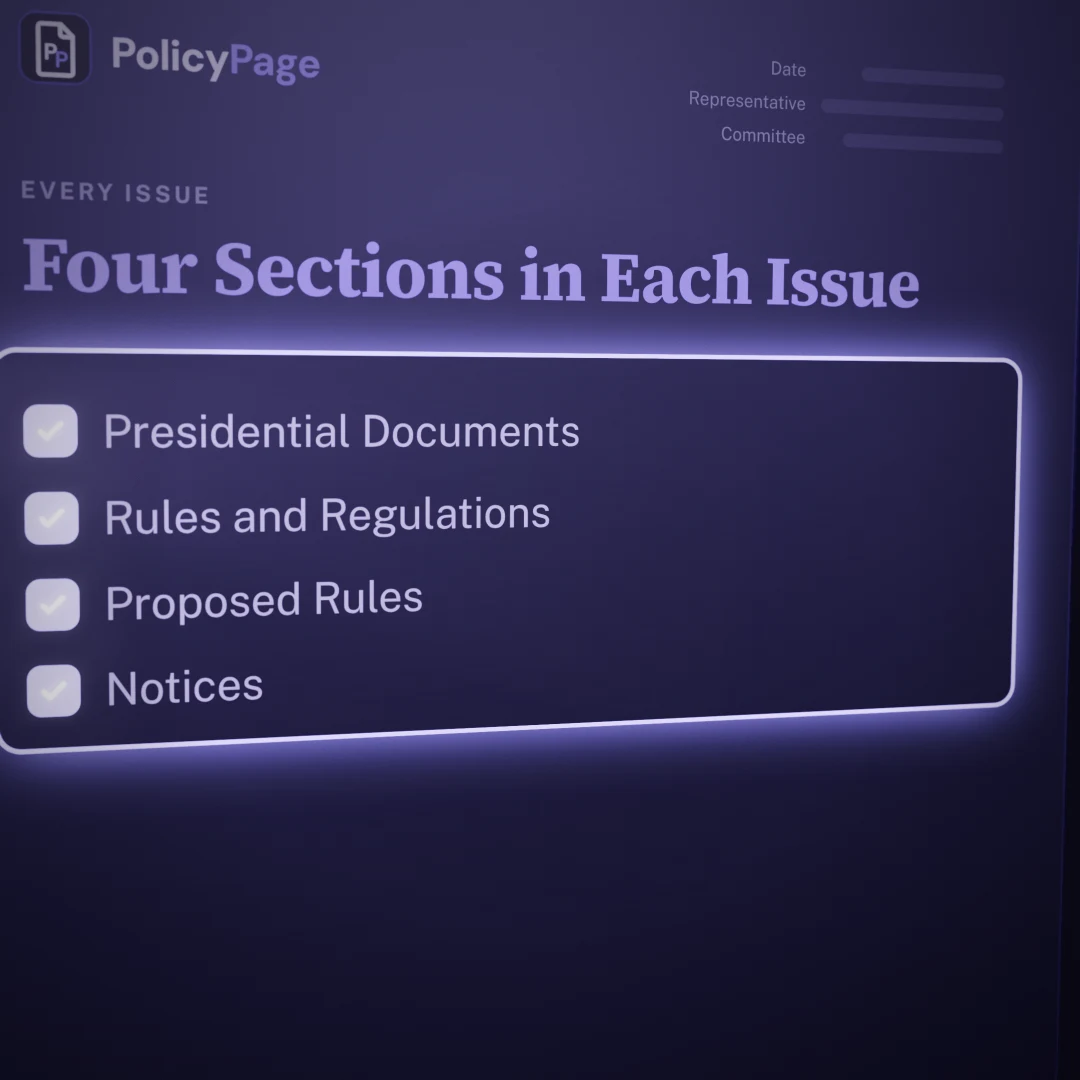
Every issue follows the same structure. The National Archives explains that each issue is organized into four categories:
- Presidential Documents. Executive orders, proclamations, and other documents signed by the President, such as memorandums and determinations.
- Rules and Regulations. Final rules, plus policy statements and interpretations of rules.
- Proposed Rules. Rules an agency wants to adopt, along with petitions for rulemaking and advance notices that ask whether a rule is needed at all.
- Notices. Scheduled public hearings and meetings, grant applications, and administrative orders.
GovInfo adds useful detail about each section. In the Federal Register system, the terms "rules" and "regulations" have the same meaning. The Notices section includes things like hearings and investigations, committee meetings, agency decisions, license actions, grant deadlines, and the availability of environmental impact statements. There is also a Sunshine Act Meetings section, because the Government in the Sunshine Act requires many agency meetings to be open and announced in the Federal Register, with the time, place, subject, and a contact person.
Each issue starts with a table of contents organized alphabetically by agency. Under each agency, documents are grouped as Rules, Proposed Rules, or Notices, with the page where each one begins. Each rule or proposed rule begins with a heading naming the agency, the part of the Code of Federal Regulations it affects, and a short description. Every rule and proposed rule, and many notices, also lists a person to contact under "FOR FURTHER INFORMATION CONTACT."
How much does the Federal Register publish?
A lot. The Office of the Federal Register's statistics show that in 2025 it published 23,690 documents: 2,441 final rules, 1,498 proposed rules, 19,280 notices, and 471 presidential documents. Notices are by far the largest group.
Page counts change a great deal from year to year. The same office reports 107,262 pages in 2024 and 61,584 pages in 2025. Compare that with 2,620 pages in 1936, the first year. No one reads it cover to cover. Most people search it for their agency, issue, or rule.
How does the Federal Register work?
A document does not just appear one morning. It follows a short, predictable path from the agency to the public. Here is how that works, one step at a time.
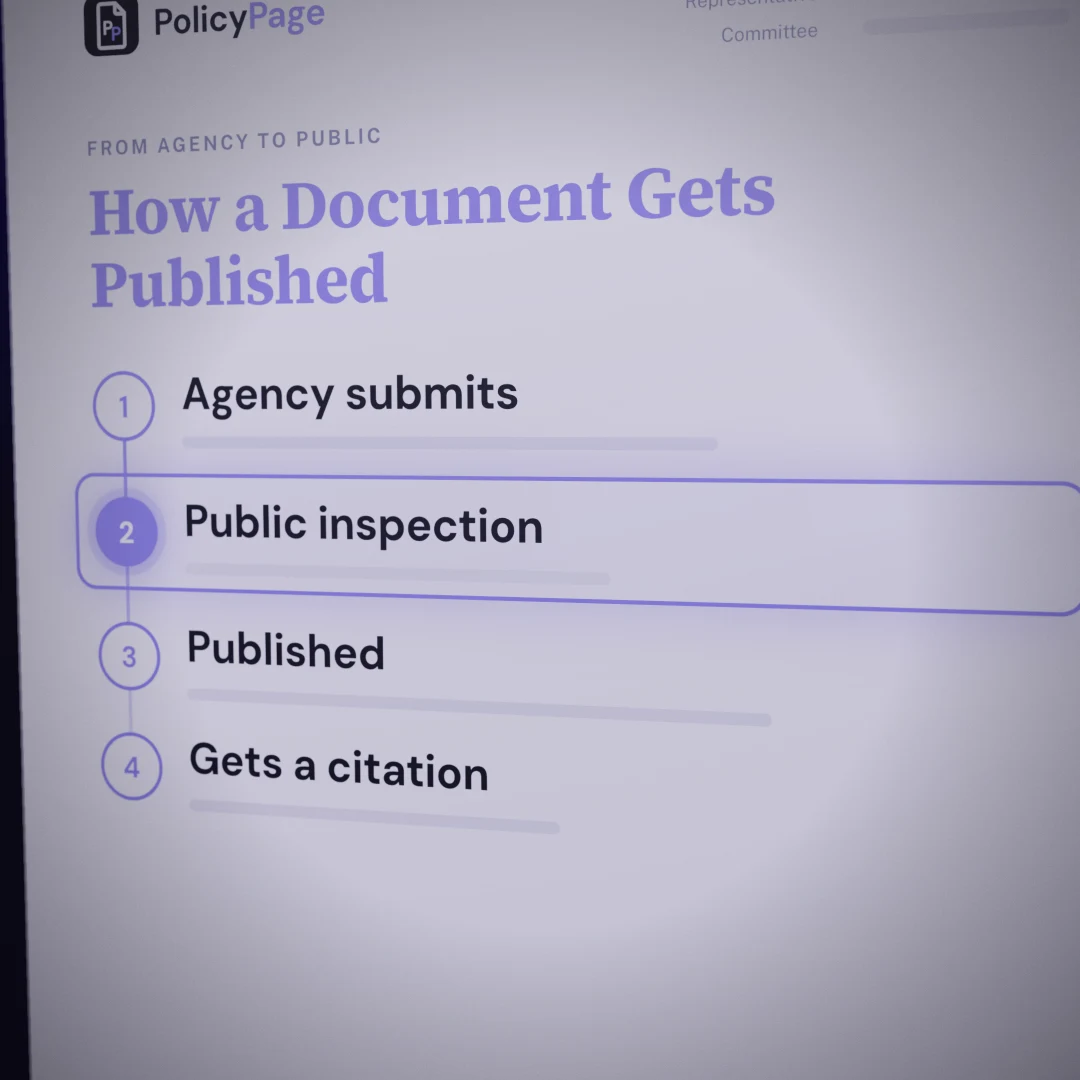
- An agency sends a document. A federal agency, or the White House for presidential documents, submits a signed document to the Office of the Federal Register.
- It goes on public inspection. The National Archives says documents are held in confidence until they are filed for public inspection at least one business day before publication. The public inspection page on federalregister.gov explains that regular filings are placed on file at 8:45 a.m. Eastern Time for publication in the next day's issue. This is the earliest official look at what is coming.
- It is published. The next business day, the document appears in the Federal Register, which GovInfo posts by 6 a.m.
- It gets a citation. Each document gets a page number in that year's volume. GovInfo explains that a new volume starts every year and shows the citation format as volume and page, for example 70 FR 7298. GovInfo cites Executive Order 12866, signed September 30, 1993, as 58 FR 51735: volume 58, page 51,735.
The citation is worth knowing. When a fact sheet, news story, or agency letter mentions something like "58 FR 51735," it is pointing to an exact page of the Federal Register that anyone can look up.
Is federalregister.gov the official Federal Register?
There are two main places to read it, and the difference matters if you need the legal version. GovInfo says its online edition is the official legal equivalent of the paper and microfiche editions. It describes federalregister.gov as an unofficial, HTML edition of the daily Federal Register provided by the Office of the Federal Register. The federalregister.gov public inspection page makes the same point: only official editions provide legal notice to the public and judicial notice to the courts.
For everyday reading, federalregister.gov is easier to search and browse. For a legal filing or a formal citation, use the official PDF on GovInfo. GovInfo also notes that an agency may post a new rule on its own website before publication, but that version is not official, and the effective date is generally based on when the rule is published in the Federal Register.
Federal Register vs. Code of Federal Regulations (CFR)
This is one of the most common questions, and the answer is simple once you see the difference. The Federal Register is a daily record of changes. The Code of Federal Regulations (CFR) is the organized rulebook those changes update.
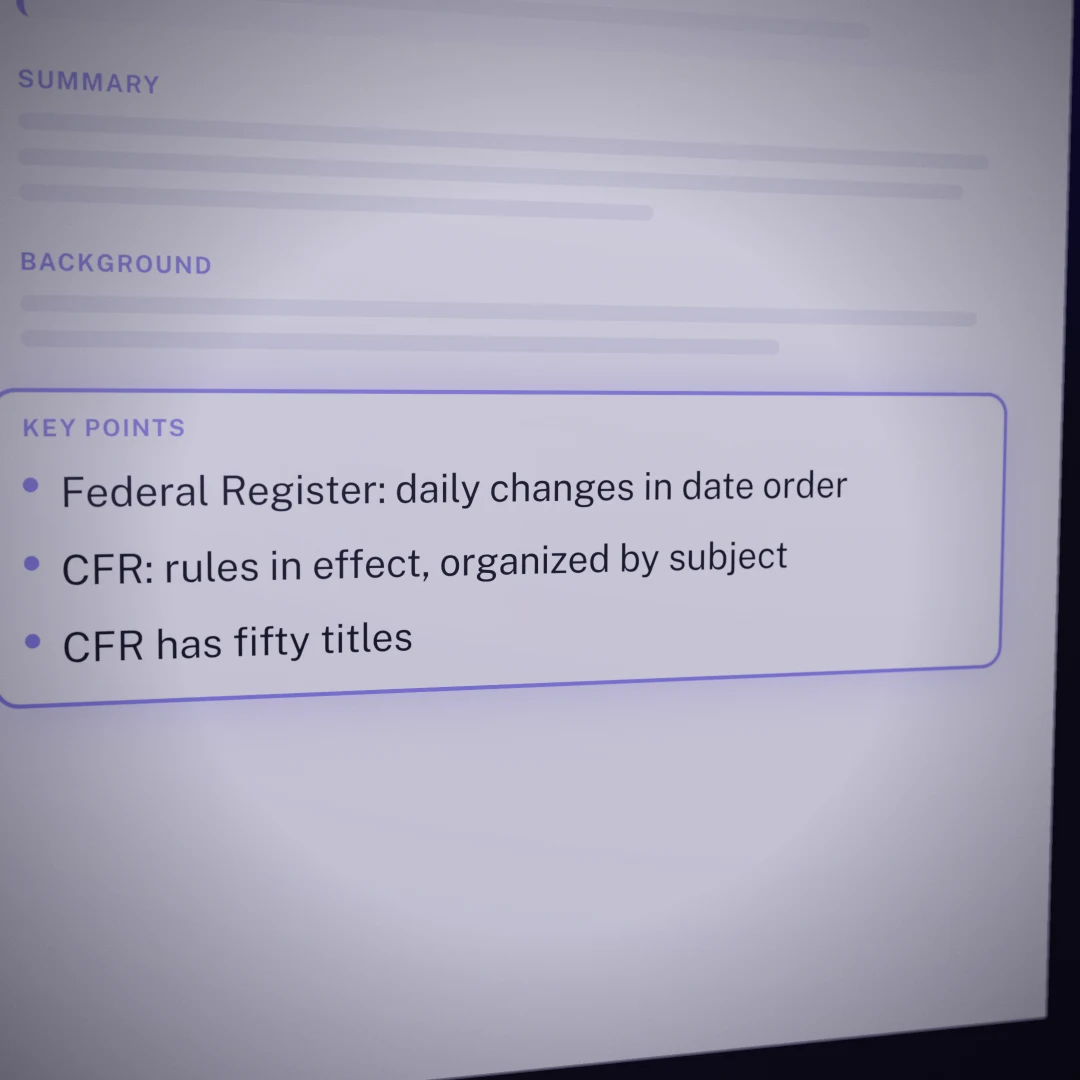
An analogy helps. The Federal Register is like the daily stream of updates to a big reference manual: every day, it records which pages were added, changed, or removed. The CFR is the manual itself, arranged by subject, showing the rules as they stand.
The National Archives explains that rules and proposed rules in the Federal Register include citations to the parts of the CFR they affect, and that the CFR contains the complete and official text of agency regulations organized into fifty titles covering broad subject areas. Federal law says each part of the CFR must be supplemented and republished at least once each calendar year.
Because the printed CFR is updated once a year, the Office of the Federal Register also runs the eCFR. Its site describes the eCFR as a version of the CFR that we update daily, built from the amendments published in the daily Federal Register. The eCFR itself notes that it is an editorial compilation, so legal researchers should check results against the official edition.
Here is the short version:
- Federal Register: daily, in date order, includes proposals and notices, shows how and why a rule changed.
- Code of Federal Regulations: organized by subject, includes only rules in effect, shows what the rule says now.
If you want to know what a regulation requires today, look in the CFR. If you want to know why it changed, when, and what the agency said about public comments, look in the Federal Register. The explanation that comes with each rule, called the preamble, lives in the Federal Register, not the CFR.
How to comment on a proposed rule in the Federal Register
The most powerful feature of the Federal Register for the public is the chance to weigh in before a rule is final. This is called notice and comment rulemaking, and it is required for most rules by the Administrative Procedure Act (APA).
The APA, at 5 U.S.C. 553, says a general notice of proposed rulemaking shall be published in the Federal Register. That notice must include the time, place, and nature of the proceedings, the legal authority for the rule, and either the terms of the proposed rule or a description of the subjects and issues involved. It must also include the internet address of a plain-language summary of the proposed rule of no more than 100 words. Then the agency must give interested persons a chance to participate by submitting written data, views, or arguments.
Regulations.gov, the government's site for public comments, describes the stages in its overview of the rulemaking process:
- Before a rule. An agency cannot issue a rule unless a law gives it the authority. Agencies may publish an advance notice of proposed rulemaking that asks the public whether a rule should be started at all.
- The proposed rule. After researching the issue, an agency often publishes a notice of proposed rulemaking (NPRM) in the Federal Register.
- The final rule. After the comment period closes, the agency reviews all comments received. It then decides whether to go ahead, issue a new or changed proposal, or in some cases withdraw the proposal.
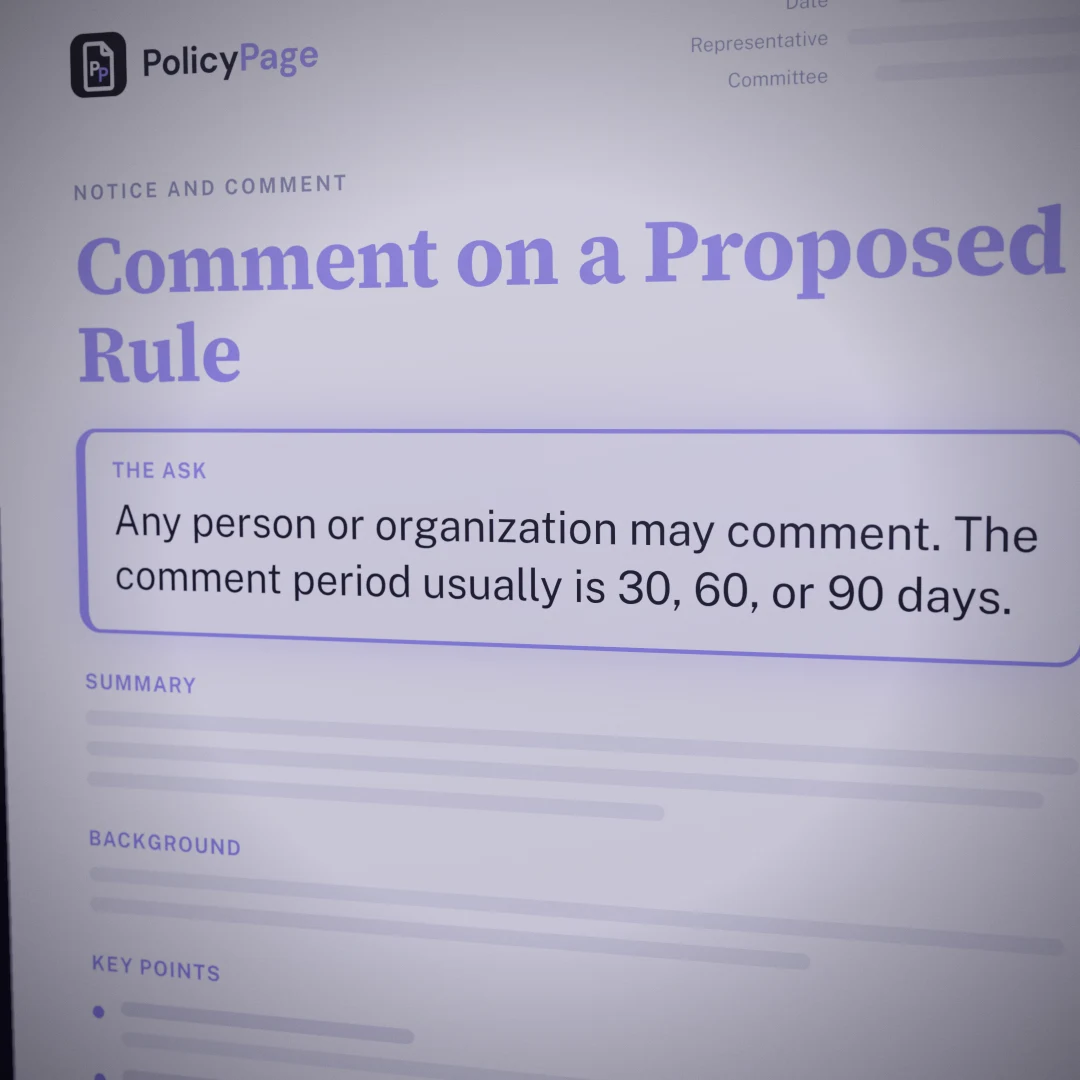
The National Archives explains that any person or organization may comment, in writing or at a hearing, and many agencies accept comments online. The comment period varies, but it usually is 30, 60, or 90 days. Every proposed rule gives instructions on how, when, and where to comment.
What happens to those comments matters. The National Archives says that when agencies publish final regulations, they must address the significant issues raised in comments and discuss any changes made in response. Under the APA, a final rule generally must be published at least 30 days before it takes effect, with some exceptions, such as rules that relieve a restriction or when an agency finds good cause. The APA also gives every interested person the right to petition an agency to issue, change, or repeal a rule.
A few tips for a useful comment:
- Comment on the proposal itself. Refer to the specific section or question in the proposed rule.
- Bring facts. Data, costs, and real examples from your own work give an agency something concrete to respond to.
- Mind the deadline. The comment due date is listed in the proposal's DATES section.
How to search the Federal Register
You do not need special training to find what you need. Both federalregister.gov and GovInfo let you search by keyword, agency, date, or document type. GovInfo's Federal Register help page shows how to search by citation, by the CFR part affected, by agency, by docket number, and by Regulation Identifier Number (RIN), a number that stays the same for the proposed and final versions of the same regulation. It also offers a free daily email of the table of contents.

A practical routine for anyone who follows an issue:
- Search by agency. Start with the one or two agencies that regulate your issue.
- Follow the docket or RIN. Once you find a proposed rule, use its docket number or RIN to track every later document on it.
- Check public inspection. Documents posted for public inspection show what will be published the next business day.
- Look for notices. Grant deadlines, public meetings, and advisory committee sessions often appear only as notices.
The Federal Register is also part of how a bill becomes law. The National Archives explains that after the President signs a bill, it is delivered to the Office of the Federal Register, where editors assign a Public Law number and prepare it for the Statutes at Large. Our guide to how a bill becomes law explains the full path, and our guide to engrossed vs. enrolled bills covers what happens to a bill's text at the end.
Why the Federal Register matters before a meeting
If you work on a federal issue, the Federal Register is often where the next chapter begins. When an agency writes rules to carry out a law, each proposal and final rule appears here. Watching it helps you catch a comment period in time, instead of learning about a new rule after it is final.
It also helps you prepare for meetings. If you are meeting with a congressional office or an agency, knowing the exact status of a rule makes your conversation sharper:
- Name the document. Use the rule's title and Federal Register citation so staff can find it quickly.
- Know the dates. Note the comment deadline and the planned effective date.
- Be specific about your ask. Ask whether the office plans to file a comment, raise questions with the agency, or follow the rule's progress.
When you are getting ready to meet a legislator's office, one clear page beats a stack of handouts. A short leave-behind that names the rule, its citation, and the key dates is easy for staff to use later. PolicyPage writes a free, cited, one-page brief for the member you are meeting, so staff can see the issue, the rule or bill involved, and what you are asking them to do.
Save this guide
Frequently asked questions
What is the Federal Register?
The Federal Register is the official daily journal of the U.S. government. Federal agencies publish rules, proposed rules, and notices in it, and it also prints executive orders and other presidential documents.
What is the Federal Register used for?
It tells the public about new and proposed federal rules, agency notices, public meetings, grant opportunities, and presidential documents. It is also where people learn how to comment on a proposed rule.
Who publishes the Federal Register?
The Office of the Federal Register, part of the National Archives and Records Administration, publishes it every business day in partnership with the Government Publishing Office.
What is the difference between the Federal Register and the Code of Federal Regulations?
The Federal Register is a daily record of new rules, proposals, and notices in date order. The Code of Federal Regulations organizes the rules in effect by subject into fifty titles.
Is federalregister.gov the official Federal Register?
No. GovInfo describes federalregister.gov as an unofficial edition. The official online edition, the legal equivalent of the printed one, is on GovInfo.
How long is a Federal Register comment period?
It varies, but the National Archives says it usually is 30, 60, or 90 days. Each proposed rule lists its own deadline and instructions.
How do I read a Federal Register citation?
A citation like 58 FR 51735 means volume 58 of the Federal Register, page 51,735. A new volume starts every year.
Terms in this article
Sources
- 1.About the Federal Register, Office of the Federal Register, National Archives
- 2.Federal Register, 1936 to Present (help and about page), GovInfo, U.S. Government Publishing Office
- 3.Federal Register Documents Published Per Category, Office of the Federal Register
- 4.Federal Register Pages Published Per Category, Office of the Federal Register
- 5.Public Inspection, Office of the Federal Register
- 6.44 U.S.C. 1505: Documents to be published in Federal Register, Legal Information Institute, Cornell Law School
- 7.44 U.S.C. 1507: Filing document as constructive notice; judicial notice, Legal Information Institute, Cornell Law School
- 8.44 U.S.C. 1510: Code of Federal Regulations, Legal Information Institute, Cornell Law School
- 9.5 U.S.C. 553: Rule making, Legal Information Institute, Cornell Law School
- 10.What is the eCFR?, Office of the Federal Register, eCFR
- 11.Public Laws, Office of the Federal Register, National Archives
- 12.Learn: The Rulemaking Process, Regulations.gov
New to some of the terms here? The advocacy glossary defines them in plain English.