
What Is a Whip in Congress? Whip Count Meaning and What Whips Do
A whip is a party leader in Congress who counts votes and rounds up members. Here is what a whip count means, what whips do, and where the term comes from.
10 minute read9 sources
In this article

A whip is a party leader in Congress whose main job is to count votes and make sure the party's members show up and vote. Each party in the House and the Senate has one. The whip asks members how they plan to vote on important bills, reports what they hear back to party leaders, and works to win over anyone who is undecided. That tally is called the whip count. In short, a whip keeps track of where the votes are before the vote happens.
What is a whip in Congress?
A whip is one of the elected leaders of a party inside a chamber of Congress. The U.S. Senate's own history office says party whips are mainly responsible for counting heads and rounding up party members for votes and quorum calls. A quorum call is a check to see whether enough members are present to do business.
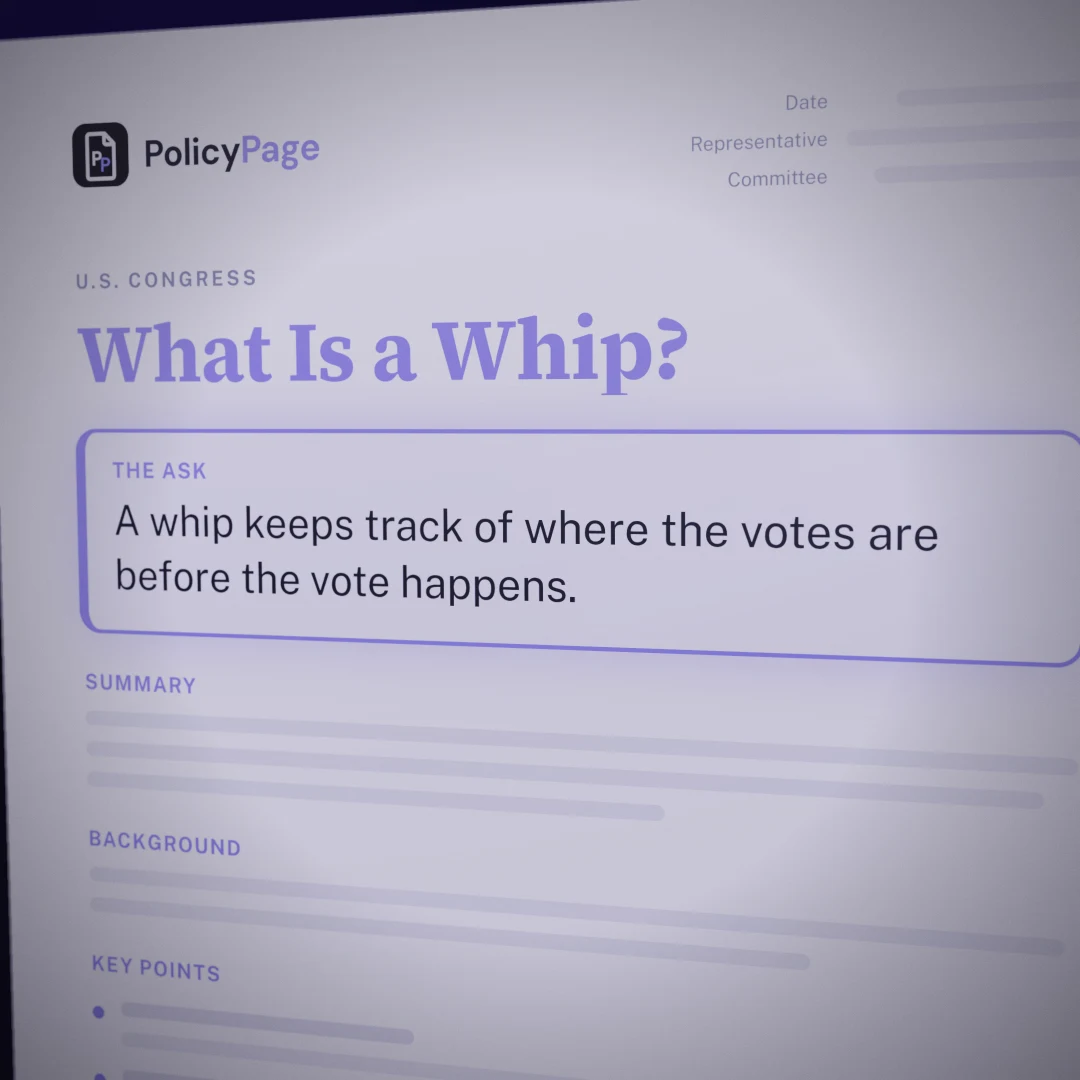
Here is a simple way to picture it. Imagine a team captain before a big game who walks down the bench and asks each player, "Are you ready to play?" The captain does not coach the game or call the plays. The captain makes sure the team knows who is in, who is out, and who needs a word of encouragement. A whip does that job for a party in Congress.
There are two main whips in each chamber, one for each major party. The whip for the party that holds the most seats is called the majority whip. The whip for the other party is the minority whip. Both do the same basic work for their own side.
If you need a short definition for a government class, try this: a party whip is a party leader in a legislature who counts votes, keeps members informed, and works to get them to vote with the party on key bills.
Is whip an acronym?
No. People sometimes search for "whip acronym," but the word does not stand for anything. It is a borrowed word from an old English hunting term, which the section on where the term comes from explains below.
What does a whip do in Congress?
A whip does four main things: counts votes, passes along information, rounds up members, and tries to win support. The Congressional Research Service (CRS), which writes nonpartisan reports for Congress, sums up the role well. Its guide to House party leaders says whips maintain communication between party leaders and members, marshal support for party positions on the floor, and count votes on key legislation.

Here is what each of those jobs looks like in practice.
- Counting votes. CRS reports on both chambers say the whip's chief responsibility is to "count heads." Leaders need to know whether they have enough votes before they bring a bill to the floor.
- Passing along information. Whips send members notices about the schedule and the bills coming up. CRS calls whip notices and advisories staple products of the whip offices. Whips also send out packets before members leave Washington for a recess.
- Rounding up members. A vote only counts if members are in the room. The Senate notes that whips round up members for votes and quorum calls. CRS has described whips sometimes standing at the chamber door with a "thumbs up" or "thumbs down" signal to tell members how the party plans to vote.
- Winning support. CRS says whips also work to "whip up" support and get out the vote. That can mean listening to a member's concerns and carrying them back to party leaders.
Whips also fill in for other leaders. The Senate's history office says whips occasionally stand in for the majority or minority leaders when they are absent.
A whip does not work alone. CRS says each House whip heads an extensive whip network of party members who help gather information. These helpers have titles such as chief deputy whip and deputy whip. The numbers change over time. A 2006 CRS report on the Senate counted one chief deputy whip and three deputy whips for Democrats, and one chief deputy whip and seven deputy whips for Republicans. A 2002 CRS report on the House found that Republicans had one chief deputy whip and Democrats had six. Treat those as snapshots, not current figures.
What is a whip count?
A whip count is the tally a whip builds by asking members of the party how they plan to vote on a bill. It answers the most practical question in any legislature: if we held the vote today, would it pass?
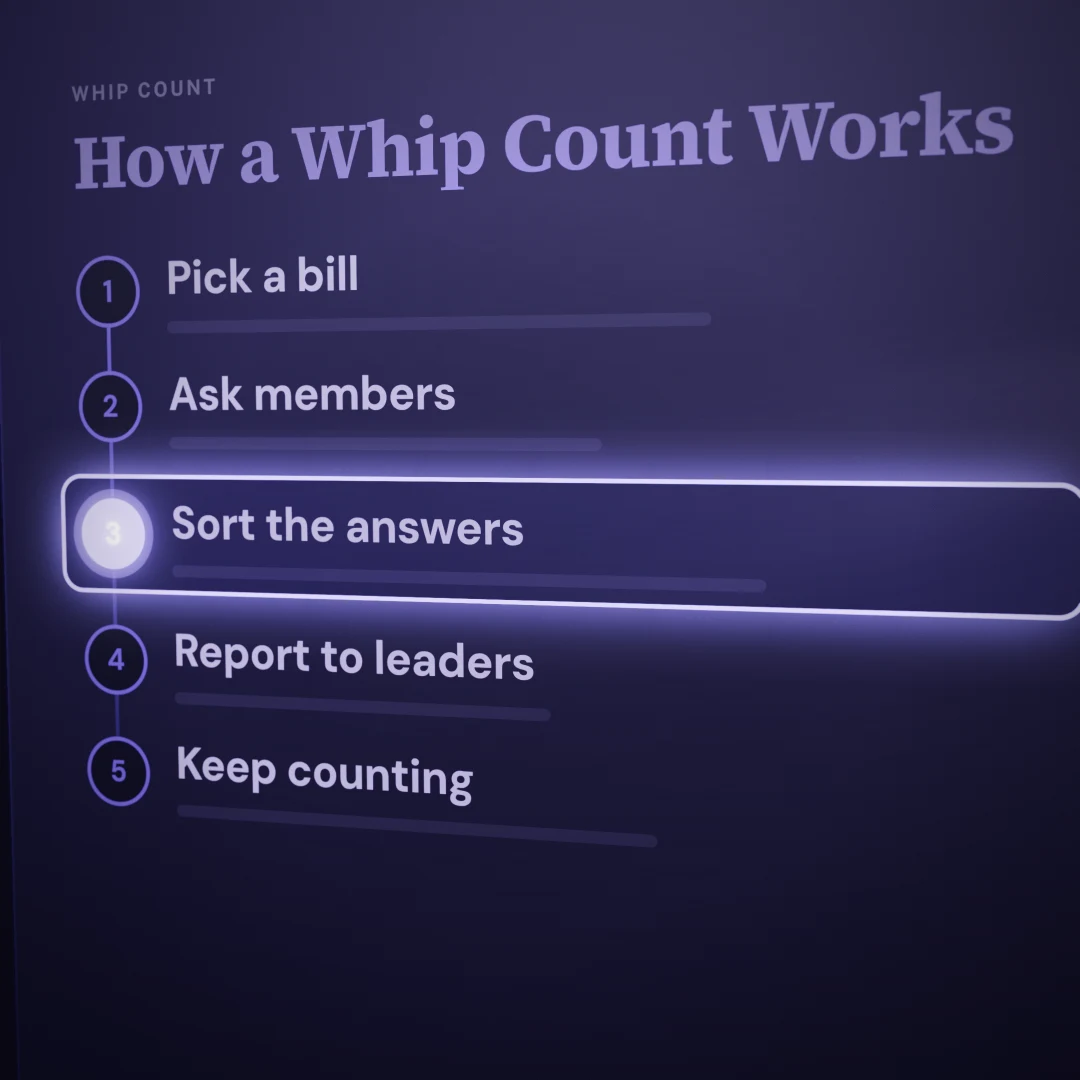
The process is simple to describe, even if it is hard to do well.
- Leaders pick a bill to check. Usually this is an important or close vote.
- The whip team asks members. Deputy whips each reach out to a group of members and ask where they stand.
- The answers are sorted. In plain terms, members end up in groups such as yes, no, and undecided.
- The whip reports to leaders. Leaders then decide whether to bring the bill up, change it, or wait.
- The work continues. The whip team talks with undecided members and keeps the count up to date until the vote.
Why does this matter so much? Leaders do not want to call a vote and be surprised by the result. A careful count tells them ahead of time. CRS also says whips help party leaders keep track of the whereabouts of members, so leaders know who will actually be there. For anyone following a bill from the outside, this is why a whip count is one of the clearest signs of where a bill really stands.
A whip count is also a two-way street. While the whip asks for votes, members get a chance to say what would change their minds. A member might say they would support a bill if a certain section were rewritten. That message travels back up to leaders. This is the communication role CRS describes: the whip carries information in both directions, from leaders to members and from members to leaders.
Whip count meaning in the news
When reporters say a bill "does not have the votes," they are often talking about a whip count, or their own best guess at one. If leaders delay a floor vote that was expected, a short count is one common reason. It is worth remembering that a whip count is a forecast, not a result. Members can change their minds, and an undecided member may not decide until the last moment.
Where does the term whip come from?
The word comes from fox hunting. The Senate's history office explains that it is short for "whipper-in," the person whose job was to keep the hunting dogs from straying from the pack during a chase. A party whip, in the same way, tries to keep members from straying from the party during a vote.

CRS says the term was first used in the British House of Commons in the late 1700s. It later crossed the Atlantic.
When did Congress get its first whips?
The House came first. The House's Office of the Historian lists the first Republican whip as James A. Tawney of Minnesota in 1897. It says the first Democratic whip was appointed in 1899. An older CRS report notes that most historical accounts set the Democratic date as 1901, so sources differ by a couple of years.
The Senate followed in 1913. According to the Senate's history office, Democrat James Hamilton Lewis of Illinois became the first party whip in 1913. Republicans created their own whip post two years later.
The Senate version started with a problem every team captain would recognize: people were not showing up. On May 28, 1913, during a fight over tariffs, the Senate Democratic caucus met with only 33 of its 50 members present. The caucus asked all members to attend regularly. To enforce that agreement, it created the post of party whip. The Senate notes that in doing so, senators followed the example of both parties in the House.
Majority whip vs minority whip: who are the whips in the House and Senate?
Every chamber has a majority whip and a minority whip. The difference is simply which party holds more seats. The duties are the same, but the majority whip's count matters more for what reaches the floor, because the majority party usually controls the schedule.

In the House, the whip ranks high in party leadership. The House historian says that when the party is in the majority, its whip holds the third highest post in the party conference, after the Speaker and the majority leader. In the Senate, CRS notes that the whip is also called the assistant party leader and is considered part of the official party leadership.
How are whips chosen?
Today, whips in both chambers are elected by their own party members, but that was not always true.
- In the House, CRS says whips are elected by each party caucus at early organizational meetings. The House historian notes that the Democratic whip was mostly appointed by the party leader until 1986, when it became an elected post.
- In the Senate, the Senate's own page says plainly that both party conferences elect whips.
Those organizational meetings come early, as each new Congress gets ready to start after a November election. If you want to know who holds the job right now, the House historian keeps lists of every whip since the posts began, and the Senate's history office does the same for the Senate.
What does whip mean in politics outside Congress?
The idea is not unique to the United States. In the United Kingdom, the system is more formal, and the word "whip" has a second meaning.
The Institute for Government, a London research group, says UK whips are members of Parliament and peers appointed to ensure their party colleagues vote according to the leader's agenda. It counts 25 government whips: 16 in the House of Commons and 9 in the House of Lords.
In the UK, "the whip" is also a document. The Institute describes it as a written instruction telling members how they are expected to vote. It is usually issued for every day the Commons sits, and it signals how important each vote is:
- One-line whip: members are requested, but not required, to attend.
- Two-line whip: attendance is necessary, and members must ask permission to miss the vote. The Institute notes this one is rarely used.
- Three-line whip: attendance is essential, and permission to miss the vote would rarely be granted.
A UK member can also "lose the whip." When a party removes it, the member sits as an independent. And when a party sets no whip at all, members get a "free vote," which the Institute says is used for matters of conscience.
In Congress, the word mostly refers to the people and their vote counting. The CRS and Senate sources above describe U.S. whips by what they do: counting heads, sharing information, and rounding up members.
What a whip count tells you before a meeting
If you work on an issue and meet with offices on Capitol Hill, the whip process is worth understanding. It explains why a bill with wide support can still sit for months, and why timing matters so much. Here are a few questions to keep in mind.
- Has leadership signaled a vote? If not, the count may not be there yet, or other bills may be ahead in line. Our guide on how a bill becomes law covers the steps before a floor vote, including the markup.
- Is this member undecided? Undecided members get the most attention from whips. They may also be the most open to hearing from people back home. Our explainer on what a constituent is covers why that connection matters.
- Is the Senate the bottleneck? In the Senate, a bill can also stall because of a Senate hold or the threat of a filibuster, even with a strong count. Our article on Senate holds explains how that works.
When you are preparing to meet a member's office about a bill that is close, it helps to bring your ask on one page. PolicyPage writes a free, cited, one-page brief for the member you are meeting, so staff can see your point quickly and pass it along.
Save this guide
Frequently asked questions
What is a whip in Congress?
A whip is a party leader in the House or Senate whose main job is to count votes and make sure party members show up and vote. Each party in each chamber has one.
What does whip count mean?
A whip count is the tally a whip builds by asking party members how they plan to vote on a bill. Leaders use it to decide whether a bill has enough support to bring to the floor.
What is a party whip in politics?
A party whip is a party leader in a legislature who counts votes, keeps members informed about upcoming business, and works to get them to vote with the party on key bills.
Is whip an acronym?
No. The word comes from the fox hunting term whipper-in, the person who kept the hunting dogs from straying from the pack.
What is the difference between the majority whip and the minority whip?
The majority whip works for the party with the most seats in the chamber, and the minority whip works for the other party. Their duties are the same, but the majority whip's count matters more for what reaches the floor.
How are whips chosen in Congress?
Whips are elected by their own party members. In the House, CRS says each party caucus elects its whip at early organizational meetings, and the Senate says both party conferences elect whips.
When did Congress get its first whips?
The House historian lists the first Republican whip in 1897 and the first Democratic whip in 1899. The Senate's first party whip was named in 1913, and Republicans added their own two years later.
What is a three-line whip?
It is a term from the UK Parliament for a written instruction saying a member's attendance at a vote is essential. Permission to miss such a vote would rarely be granted.
Terms in this article
Sources
- 1.Party Whips, U.S. Senate, Historical Office
- 2.About Parties and Leadership: Party Whips, U.S. Senate
- 3.Senators Require a Whip (May 28, 1913), U.S. Senate
- 4.Party Leaders in the House: Election, Duties, and Responsibilities (RS20881), Congressional Research Service, via Congress.gov
- 5.House Leadership: Whip Organization (RS20499), Congressional Research Service, via EveryCRSReport
- 6.Senate Leadership: Whip Organization (RS20887), Congressional Research Service, via EveryCRSReport
- 7.Republican Whips (1897 to present), U.S. House of Representatives, Office of the Historian
- 8.Democratic Whips (1899 to present), U.S. House of Representatives, Office of the Historian
- 9.Whips: What is their role?, Institute for Government
New to some of the terms here? The advocacy glossary defines them in plain English.