
What Is a Constituent? Meaning and Definition in Government
A constituent is a person a government official represents, usually someone who lives in their district or state. You do not have to vote to be one.
10 minute read16 sources
In this article
- What does constituent mean in simple terms?
- Who counts as a constituent in government?
- Constituent vs constituency: what's the difference?
- Why are constituents important to members of Congress?
- What are constituent services?
- How do you find out whose constituent you are?
- How to speak up as a constituent
- Save this guide

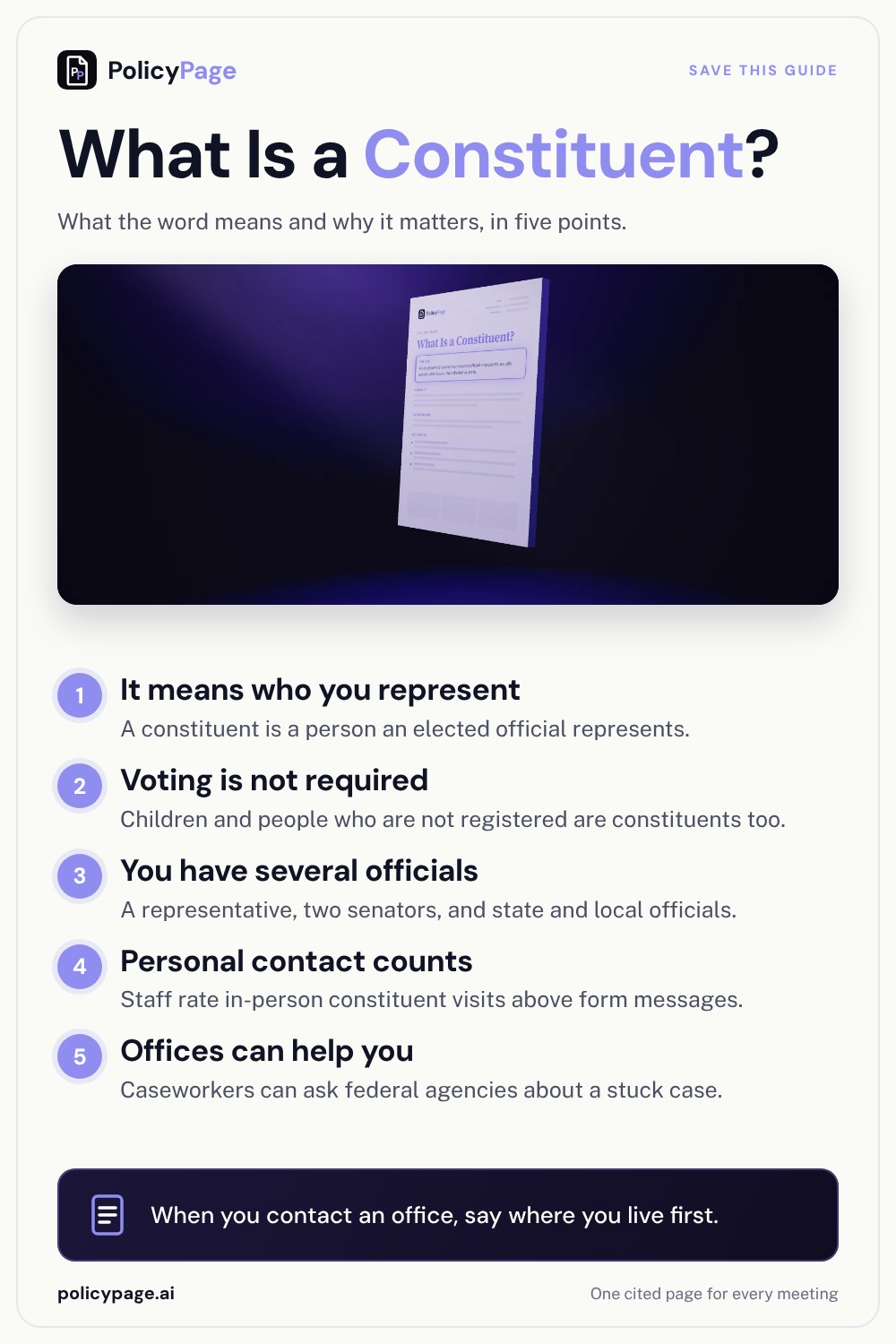
A constituent is a person an elected official represents. In most cases, that means anyone who lives in the district or state the official was elected to serve. If you live in a congressional district, you are a constituent of the member of the House who represents it, of your state's two U.S. senators, and of your state and local officials. You do not have to have voted for them, or have voted at all.
The word comes up constantly in politics because constituents are who officials answer to. A city council member, a governor, and a senator can all say "my constituents," and each means a different group of people. This guide explains what the word means, who counts, how it differs from similar words, and why it matters when you contact a government office.
What does constituent mean in simple terms?
Merriam-Webster defines a constituent, in its government sense, as a member of a constituency, such as a voter represented by an official. In everyday terms, your constituents are the people you work for if you hold elected office.
Think of an elected official as an agent and the people in the district as the group that hired the agent. The dictionary even records an older legal meaning along those lines: a person who authorizes another to act for them. The official has a boss, but the boss is several hundred thousand people who rarely agree.
Here is the word in a sentence: "The senator held a town hall to hear from her constituents about the new highway plan."
Other meanings of constituent
The word has other meanings outside government, which is why dictionary searches can be confusing. Merriam-Webster lists these too:
- A part of a whole. In chemistry or cooking, a constituent is an ingredient or component. Hydrogen is a constituent of water.
- A unit of language. In linguistics, a constituent is a word or group of words that works as a unit in a sentence.
- Having the power to create a government. As an adjective, a "constituent assembly" is a body with the power to frame or amend a constitution.
All of these trace back to the Latin word constituere, which came into English through French words meaning "to constitute." This guide covers the government meaning.
Who counts as a constituent in government?
The short answer is that anyone who lives in the area an official represents counts. The official does not need to have won your vote, and you do not need to be registered.

The way House seats are divided shows why. Seats go to states by population, not by the number of voters. The Census Bureau says the resident population used for this includes all people living in the country at the time of the census, both citizens and noncitizens. So the people a member represents include children and others who cannot cast a ballot.
Every member of Congress has constituents, and the numbers depend on the office:
- U.S. representative. Each one is elected to serve a specific congressional district for a two year term. After the 2020 census, the average seat represented 761,169 people.
- U.S. senator. The Senate has two senators from each state, and voters have elected them directly since the Seventeenth Amendment in 1913. Senators are elected statewide, so every person in the state is their constituent.
- State legislator. The size varies widely. Using 2020 census figures, Ballotpedia calculates that a Florida state senator represents about 539,263 people and a Florida state representative about 179,754, while a New Hampshire state representative represents about 3,448.
That last comparison says a lot about what the job feels like. A New Hampshire legislator may know many constituents personally. A member of Congress cannot, which is one reason legislative staff and district offices exist.
Are constituents the same as voters?
No. All voters in a district are constituents, but not all constituents are voters. A 12 year old in the district is a constituent. So is an adult who has never registered, and so is someone who voted for the other candidate. An official represents all of them after the election.
In practice, offices do pay close attention to voters, and that is not a secret. But the word itself covers everyone in the district.
Is a senator a constituent?
Sometimes, yes. A senator is an official with constituents of their own, but a senator also lives somewhere. The senator is a constituent of the U.S. representative for the district they live in, and of their own state and local officials. The word describes a relationship, not a status. Anyone can be a constituent of one official and represent others.
Can you be a constituent if you don't live there?
Usually not, at least for a legislator's office. Residence is what offices check. Businesses, schools, and nonprofits are often described as part of a member's constituency when they operate in the district, and an out of state owner may have real interests there. But if you personally live elsewhere, your own officials are the ones who represent you.
Congress pays attention to this. The Senate tells people that policy questions and requests for personal help should go to the senators from their own state, and says many senators will acknowledge, but not answer, messages from people in other states.
Constituent vs constituency: what's the difference?
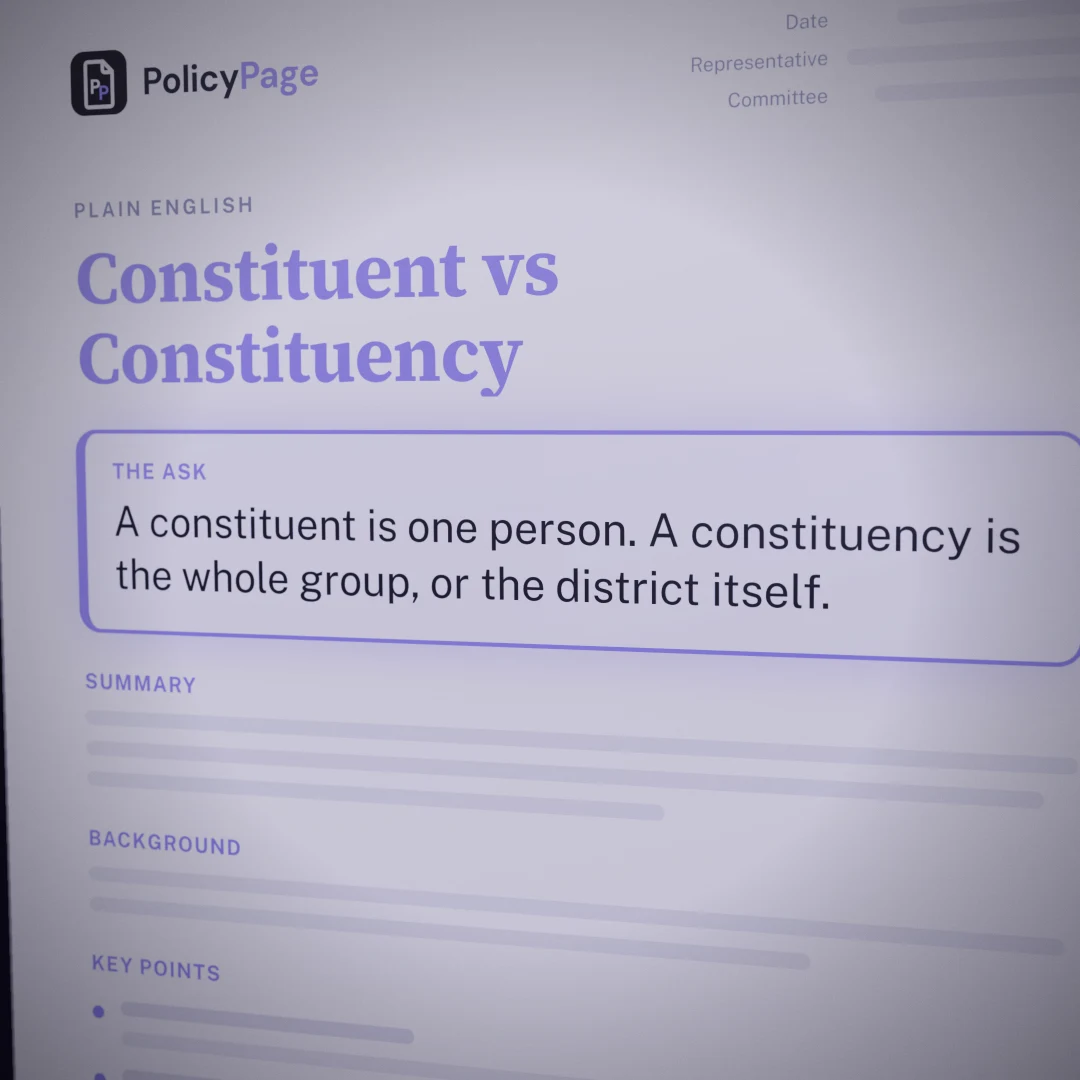
These two words are close but not the same. A constituent is one person. A constituency is the whole group, or the district itself. It can also mean a group that backs a cause or a person, which is how the word gets used outside of elections, as in "the company's constituency."
| Word | What it means | Example |
|---|---|---|
| Constituent | One person an official represents | "A constituent called about her Social Security check." |
| Constituency | The group of people, or the district | "Farmers are a large part of his constituency." |
| Voter | A person who casts a ballot | "Voters chose her by 300 votes." |
| Citizen | A person with legal citizenship | Not every constituent is a citizen. |
| Stakeholder | Anyone with an interest in a decision | A company in another state can be a stakeholder but not a constituent. |
You may also hear about "constituent groups." That phrase usually refers to organized groups in a district, such as local business owners, veterans, or teachers, or the groups an organization serves.
Why are constituents important to members of Congress?
There are two basic reasons. First, the job itself. The Congressional Research Service (CRS), Congress's nonpartisan research agency, describes the duties of a member as representation, legislation, constituent service and communication, and electoral activities. Members act as advocates for the people they represent while also looking after national interests, and most balance those viewpoints against their own judgment.

Second, the election. Constituents decide whether a House member gets another two years. No rule requires a member to vote the way the district wants. But the district does get the next word.
That is also the only direct power constituents have. Sometimes people search "can constituents recall a senator" or "can constituents remove a member of Congress." The answer is no. A CRS report explains that the Constitution does not provide for recall of federal officers, and no member of Congress has ever been recalled. A member's chamber can expel them with a two thirds vote, but that decision belongs to the members, not to voters back home. Some states do let voters recall state or local officials, but those rules vary by state.
How much do constituents influence Congress?
Surveys of congressional staff suggest quite a lot, when the contact is personal. The Congressional Management Foundation surveyed 260 staffers in late 2010. When it asked senior managers and mail staff, 46 percent said an in-person constituent visit to the Washington office would have "a lot" of influence on an undecided member, compared with 8 percent for a lobbyist's visit.
The same research found that personalized messages count for much more than identical form messages. About 20 percent of staff said individualized email or postal mail would have "a lot" of influence on an undecided member, compared with 1 percent for form messages, and 53 percent agreed that most identical form campaigns were sent without the constituent's knowledge or approval. That survey is more than 15 years old and reflects what staff believed at the time, so treat it as a useful signal rather than a precise current measure.
The practical lesson is simple. A real person from the district, speaking about the local effect of a bill, gets attention that a stack of national statistics does not. That is why advocacy days and grassroots campaigns work so hard to match people with their own representatives, and why one page briefs that show local impact work better than generic ones. Our guide to planning an advocacy day covers how groups organize those meetings.
What are constituent services?
Constituent services are the things a congressional office does for people that are not about passing laws. CRS defines them as a wide range of nonlegislative activities and groups them into four areas:
- Help with government. This includes casework (below) and help with federal grants.
- Opportunities for students. Nominations to U.S. service academies, plus internships.
- Washington, D.C., visits. Help arranging Capitol tours and similar visits.
- Commemorations. Flag requests, plus congressional congratulations and presidential greetings.

Offices choose how much to offer, so services differ from one member to the next.
What is casework?
Casework is the part most people end up needing. CRS describes it as the response or services members provide to constituents who ask for help, often with a federal agency. If your benefits check is stuck, or a passport or veterans claim seems lost, a caseworker can ask the agency what is happening.
There are limits, and they are worth knowing before you call:
- Staff can ask, but they can't order. CRS says staff cannot force an agency to speed up a case or decide in a constituent's favor.
- You usually have to sign a form. Agencies generally cannot reply about your case without a signed Privacy Act release from the person involved.
- Courts are off limits. Offices do not step into cases before a court, and they don't give legal advice.
- Where you live matters. Congressional guidance says House members should not use official resources for casework for people outside their district. They may refer those people to their own representative or senator.
How do you find out whose constituent you are?
Everyone in the U.S. has several sets of representatives at once. Here is how to look up the main ones:
- Your U.S. representative. The House has a Find Your Representative tool that matches your ZIP code to your district. It also warns that maps may have changed recently, so the person listed is the one representing you now.
- Your U.S. senators. The Senate's contact page lists all senators by state.
- Your state legislators. Most states publish a lookup tool. In Florida, for example, the Senate's Find Your Legislators page shows your state and U.S. lawmakers from your address.
How to speak up as a constituent
If you contact an office, you will be taken more seriously if you make the relationship clear right away. Offices want to know who is in their district. A few habits help:
- Say where you live. Give your name and city, or your ZIP code, at the start.
- Ask for one thing. "Please vote yes on this bill" is easier to act on than a general complaint about a problem.
- Tell your own story. A local detail is something staff can't get from a national report.
- Know where your issue stands. A bill in markup calls for a different request than one heading to a floor vote. Our guide to how a bill becomes law explains the stages.

If you are preparing to meet with a legislator or their staff, PolicyPage writes a free, one page, cited brief for the specific member you are meeting, built around their district or state.
Save this guide
Frequently asked questions
What is a constituent in simple terms?
A constituent is a person an elected official represents, usually anyone who lives in that official's district or state. If you live in a congressional district, you are a constituent of its representative and of your state's two senators.
Are constituents the same as voters?
No. Voters in a district are constituents, but so are children, people who are not registered, and people who voted for someone else. An official represents everyone in the district, not only supporters.
What is the difference between a constituent and a constituency?
A constituent is one person. A constituency is the whole group of people an official represents, or the district itself.
How many constituents does a member of Congress have?
After the 2020 census, a House seat represented an average of 761,169 people, according to the Census Bureau. Senators represent everyone in their state, so their numbers depend on the state's population.
Is a senator a constituent?
A senator is an official with constituents of their own, but a senator is also a constituent of the House member for the district they live in and of their state and local officials.
Can constituents recall a member of Congress?
No. The Congressional Research Service explains that the Constitution does not provide for recalling federal officers, and no member of Congress has ever been recalled. A chamber can expel a member by a two thirds vote.
What are constituent services?
They are the nonlegislative help a congressional office provides, such as casework with federal agencies, service academy nominations, Capitol tours, and flag requests. Each office decides how much it offers.
Terms in this article
Sources
- 1.Constituent, Merriam-Webster
- 2.Constituency, Merriam-Webster
- 3.Congressional Apportionment: Frequently Asked Questions, U.S. Census Bureau
- 4.Historical Apportionment Data, U.S. Census Bureau
- 5.The House Explained, U.S. House of Representatives
- 6.About the Senate and the Constitution, U.S. Senate
- 7.Contacting U.S. Senators, U.S. Senate
- 8.Find Your Representative, U.S. House of Representatives
- 9.The Constitution of the United States: A Transcription, National Archives
- 10.Roles and Duties of a Member of Congress: Brief Overview (RL33686), Congressional Research Service
- 11.Constituent Services: Overview and Resources (R44726), Congressional Research Service
- 12.Casework in a Congressional Office: Background, Rules, Laws, and Resources (RL33209), Congressional Research Service
- 13.Recall of Legislators and the Removal of Members of Congress from Office (RL30016), Congressional Research Service
- 14.Communicating with Congress: Perceptions of Citizen Advocacy on Capitol Hill, Congressional Management Foundation
- 15.Population represented by state legislators, Ballotpedia
- 16.Find Your Legislators, The Florida Senate
New to some of the terms here? The advocacy glossary defines them in plain English.