
What Does the Congressional Budget Office Do? CBO Scores Explained
The Congressional Budget Office (CBO) gives Congress nonpartisan cost estimates and budget projections. Here is what it does and how a CBO score is made.
12 minute read9 sources
In this article
- What does the Congressional Budget Office do?
- Who controls the CBO? Is it nonpartisan?
- What is a CBO score?
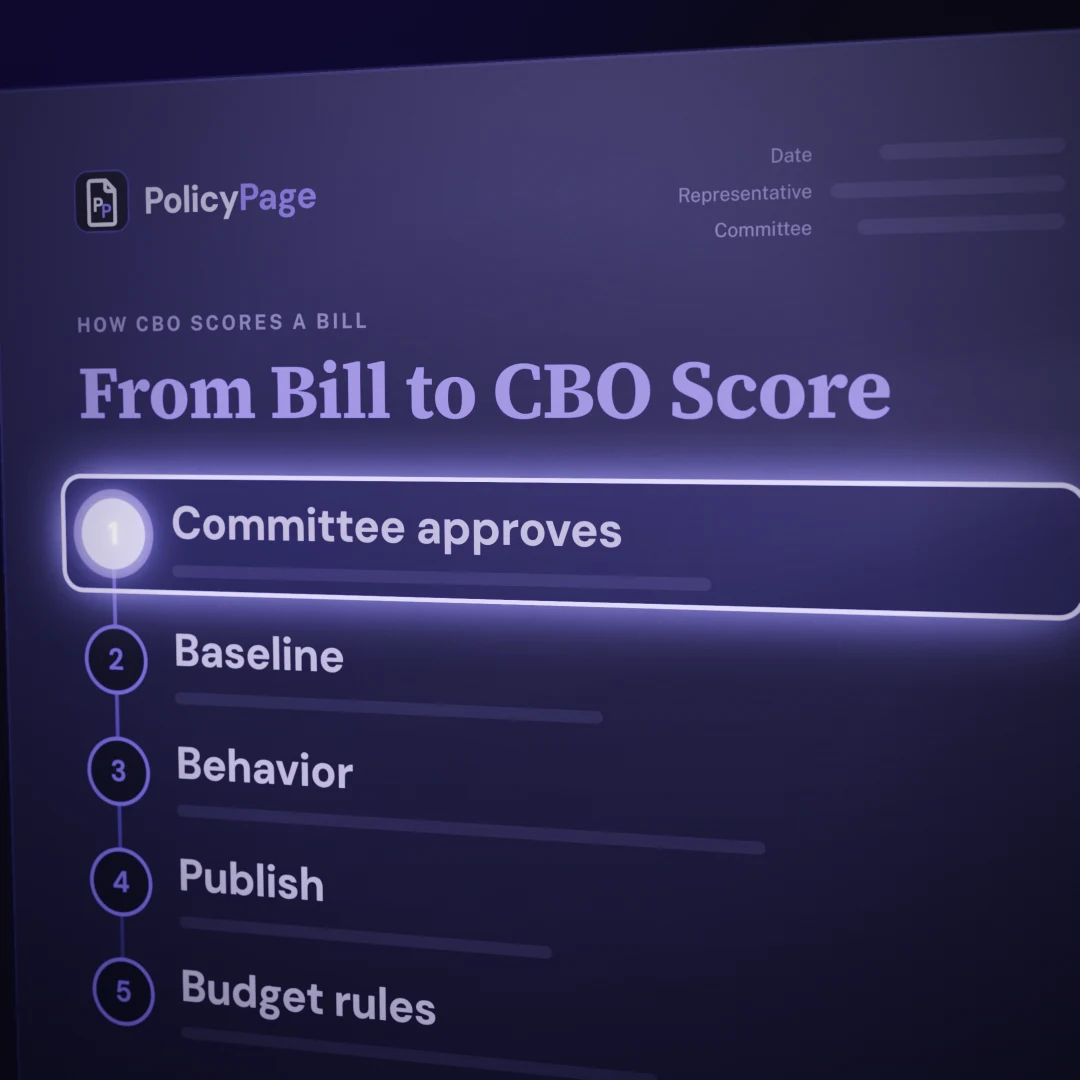
- How does CBO score a bill, step by step?
- Step 1: A committee approves the bill, or asks early
- Step 2: Analysts measure the bill against the baseline
- Step 3: Analysts estimate how people would respond
- Step 4: CBO publishes the cost estimate
- Step 5: The Budget Committees use the score to enforce the rules
- CBO vs OMB vs JCT: what is the difference?
- Why CBO scores matter for advocates
- The bottom line
- Save this guide

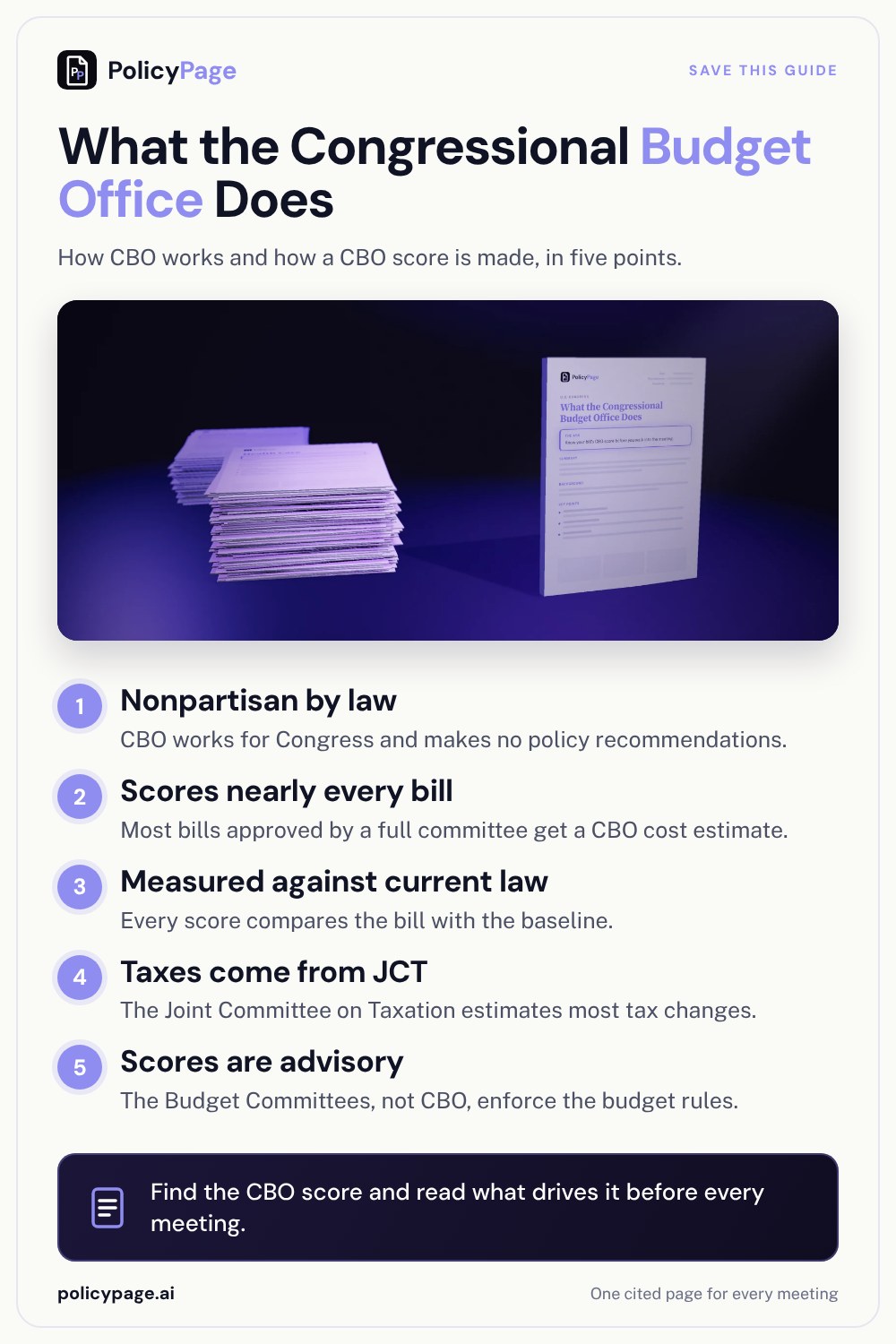
The Congressional Budget Office (CBO) is the nonpartisan agency that tells Congress what bills would cost. It projects federal spending, revenue, and the deficit over the next 10 years, and it writes a cost estimate, often called a "CBO score," for nearly every bill a full House or Senate committee approves.
CBO does not make policy recommendations, and it does not enforce budget rules. Its job is to give lawmakers of both parties the same set of numbers to argue about. Those numbers shape which bills move, how they get changed, and whether they can pass under the budget rules that each chamber has set.
This guide answers the questions people search most: "what does the CBO do," "what is a CBO score," "is the Congressional Budget Office nonpartisan," and "who controls the CBO." It also walks through how CBO scores a bill, step by step.
What does the Congressional Budget Office do?
Congress created CBO in the Congressional Budget Act of 1974 "to help Congress play a stronger role in budget matters," according to CBO's own introduction to the agency. Before then, lawmakers relied mostly on numbers from the executive branch. CBO says it offers "an alternative to the information provided by the Office of Management and Budget and other agencies in the executive branch."
CBO, in effect Congress's in-house accountant and forecaster, does five main kinds of work, as listed on its products page:
- Baseline projections. Each year CBO publishes The Budget and Economic Outlook, which projects spending, revenue, deficits, and debt for the next decade if current laws stay the same.
- Cost estimates. CBO estimates how a bill would change federal spending and revenue. It publishes about a thousand of these a year.
- Technical assistance. CBO answers thousands of requests a year from committee staff who are drafting bills and want to know what different options would cost.
- Analytic reports and budget options. CBO writes reports on major policy areas, and every two years it publishes a volume of options for reducing deficits, each with a 10-year estimate.
- Tracking the budget. CBO publishes a monthly budget review on the sixth working day of each month and analyzes the President's budget each spring using its own methods.
The Budget and Economic Outlook is the best-known product. The 2026 edition, released February 11, 2026, projected a federal deficit of $1.9 trillion for fiscal year 2026 and federal debt rising to 120 percent of gross domestic product (GDP) in 2036. Those figures assume current law. They are not a prediction of what Congress will do.
Who controls the CBO? Is it nonpartisan?
CBO works for Congress, not for the President, and not for one party. Under the Budget Act, it serves all congressional committees. Its "chief responsibility" is to the House and Senate Budget Committees, with priority also given to the Appropriations Committees, the House Ways and Means Committee, and the Senate Finance Committee, as CBO explains in 10 Things to Know About CBO.
The law that created CBO, now 2 U.S.C. 601, sets out who runs it:
- The Director is appointed by the Speaker of the House and the President pro tempore of the Senate, after they consider recommendations from the two Budget Committees.
- The appointment must be made "without regard to political affiliation and solely on the basis of his fitness to perform his duties."
- The Director serves a 4-year term that ends on January 3 of the year before each presidential election.
- Either the House or the Senate can remove the Director by resolution.
- All CBO staff must also be hired without regard to political affiliation.
So who controls the CBO? Congress sets its priorities and its budget, and congressional leaders choose its Director. But no single member, committee, or party directs its findings.
Is the Congressional Budget Office really nonpartisan? CBO describes itself as "objective, impartial, and nonpartisan." It has about 275 staff members, with the largest share of its analysts focused on health policy. It enforces ethics rules against conflicts of interest, has its work reviewed internally, and seeks outside review from experts, including its Panel of Economic Advisers and Panel of Health Advisers. It also publishes reviews of how accurate its past projections were.
CBO is also clear about what it will not do. Its processes page explains that policy choices "inevitably involve value judgments that CBO does not and should not make." That is why a CBO report can say what a policy would cost and who it would affect, but never whether Congress should pass it. CBO publishes the basis for each estimate so anyone can check its reasoning.
What is a CBO score?
A CBO score is CBO's official estimate of how a bill would change federal spending and revenue. "Score" is just Washington shorthand for a cost estimate. For example, if someone says a bill "scores at $5 billion," they mean CBO estimates it would add $5 billion to the deficit over the budget window, usually 10 years.
The law behind it is short. Under 2 U.S.C. 653, CBO must, "to the extent practicable," prepare an estimate for each public bill reported by a House or Senate committee, except the Appropriations Committees. The estimate covers the fiscal year the bill would take effect and at least the 4 years after it, along with the basis for the estimate. If the estimate is ready in time, it goes into the committee's report on the bill.
In practice, CBO's estimates usually go further. According to CBO's products page, a cost estimate typically covers the next 5 or 10 years, depending on the type of spending, and shows how a bill would affect:
- Discretionary spending, the money Congress provides each year through appropriations;
- Mandatory spending (also called direct spending), such as benefit programs that run on their own under existing law;
- Revenues, such as taxes, fees, and fines; and
- Mandates, meaning costs a bill would impose on state, local, and tribal governments or on the private sector.
A state version of the same idea is the fiscal note, the cost estimate that state legislatures, including Florida's, attach to their bills.
How does CBO score a bill, step by step?
CBO describes the process across its products and processes pages. Here it is as five steps, from the moment a bill is ready to be scored to the moment the score starts to matter on the floor.
Step 1: A committee approves the bill, or asks early
The usual trigger is a committee vote. CBO is required to produce a cost estimate for nearly every bill approved by a full committee of the House or the Senate, usually after a markup. CBO says it tries to finish an estimate before the bill reaches the floor of either chamber.
Much of the work starts earlier. Committee staff often ask CBO for preliminary estimates while they are still drafting, so they can compare options and change the bill to fit a budget target. CBO keeps that early work confidential until the proposal is public. CBO also scores bills at other stages if a relevant committee or congressional leadership asks, and it reviews bills the House plans to pass under suspension of the rules. Individual members' offices can ask for preliminary help too, "as time allows."
Appropriations bills are handled differently. They do not get written cost estimates, but CBO estimates their budget effects for the Appropriations Committees.
Step 2: Analysts measure the bill against the baseline
Every score is a comparison. CBO measures what would happen if the bill became law against what would happen under current law. That current-law picture is the baseline.
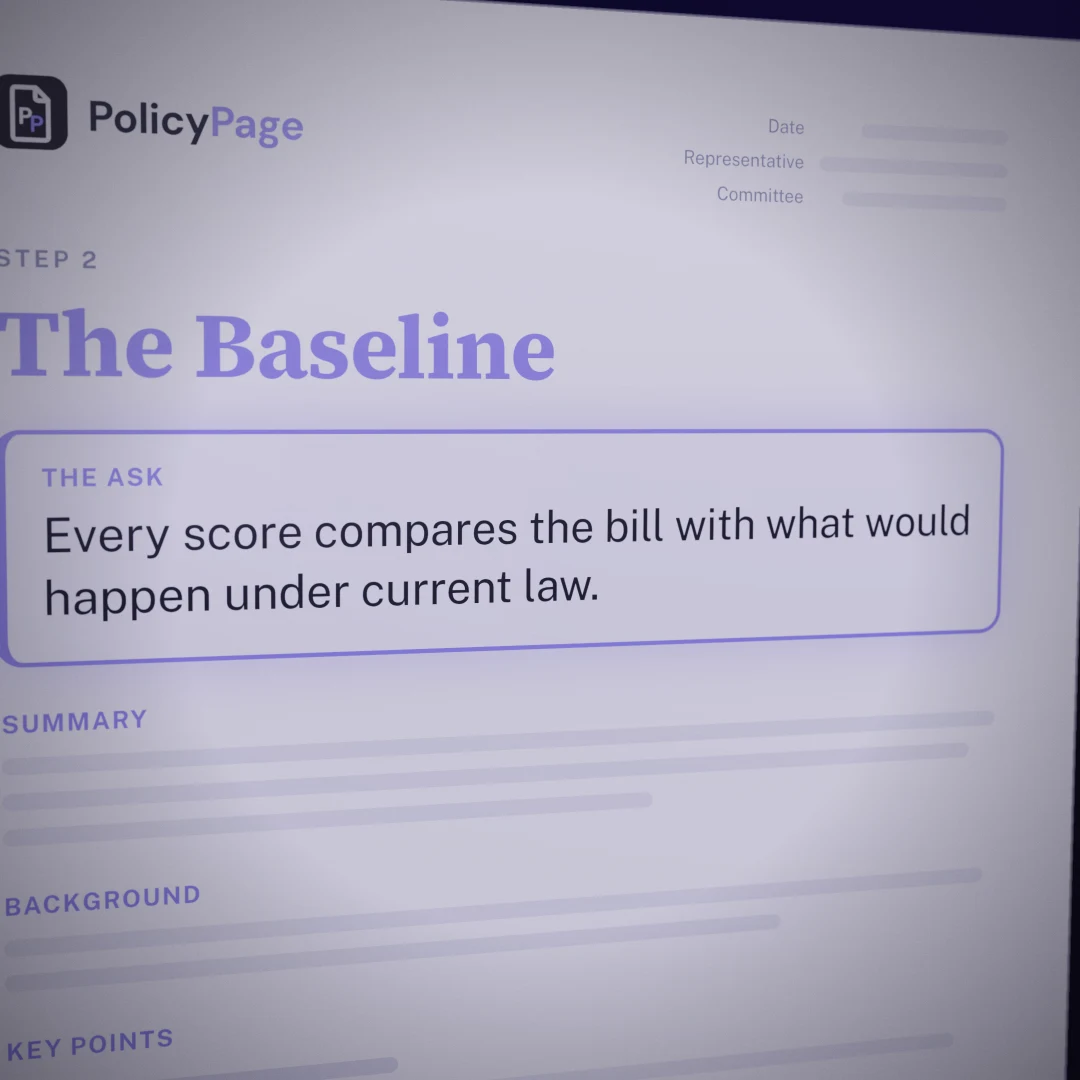
CBO's processes page explains that the baseline assumes "current laws governing federal revenues and spending will generally remain unchanged." It is not a forecast of what Congress will do. It is a neutral starting line, so that every bill is measured the same way.
CBO also takes each bill "as it is written." It does not guess what Congress meant, and it does not assume future changes. If a program in the bill expires after three years, the estimate counts three years, even if everyone expects Congress to extend it.
Step 3: Analysts estimate how people would respond
A bill changes behavior, and behavior changes costs. CBO's analysts build those effects into their estimates. CBO gives examples: how much farmers would change what they plant under a new farm policy (the kind set in the farm bill), how many people would sign up for a benefit if the rules changed, or how much health care would be provided if Medicare changed what it pays.
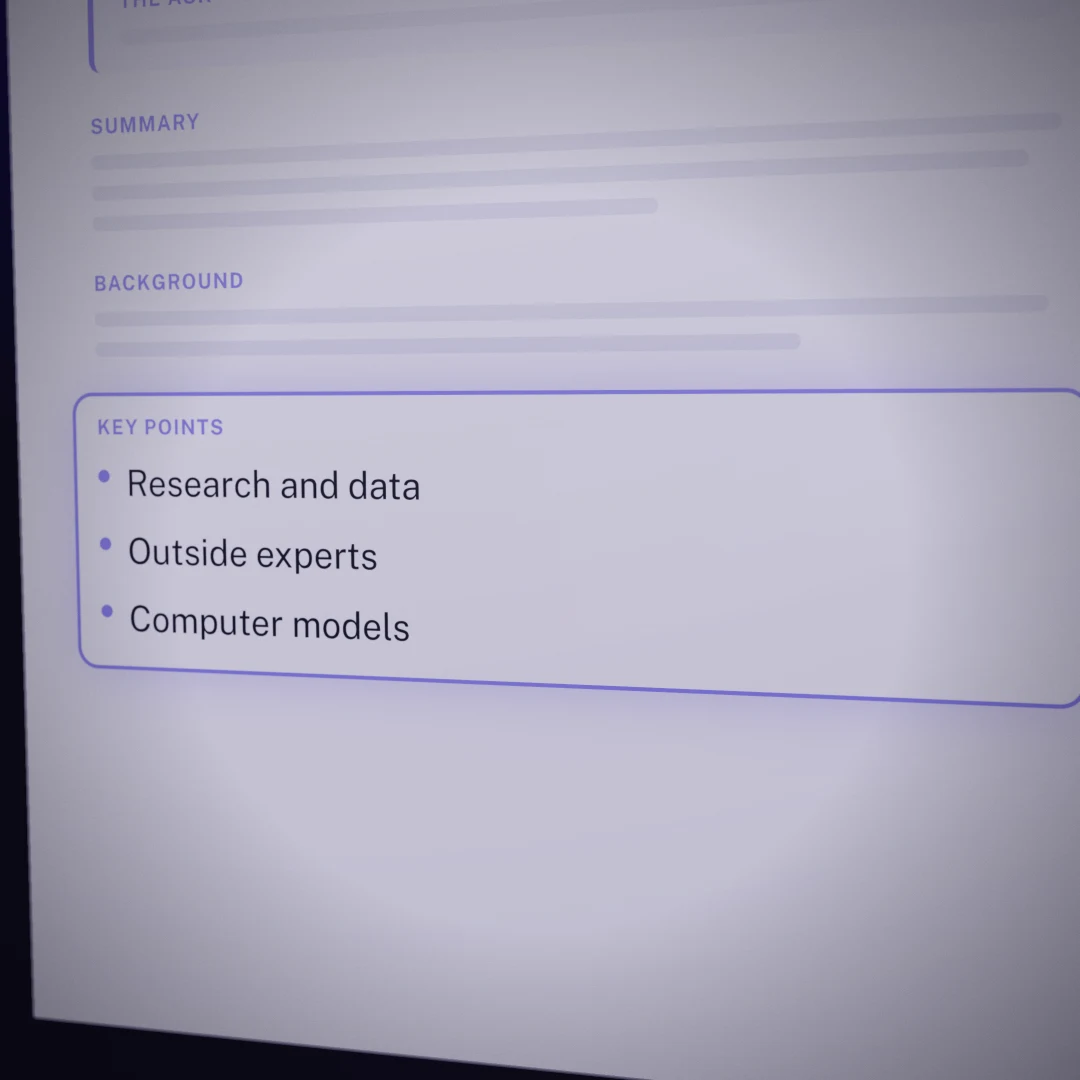
To do this, CBO uses research, government and private data, outside experts, and many computer models. But CBO stresses that "models do not produce CBO's estimates; CBO does." Analysts combine model results with other evidence. Its stated goal is an estimate "in the middle of the distribution of potential outcomes."
One kind of effect is usually left out. By long-standing convention, CBO cost estimates generally do not include "dynamic analysis," meaning the wider effects a bill would have on the whole economy, such as changes in how much people work or invest, and the budget effects that follow. CBO provides that information when the Budget Committees ask and when it is practical.
For tax bills, CBO does not make the main estimate itself. Federal law requires CBO to use revenue estimates from the Joint Committee on Taxation (JCT) for income, estate and gift, excise, and payroll taxes. CBO then combines JCT's numbers with its own estimates for the rest of the bill.
Step 4: CBO publishes the cost estimate
CBO delivers the estimate to the bill's sponsor, the leaders of the committee that wrote it, and the Budget Committees. Soon after, it posts the estimate on its website. Estimates also appear on the bill's page on congress.gov, according to CBO's processes page.
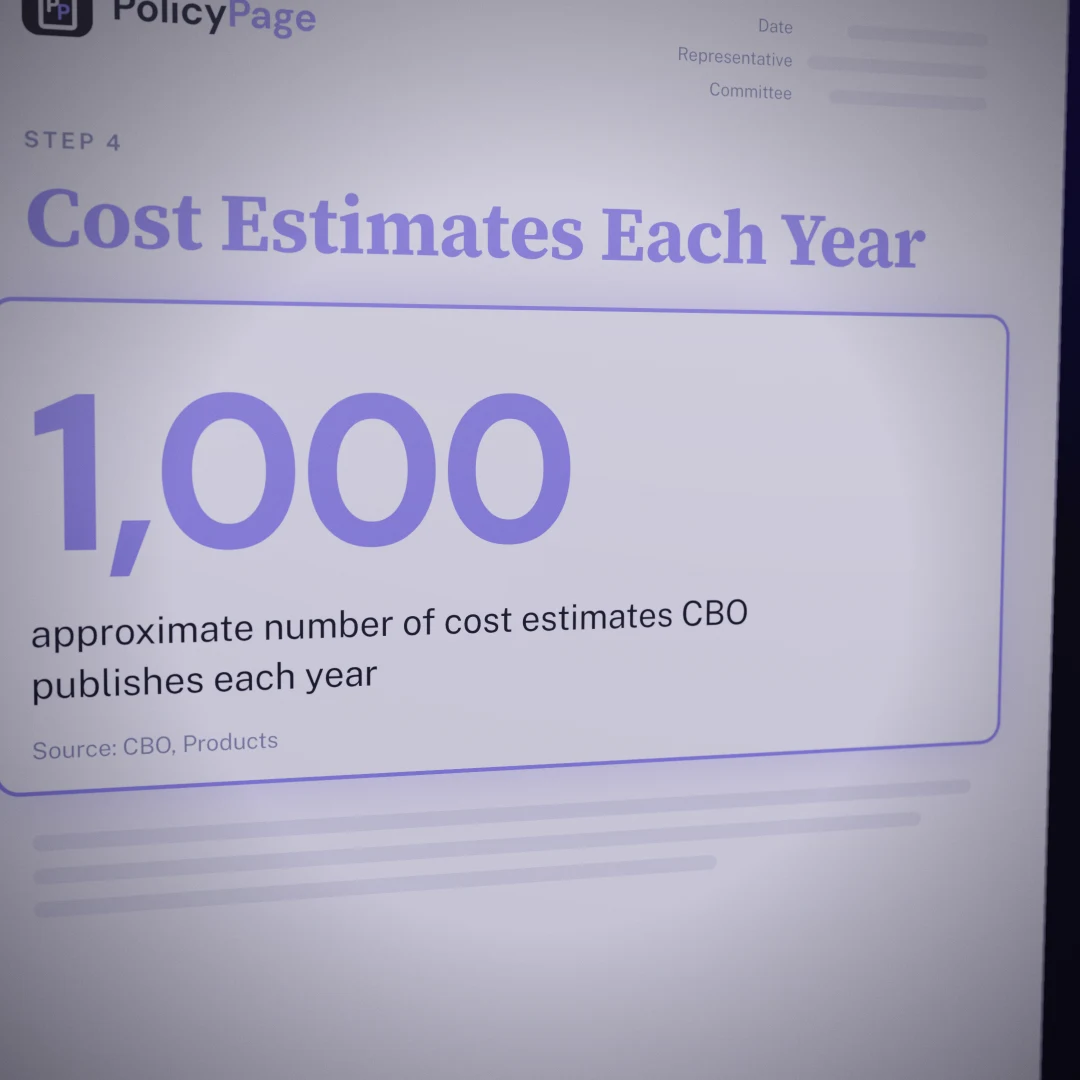
A published estimate shows the bill's budget effects over the next 5 or 10 years, describes the basis for the estimate, and includes the review of mandates on state, local, and tribal governments and the private sector. The law requires CBO to explain the basis for each estimate, so the reasoning is on the page, not hidden. CBO can also publish estimates at later stages, such as for a version headed to the floor, if a relevant committee or congressional leadership asks.
Step 5: The Budget Committees use the score to enforce the rules
Here is the part many people miss: a CBO score is advisory. CBO says its estimates "can, but need not" be used to enforce budget rules, and CBO does not enforce them. The Budget Committees are Congress's official scorekeepers, and under 2 U.S.C. 601 they "determine all estimates with respect to scoring points of order."
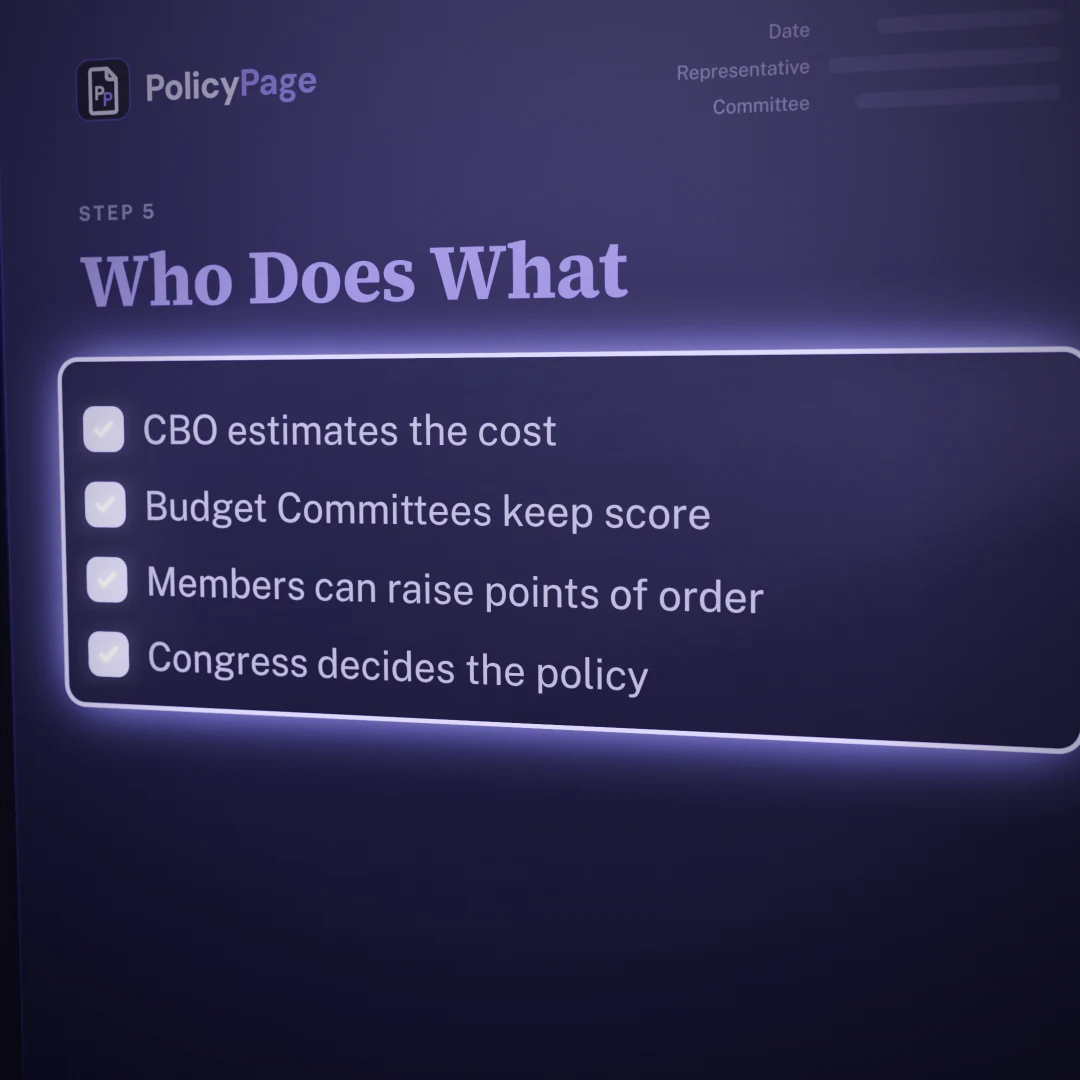
A point of order is an objection a member raises on the floor that a bill breaks a chamber rule. Many budget rules depend on costs. Many of those rules compare a bill's costs with the levels in the budget resolution, and some look at costs in the decades after the 10-year window. CBO now adds that longer-term information to its estimates to help the committees decide points of order. That is why a score can change a bill's path. CBO notes that committee staff often adjust a proposal in response to its preliminary estimates before the proposal goes public.
Scores matter most of all in budget reconciliation, where the bill has to meet the budget targets the budget resolution set. CBO also sends the Budget and Appropriations Committees regular scorekeeping reports that track whether Congress's actions fit the levels set in the budget resolution.
CBO vs OMB vs JCT: what is the difference?
People often mix up the three main federal budget scorekeepers. Here is how they compare, based on CBO's products page, the Joint Committee on Taxation, and the Office of Management and Budget:
| Congressional Budget Office (CBO) | Office of Management and Budget (OMB) | Joint Committee on Taxation (JCT) | |
|---|---|---|---|
| Branch | Legislative (Congress) | Executive (White House) | Legislative (Congress) |
| Works for | All committees, mainly the Budget Committees | The President | The tax-writing committees and members of both parties |
| Main job | Budget projections and cost estimates for most bills | Helping the President meet policy, budget, management, and regulatory goals, including building the President's budget | Official revenue estimates for all tax legislation |
| Makes policy recommendations? | No | It supports the President's policy goals | No, it calls itself nonpartisan |
The JCT, set up under the Revenue Act of 1926, is a congressional committee whose staff of economists, attorneys, and accountants prepares the "official revenue estimates of all tax legislation considered by the Congress." Its chair rotates between the chairs of the Senate Finance Committee and the House Ways and Means Committee.
The key contrast is between CBO and OMB. OMB works for the President and helps carry out the President's agenda, including the budget request that starts the federal budget process. CBO was built so Congress would not have to rely on those numbers alone. After the President submits a budget, CBO re-estimates it using its own economic forecast and methods, so Congress can compare proposals on the same terms.
Why CBO scores matter for advocates
If you work on a bill, expect the office you meet to ask what it costs. Because budget rules and points of order turn on CBO's numbers, a bill's score can decide whether it reaches the floor at all.
A few practical points help:
- Find the score before the meeting. Search the bill on congress.gov or on cbo.gov. If the bill has passed a committee, there is probably an estimate. If it has not, there may be none yet.
- Read the basis, not just the total. The explanation tells you what drives the cost. If one provision makes up most of it, that is where a fix would help.
- Know the time window. A 10-year total and a 5-year total are not the same number. Check which years the estimate covers before you compare it with anything else.
- Separate tax and spending effects. If your bill changes the tax code, the revenue part comes from JCT, and CBO's estimate will include it.
- Do not overstate the score. A CBO estimate is an estimate. It is not a ruling on whether a bill is good policy, and CBO never says it is.
A short, accurate summary of the score, with a link to the estimate, is often more useful to a staffer than pages of argument. If you are preparing to meet a member of Congress or a Florida legislator, PolicyPage can turn a bill, its cost estimate, and your ask into a free, cited one-page brief tailored to the office you are visiting.
The bottom line
The Congressional Budget Office is Congress's nonpartisan budget referee. It projects where the budget is heading under current law, scores nearly every bill that clears a full committee, and explains how it reached each number. It does not recommend policy or enforce rules. The Budget Committees do the enforcing, and lawmakers decide what to do with the numbers.
Save this guide
Frequently asked questions
What does the Congressional Budget Office do?
CBO gives Congress nonpartisan budget and economic information. It projects spending, revenue, and deficits for the next 10 years under current law and writes cost estimates for nearly every bill approved by a full House or Senate committee.
What is a CBO score?
A CBO score is the Congressional Budget Office's estimate of how a bill would change federal spending and revenue, usually over 10 years. It is advisory; the House and Senate Budget Committees decide how it is used to enforce budget rules.
Is the Congressional Budget Office nonpartisan?
Yes. By law, its Director and staff are hired without regard to political affiliation, and CBO makes no policy recommendations. It publishes the basis for each estimate so anyone can check its work.
Who controls the CBO?
CBO works for Congress. Its Director is appointed by the Speaker of the House and the President pro tempore of the Senate after recommendations from the Budget Committees, serves a 4-year term, and can be removed by either chamber.
What is the difference between CBO and OMB?
CBO is part of Congress and provides nonpartisan estimates without recommendations. The Office of Management and Budget (OMB) is part of the White House and helps the President build the budget and carry out the President's policy goals.
Does CBO score tax bills?
For income, estate and gift, excise, and payroll taxes, the law requires CBO to use revenue estimates from the Joint Committee on Taxation. CBO combines those with its own estimates of the bill's other effects.
Do appropriations bills get a CBO score?
Appropriations bills do not get written cost estimates, but CBO estimates their budget effects for the Appropriations Committees and tracks whether spending fits the budget resolution.
Terms in this article
Sources
- 1.Introduction to CBO, Congressional Budget Office
- 2.10 Things to Know About CBO, Congressional Budget Office
- 3.Processes, Congressional Budget Office
- 4.Products, Congressional Budget Office
- 5.The Budget and Economic Outlook: 2026 to 2036 (February 11, 2026), Congressional Budget Office
- 6.2 U.S. Code 601: Establishment, Legal Information Institute, Cornell Law School
- 7.2 U.S. Code 653: Analysis by Congressional Budget Office, Legal Information Institute, Cornell Law School
- 8.Overview, Joint Committee on Taxation
- 9.Office of Management and Budget, The White House
New to some of the terms here? The advocacy glossary defines them in plain English.