
What Is the Congressional Research Service? How to Use CRS Reports
The Congressional Research Service (CRS) is Congress's nonpartisan research office in the Library of Congress. Here is what it does and how to use its reports.
11 minute read10 sources
In this article
- What is the Congressional Research Service?
- What does the Congressional Research Service do?
- Is the Congressional Research Service a government agency?
- Is the Congressional Research Service nonpartisan and reliable?
- What are CRS reports?
- How to find and read a CRS report
- Congressional Research Service vs GAO vs CBO
- How CRS reports help before a meeting with Congress
- The bottom line
The Congressional Research Service (CRS) is Congress's own nonpartisan research office, housed inside the Library of Congress, that answers questions and writes reports for members of Congress, committees and their staff. It works only for Congress, but since 2018 its general reports have been posted free for anyone to read on Congress.gov.
Think of CRS as a reference desk and a think tank rolled into one, with a single client. A senator's office can call CRS and ask how a program is funded, what a court ruling means for a bill, or how many people in a state get a federal benefit, and a CRS expert will answer. Congress's official site describes CRS as working exclusively for Congress, providing timely, objective and authoritative research to committees and members of both chambers. This guide explains what CRS does, who runs it, how reliable its reports are, how it differs from the Government Accountability Office and the Congressional Budget Office, and how to find and read a CRS report before a meeting.
What is the Congressional Research Service?
The Congressional Research Service is a department of the Library of Congress that provides research, analysis and confidential advice to Congress. The federal government's agency directory sums up its job as serving Congress throughout the legislative process with research that is timely, objective, authoritative and confidential. Its main address is 101 Independence Avenue SE in Washington, DC, the Library of Congress campus across from the Capitol.
CRS describes itself in one of its own guides as Congress's own nonpartisan think tank, reference library and information hub. It serves every congressional office, including the offices members keep back home in their districts and states.
The service is older than most people expect. It began in 1914 as the Legislative Reference Service, a small staff that looked up reference information for members. As government grew more complex, it shifted from a reference bureau to a research and analysis arm. The Legislative Reorganization Act of 1970 gave it its current name and a bigger mission, and the law that renamed it, now 2 U.S.C. 166, still sets its duties today.
What does the Congressional Research Service do?
The short answer is that CRS answers Congress's questions. The longer answer is set out in law. Under 2 U.S.C. 166, CRS must do its work without partisan bias, and its duties include:
- Advising any House, Senate or joint committee, on request, about bills and proposals in its area, including the likely results of a proposal and the alternatives to it.
- Giving each committee, at the start of a new Congress, a list of programs in its area that are set to expire during that Congress, plus a list of subjects worth studying in depth.
- Collecting and analyzing data that bears on legislation, both when asked and on its own initiative in anticipation of questions.
- Writing summaries of public bills and resolutions as they are introduced.
- Preparing a short memo, on request, about any bill set for a committee hearing, covering its purpose, similar past bills and what happened to them.
The law also lists 22 broad fields where CRS can appoint senior experts, from agriculture, education and housing to national defense, taxation and veterans' affairs.
The numbers show how much of this work happens out of public view. In fiscal year 2025, which ran from October 1, 2024 through September 30, 2025, the CRS annual report counted 76,228 custom responses to requests from Congress. CRS also held 308 seminars and trainings with about 11,800 attendees, summarized 5,405 bill versions, published 1,158 new products (including 1,042 new reports), and updated 1,967 more. It reported serving 100 percent of member offices.
Much of that work is private. Most of those 76,228 responses went to one office, and many were confidential. The public reports are only the part of CRS that the rest of us can see.
CRS also helps with the day to day work of member offices. Its guide for district and state staff points to resources on casework, grants and service academy nominations, and notes that CRS keeps a directory of about 200 congressional liaison offices at federal agencies. That help supports how offices serve their constituents, even though CRS itself does not talk to the public.
Is the Congressional Research Service a government agency?
Yes. CRS is a federal office in the legislative branch, part of the Library of Congress, and it runs on money Congress appropriates each year. In fiscal year 2025, the annual report says, CRS managed $136.1 million in appropriated funds, plus about $730 thousand in grant funds used mainly for its seminar for new members of Congress.
Who runs it? A Director leads CRS. Under the law, the Librarian of Congress appoints the Director after consulting the Joint Committee on the Library, a committee made up of members of both chambers. The same law tells the Librarian to give CRS complete research independence and as much administrative independence as practical.
Who works there? CRS reported about 600 staff in fiscal year 2025, and 94 percent of them provide direct support to Congress. They include attorneys, economists, policy analysts and research librarians organized into divisions such as the American Law Division, the Domestic Social Policy Division and the Foreign Affairs, Defense, and Trade Division. The law requires that CRS hire people without regard to political affiliation and solely on their fitness for the job.
Is the Congressional Research Service nonpartisan and reliable?
CRS is nonpartisan by law. Its duties must be carried out without partisan bias, and every public report carries a required statement that CRS serves as nonpartisan shared staff to congressional committees and members and operates solely at the direction of Congress.
CRS reports are not peer reviewed the way academic journal articles are, but they do go through an internal review. The annual report describes an Editorial and Review Office that edits, reviews and approves CRS research products before they go out, to keep the analysis objective, authoritative and nonpartisan.
A few cautions help you use CRS reports well:
- Check the date. Congress.gov marks each product as active or archived. Archived products were current as of their publication date but have not been updated, so their facts may be stale.
- Know what CRS does not do. CRS lays out options and their likely effects. It does not tell Congress which option to choose, and its reports are written for lawmakers, not for the general public.
- Read the disclaimer. The required statement says information in a CRS report should not be relied on for purposes other than public understanding of what CRS provided to Congress. In other words, a CRS report explains an issue. It is not legal advice and not an official position of Congress.
If you are a student, ask your instructor whether CRS reports count as scholarly sources for your assignment. Either way, citing the report number and date makes it easy for a reader to find the exact version you used.
What are CRS reports?
CRS reports are the written research products CRS makes available to every member and committee. Congress.gov lists several product types:
| Product | What it is | Best for |
|---|---|---|
| Report | A full, nonpartisan analysis, from several pages to more than 100 | Deep background on an issue |
| In Focus | A brief, executive-level overview | A quick start on a topic |
| Insight | A concise, timely take on a subject | Something in the news |
| Legal Sidebar | A concise legal analysis from the American Law Division | A new court ruling or law |
| Infographic | Maps, charts, timelines or diagrams in condensed form | Seeing a process at a glance |
| Testimony | A written statement CRS prepared for a committee hearing | What CRS told a committee |
| Appropriations Status Table | The status of spending bills, continuing resolutions and budget resolutions | Tracking the year's funding |
Each product has a number, such as R48291 for a report or IF12500 for an In Focus, and that number is the easiest way to find it again.
Until 2018, the public had no official way to read these reports. Congress changed that in the Consolidated Appropriations Act of 2018, signed March 23, 2018. The law, now 2 U.S.C. 166a, directs the Library of Congress to keep a public website of CRS reports that is free, searchable, sortable and downloadable in bulk, and updated as new reports come out.
Two limits matter. First, confidential work for a single office is excluded, so the memos CRS writes privately for one member stay private unless that office shares them. Second, the law says nothing stops members and committees from sharing CRS products with the public themselves, including on their own websites.
CRS reports are also free to reuse. As works of the U.S. government, they are not subject to copyright in the United States and can be shared in full without permission, though a report may include third party images or material that still need permission.
How to find and read a CRS report
You do not need a special account to read CRS reports. Here is a simple routine that works for almost any topic.
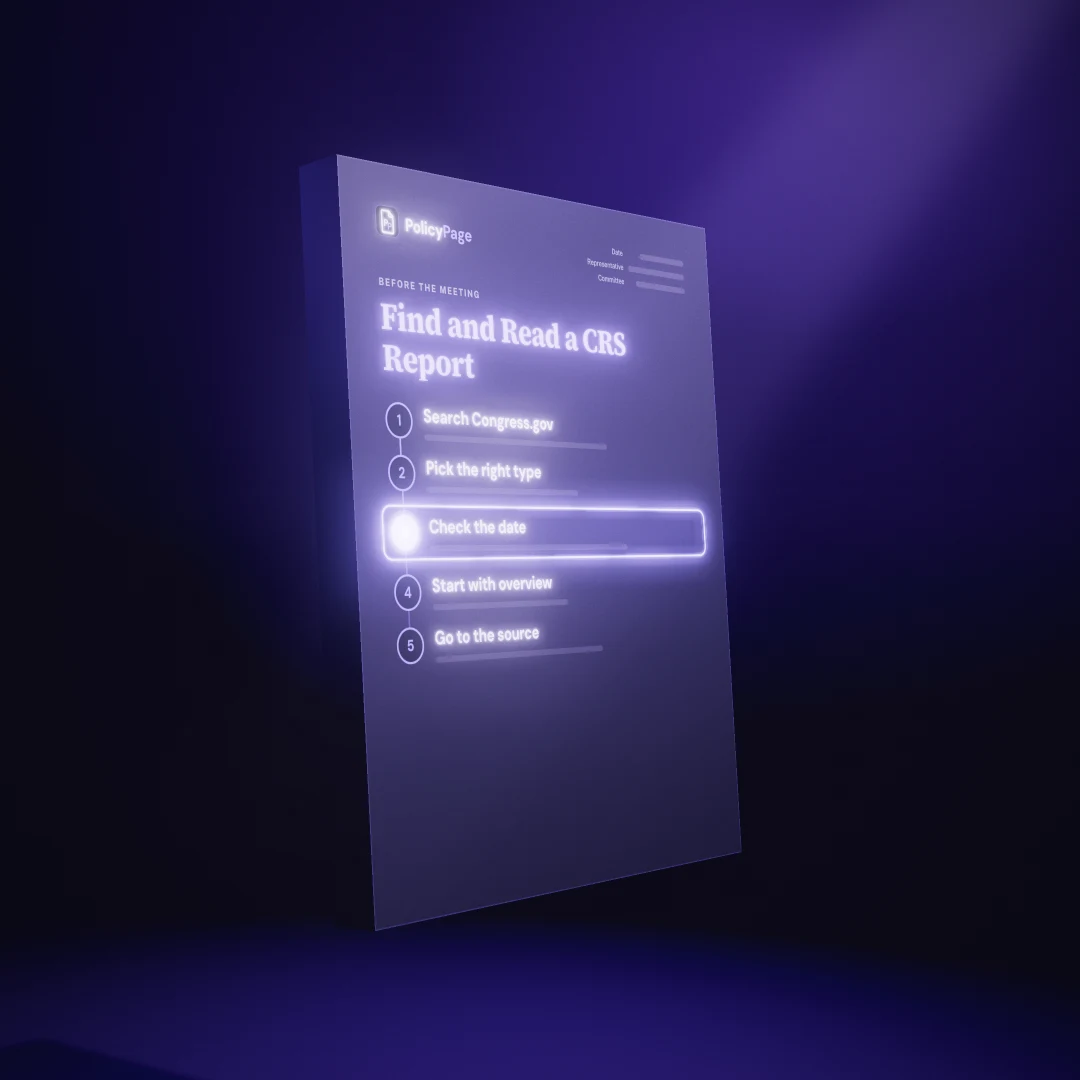
- Search Congress.gov. Type your topic in the search bar on Congress.gov, then choose CRS Products (Library of Congress) under Limit Your Search. If you already know the number, a search such as displayCitation:R42843 returns only that report.
- Pick the right product type. Start with an In Focus for a quick overview and move to a full report when you need detail. Use a Legal Sidebar for a court ruling and the Appropriations Status Table for spending bills.
- Check the date and status. Each product page shows the type, number, topics and publication date, plus a link to earlier versions. For example, the CRS report on committee types and roles, 98-241, shows a publication date of November 25, 2025. Prefer an active, recently updated product.
- Start with the overview. If the report opens with a summary, read it first, then jump to the sections that match your question. You rarely need all of a long report.
- Go to the original source. When a report cites a law, a court case or agency data, open that source for the exact number or wording you plan to repeat in a meeting.
One more tip: the PDF Version History link on a product page shows earlier versions, which helps when a fact you remember has since been updated.
Congressional Research Service vs GAO vs CBO
People often confuse CRS with the other two research agencies that serve Congress. All three are nonpartisan and part of the legislative branch, but each has a different job.
| Congressional Research Service (CRS) | Government Accountability Office (GAO) | Congressional Budget Office (CBO) | |
|---|---|---|---|
| Created | 1914 as the Legislative Reference Service; renamed in 1970 | 1921, by the Budget and Accounting Act | 1974, by the Congressional Budget Act |
| Main job | Research, analysis and confidential advice on any issue | Audits and investigations of how federal money is spent | Budget and economic analysis, including cost estimates for bills |
| Who it serves | Every member and committee | Congress, with reports that also go to agencies | All committees, especially the Budget Committees |
| Public work | General reports on Congress.gov; confidential work stays private | Public reports, testimony and legal decisions | Public cost estimates and reports |
| Recommends policy? | No | Recommends ways agencies can improve | No |
GAO calls itself the congressional watchdog. It examines how taxpayer dollars are spent and helps the government work more efficiently. CBO was created by the Budget Act of 1974 to give Congress objective, nonpartisan budget information, and it does not make policy recommendations. If you want to know what a bill will cost, you want a CBO score. Our guide to what the Congressional Budget Office does explains how those estimates are made.
If you want to understand how a program works, what the law says, or what options Congress has, start with CRS.
How CRS reports help before a meeting with Congress
Staff in congressional offices read CRS reports every day. CRS reported more than 1 million congressional views of pages on its internal website in fiscal year 2025. When you cite the same report a staffer has on their desk, you are speaking a shared language.
Here is how advocates and organizations use them:
- Get the basics right. A CRS report on your program is a fast, neutral way to check how it is funded, which standing committee oversees it, and when it expires. Our guide to how congressional committees work shows why the committee matters.
- Use neutral numbers. A figure from CRS is harder to dismiss than one from an interest group, because the office you are meeting trusts the source.
- Know the options on the table. CRS reports lay out the choices Congress is weighing, which helps you frame your ask as one of those choices.
- Keep it short. A 60 page report is background reading for you, not a handout for them. The legislative assistant you meet has a few minutes. Pull the one or two facts that matter and cite the report number so they can look it up.
That last step is where most meeting prep stalls, because turning a long report into one clear page for a specific office takes time. If you are preparing to meet a member of Congress or a state legislator, PolicyPage can turn your notes and sources into a one-page, cited policy brief tailored to the office you are visiting. It is free.
The bottom line
The Congressional Research Service is Congress's in-house, nonpartisan research office. It began in 1914, took its current name in 1970, and today has about 600 staff answering tens of thousands of requests a year from every member office. Its confidential work stays with Congress, but its general reports are free to read on Congress.gov. Search by topic or number, check the date, read the summary, and follow the footnotes, and you will walk into your next meeting with the same facts the staff are reading.
Frequently asked questions
What is the Congressional Research Service?
The Congressional Research Service (CRS) is a nonpartisan research office inside the Library of Congress that works only for Congress. It answers questions from members, committees and staff and writes reports on the issues Congress is weighing.
What does the Congressional Research Service do?
CRS analyzes bills and policy options, writes reports, summarizes bills as they are introduced, briefs committees and trains congressional staff. In fiscal year 2025 it answered 76,228 custom requests from Congress.
Is the Congressional Research Service a government agency?
Yes. CRS is a federal office in the legislative branch and a department of the Library of Congress, funded by money Congress appropriates each year.
Who runs the Congressional Research Service?
A Director runs CRS. The Librarian of Congress appoints the Director after consulting the Joint Committee on the Library, and the law gives CRS complete research independence.
Is the Congressional Research Service nonpartisan?
Yes. Federal law requires CRS to do its work without partisan bias and to hire staff without regard to political affiliation, and every public report states that CRS serves as nonpartisan shared staff to Congress.
Where can I find CRS reports?
CRS reports are free on Congress.gov. Search your topic, choose CRS Products under Limit Your Search, or search by report number if you have it.
What is the difference between CRS and GAO?
CRS researches issues and advises Congress, often confidentially. The Government Accountability Office audits and investigates how federal agencies spend money and recommends improvements.
Terms in this article
Sources
- 1.About Congressional Research Service (CRS) Products, Congress.gov, Library of Congress
- 2.CRS Services to District and State Offices: Overview and Selected Resources (IF12696, updated June 2, 2026), Congressional Research Service, Congress.gov
- 3.CRS Annual Report, Fiscal Year 2025, Congressional Research Service, Library of Congress
- 4.History and Mission, Congressional Research Service, Library of Congress
- 5.2 U.S. Code 166: Congressional Research Service, Legal Information Institute, Cornell Law School
- 6.2 U.S. Code 166a: Equal access to Congressional Research Service Reports, Legal Information Institute, Cornell Law School
- 7.Congressional Research Service (CRS), USAGov
- 8.Committee Types and Roles (CRS 98-241), Congressional Research Service, Congress.gov
- 9.About GAO, U.S. Government Accountability Office
- 10.Introduction to CBO, Congressional Budget Office
New to some of the terms here? The advocacy glossary defines them in plain English.