
Grassroots vs Grasstops Advocacy: What Each Means and How They Work
Grassroots advocacy rallies many everyday constituents. Grasstops advocacy enlists a few trusted local leaders. Here is what each means and how they work together.
12 minute read9 sources
In this article

Grassroots advocacy means asking many everyday people, especially a legislator's own constituents, to contact that legislator about an issue. Grasstops advocacy means asking a small number of trusted local leaders, such as business owners, local officials, or heads of community groups, to reach out because they already have the legislator's ear. The short version: grassroots is about numbers, and grasstops is about relationships. Most strong campaigns use both, and they work best when every voice delivers the same clear request.
People search for this in many ways: "grassroots advocacy meaning," "grasstops meaning," "grasstops vs grassroots," and "grassroots vs grasstops lobbying." This guide answers all of them in plain English. It covers what each term means, how they differ, what the law says about grassroots lobbying, why congressional staff pay attention to constituents, what astroturfing is, and how to bring both approaches together before a meeting with a legislator.
What is grassroots advocacy?
Grassroots advocacy is organizing everyday people to speak up to their elected officials. In practice it looks like calls, emails, letters, petitions, town hall questions, and visits to a district office, all coming from people who live and vote in the area a legislator represents. The PolicyPage glossary defines grassroots advocacy as mobilizing everyday people, especially constituents, to contact their legislators about an issue.
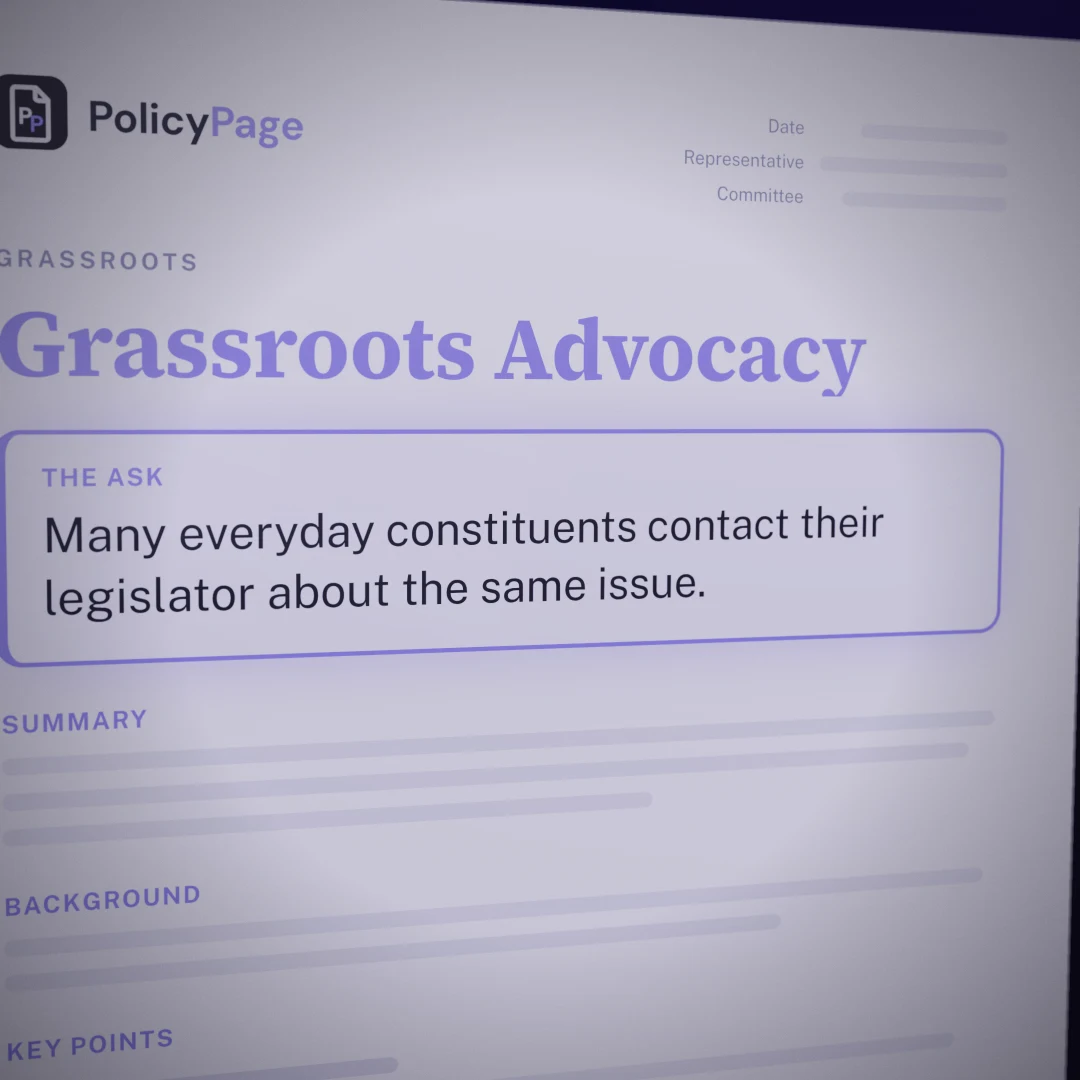
The word comes from ordinary English. Merriam-Webster defines grassroots as the basic level of society or of an organization, especially when compared with centralized power. As an adjective, it means something operating at that basic level, and the dictionary's own example is grassroots political support. The image is simple: the grass roots are the base, close to the ground, and they spread wide.
That is the strength of grassroots work. One person writing to a legislator is a single message. A thousand people from the same district writing about the same bill is a signal that voters care. Grassroots advocacy gives an office evidence that an issue matters to the people it represents, not just to the group that raised it.
Grassroots work is open to anyone. A parent, a nurse, a farmer, a student, or a retiree can be a grassroots advocate. They do not need a title or a connection. They only need to be a constituent with a view and a willingness to share it.
What does a grassroots advocate do?
A grassroots advocate usually does a few simple things. They learn the basics of an issue, they find out who represents them, and they contact that person's office with a specific request. Some go further and invite neighbors to do the same, speak at a public meeting, or join an advocacy day where many constituents visit their legislators on the same day. Our guide on how to plan an advocacy day walks through how organizations set one up.
What is grasstops advocacy?
Grasstops advocacy is engaging a small number of influential people who already have a relationship with a legislator, and asking them to make the case. The PolicyPage glossary defines grasstops advocacy as engaging influential community leaders, such as business owners, local officials, and donors, who have personal relationships with a legislator.
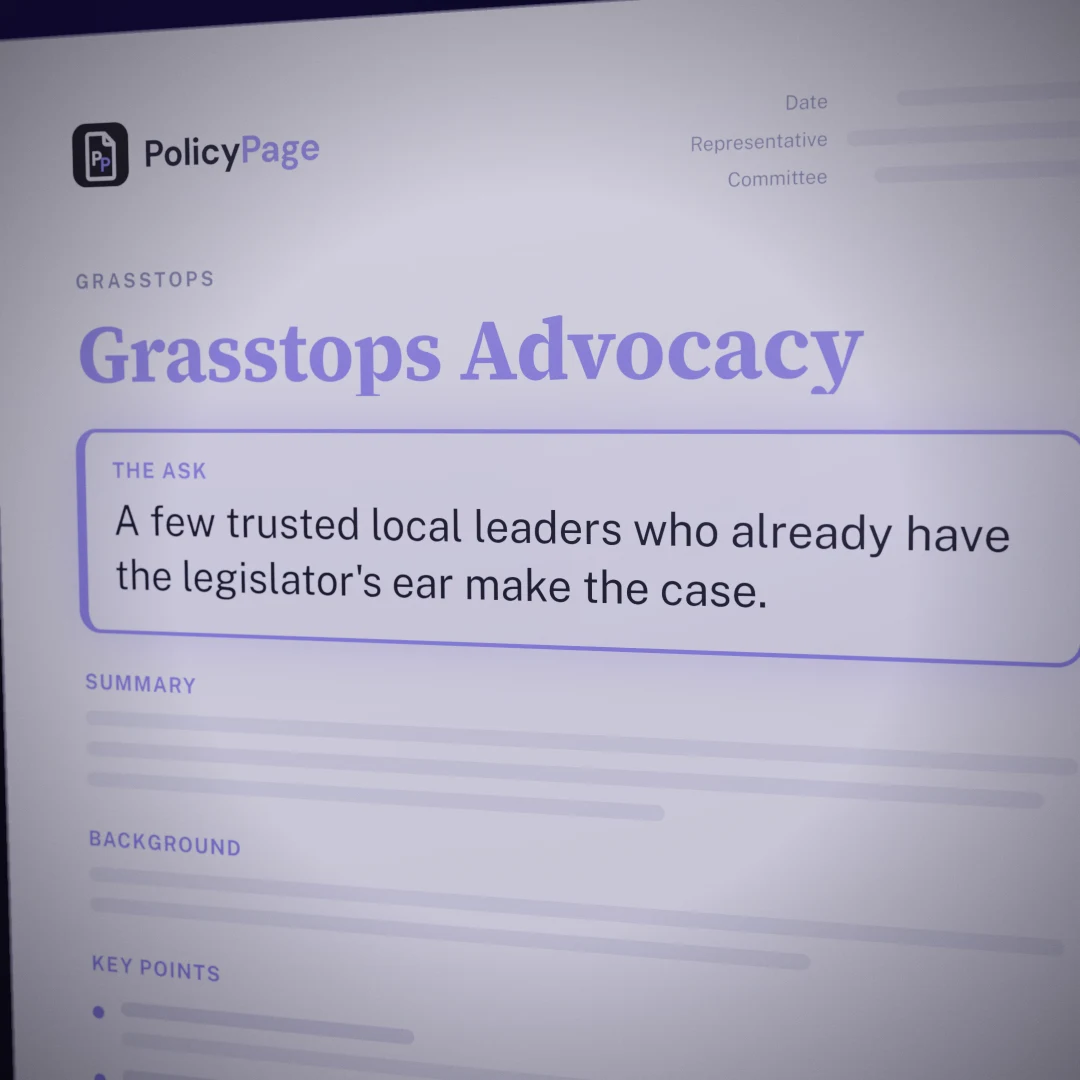
The word is a play on grassroots. If the roots are the wide base, the tops are the few blades that stand tallest. A grasstops advocate might be the owner of the largest employer in a district, a respected local pastor, a university president, a mayor, a longtime volunteer, or a hospital leader. What these people have in common is not money or fame. It is trust. The legislator or senior staff know them, take their calls, and value their judgment.
Where grassroots is about volume, grasstops is about access and credibility. A single call from someone the legislator has known for years can sometimes open a door that a stack of emails cannot. Grasstops leaders can often get a meeting scheduled, get a few extra minutes with the member, or get an issue onto a busy office's radar.
What makes someone a grasstops leader?
There is no official list or legal definition. Advocates usually look for three things. First, a real connection to the legislator, such as a shared history, past work together, or a seat on a local board. Second, standing in the community, so their view carries weight with voters. Third, a genuine stake in the issue, so the message is sincere rather than borrowed. A grasstops leader who personally understands why a bill matters to their town is far more persuasive than one reading talking points.
Grassroots vs grasstops: what is the difference?
Both approaches aim at the same goal: helping a legislator understand how an issue affects the people they represent. The difference is in who speaks and how many voices are involved.
Here is a simple way to compare them:
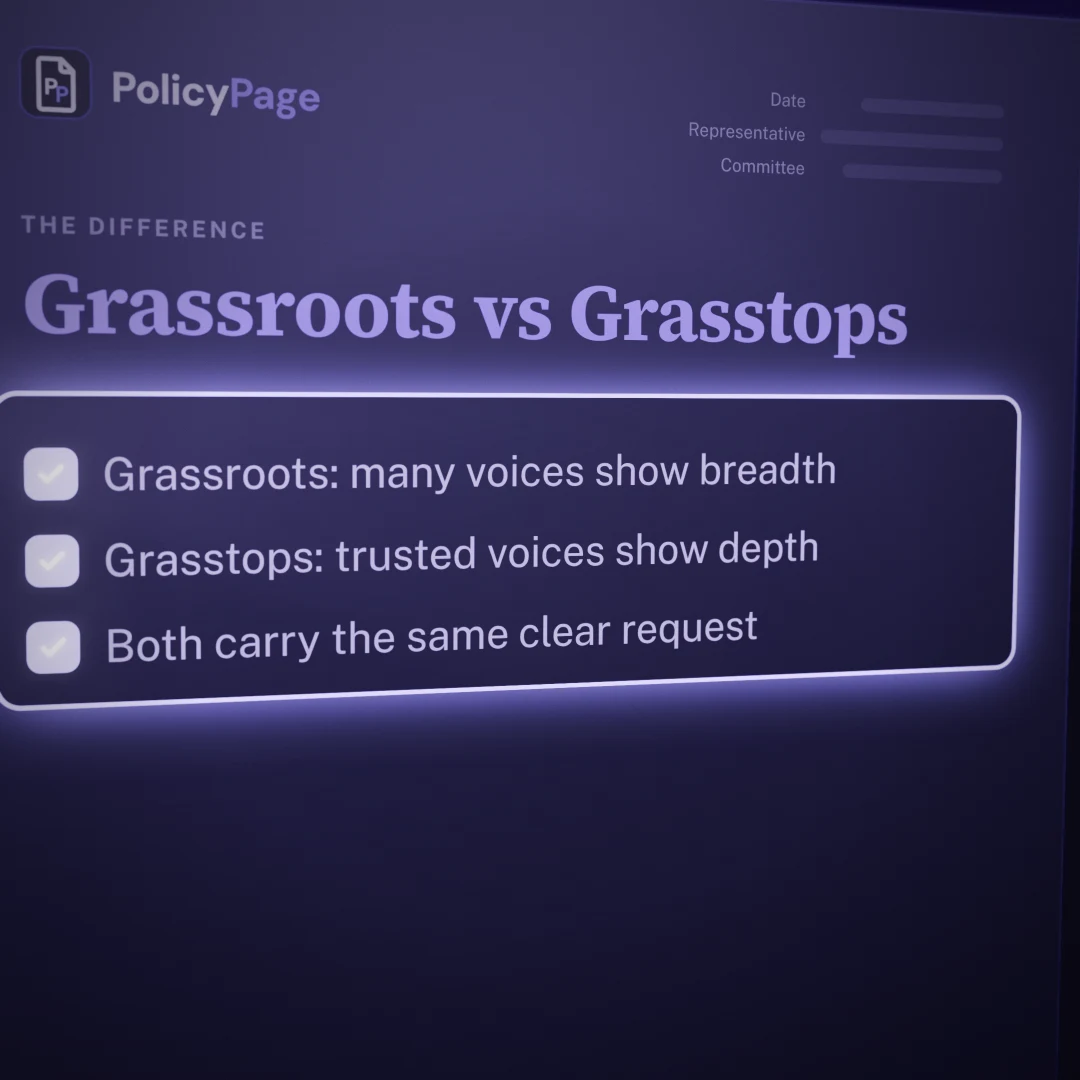
- Who speaks. Grassroots relies on many ordinary constituents. Grasstops relies on a few well-known, well-connected leaders.
- What it proves. Grassroots shows breadth: lots of voters care. Grasstops shows depth: people the legislator trusts care.
- How it reaches the office. Grassroots messages usually arrive through public channels like phone lines, email forms, and district office visits. Grasstops messages often arrive through personal relationships, like a direct call or a private conversation.
- What it takes to organize. Grassroots needs lists, tools, and clear instructions for many people. Grasstops needs careful research to find the right few people and help them prepare.
- The main risk. Grassroots can look manufactured if messages are identical and impersonal. Grasstops can look like insider pressure if it is not grounded in real local impact.
Neither one is better in every case. A useful analogy is a court case. Grassroots is like a large number of witnesses who all saw the same thing. Grasstops is like one expert witness whom the judge already respects. A strong case often has both.
Grassroots vs grasstops examples
To make this concrete, here is a simple illustration (not a real campaign). Imagine a group of rural clinics that wants a state legislature to fund broadband for telehealth. A grassroots effort might ask hundreds of patients and clinic workers in each district to email their legislators with a short personal story about a missed appointment. A grasstops effort might ask the director of the largest clinic in each district, who already knows the local legislator, to call and request a meeting. The two efforts carry the same request, from different angles.
Grassroots lobbying vs direct lobbying: what the law says
The terms grassroots and grasstops are mostly strategy words. But "grassroots lobbying" also has a specific meaning in federal tax law, and it matters for nonprofits.
How the tax code defines grassroots lobbying
Charities organized under section 501(c)(3) of the Internal Revenue Code can lobby, but only within limits. The IRS says a 501(c)(3) organization may engage in some lobbying, but too much lobbying risks loss of tax-exempt status. The IRS also says an organization is treated as attempting to influence legislation if it contacts, or urges the public to contact, members or employees of a legislative body.
That second part, urging the public to contact legislators, is the heart of grassroots lobbying. The tax code splits "influencing legislation" into two kinds. Under 26 U.S.C. 4911, one kind is any attempt to affect the opinions of the general public. The other is communication with any member or employee of a legislative body. The first is grassroots lobbying. The second is direct lobbying.
Treasury regulations spell out the test. Under 26 CFR 56.4911-2, a grassroots lobbying communication is one that refers to specific legislation, reflects a view on that legislation, and encourages the recipient to take action about it. The regulation lists four ways a message can encourage action: telling people to contact a legislator, giving a legislator's address or phone number, providing a petition or tear-off postcard, or naming legislators who will vote on the bill as opposed, undecided, the reader's own representative, or members of the committee that will consider it.
The 25 percent grassroots limit
Charities that choose the expenditure test, known as the 501(h) election, get clear dollar limits instead of the vaguer "no substantial part" rule. The IRS says eligible organizations may elect the expenditure test under section 501(h) by filing Form 5768. Under that test, the overall lobbying limit is a sliding scale that starts at 20 percent of the first $500,000 of exempt purpose spending and is capped at $1,000,000.
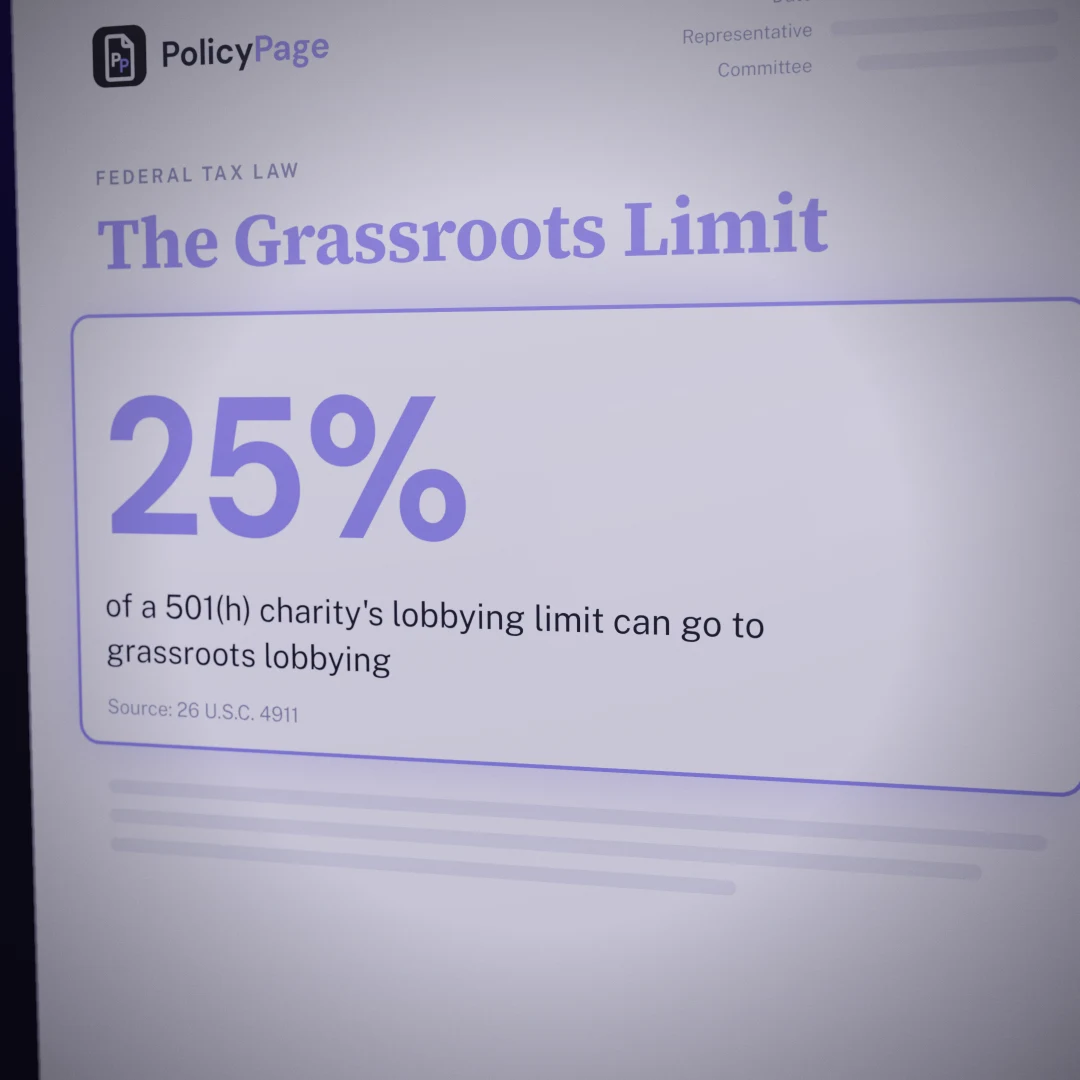
Grassroots lobbying has a tighter limit inside that total. Section 4911 sets the grassroots nontaxable amount at 25 percent of the lobbying nontaxable amount. In other words, an electing charity can spend only a quarter of its lobbying budget on grassroots lobbying. Going over either limit triggers an excise tax of 25 percent of the excess, and the IRS says excessive lobbying over a four-year period can cost a charity its exempt status. Nonprofits planning a large grassroots campaign should talk with a lawyer or tax adviser about how these rules apply to them.
What about federal lobbying disclosure?
The Lobbying Disclosure Act (LDA) works differently. It focuses on direct contact with officials. The law defines a lobbying contact as any oral or written communication to a covered executive or legislative branch official made on behalf of a client about legislation, rules, policies, programs, or certain nominations. It excludes communications made in a speech, article, or other material distributed to the public.
The joint House and Senate LDA guidance, last revised February 28, 2025, notes that it does not have the force of law. It also explains how organizations that use tax code definitions handle grassroots lobbying when they report. For most everyday constituents writing to their own legislator about their own views, none of these registration rules apply. They are aimed at paid professionals and organizations.
Why is grassroots advocacy important?
Congressional offices hear from many people, so it is fair to ask whether constituent contact actually matters. Surveys of congressional staff suggest it does.
The Congressional Management Foundation (CMF), a group that studies how Congress works, has surveyed congressional staff about this for years. Its 2017 report, "Citizen-Centric Advocacy," drew on nine surveys of congressional staff and four surveys of citizen advocates conducted between August 2004 and July 2016, with more than 1,200 responses in all, according to Roll Call's coverage.
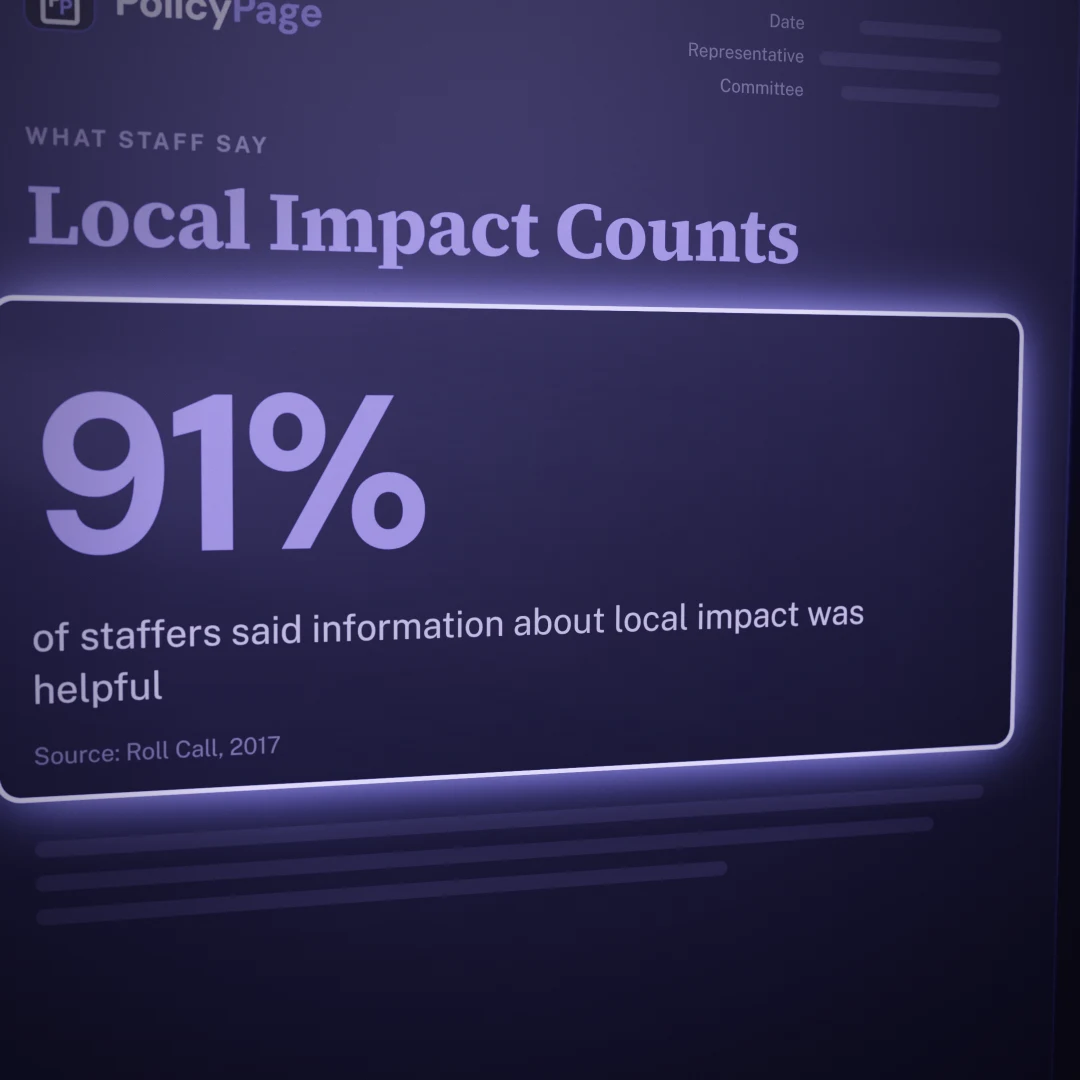
Roll Call reported that more than 90 percent of congressional staffers said in-person visits from constituents could influence a lawmaker, and that this held across surveys in 2004, 2010, and 2015. It also reported that 91 percent of staffers said information about local impact was helpful, but only 9 percent said constituents frequently included it.
That gap is the lesson. Constituent voices carry weight, but many advocates leave out the one thing staff most want: how the issue affects people back home. Whether a message comes from a thousand constituents or one trusted local leader, it lands better when it connects the request to the district.
Do form letters work?
They can show volume, but staff respond best to messages that sound like a real person. According to Roll Call's coverage of the CMF report, staffers said constituents should include their own reasons for caring, a specific request, and a personal story. That is why advocates encourage people to put messages in their own words instead of sending an identical script. A form message with one added sentence about how the issue affects the sender's family, job, or town is far more useful to an office than the script alone.
What is astroturfing?
Astroturfing is the opposite of real grassroots. The name comes from a brand of artificial grass. Merriam-Webster defines astroturfing as organized activity meant to create a false impression of a widespread, spontaneously arising, grassroots movement when it is actually started and controlled by a concealed group or organization.
The key word is concealed. It is normal and legitimate for an organization to ask its members to contact legislators. That is how most grassroots campaigns start. What makes something astroturf is hiding who is behind it or inventing support that does not exist, such as fake names or messages sent without people's consent. Offices are alert to this, which is one more reason personal, honest messages from real constituents carry more weight.
How grassroots and grasstops work together
The most effective campaigns usually combine both approaches, with each one doing the job it does best.
- Start with one clear request. Before anyone calls or writes, decide exactly what you are asking for: a vote, a cosponsorship, a meeting, or a letter to an agency. The glossary entry for grassroots advocacy puts it well: a clear ask beats a vague call to fix a problem.
- Use grasstops to open the door. A trusted local leader can request the meeting and set the tone, so the office knows serious people in the district care.
- Use grassroots to show breadth. Around the same time, constituents across the district contact the office in their own words, proving the issue is not just one leader's concern.
- Bring local facts to the meeting. Staff say local impact is helpful and often missing. Show what the issue means for jobs, schools, clinics, or families in that specific district.
- Leave something behind. After the meeting, give the staff a short leave-behind that restates the request and the local facts, so they can share it with the legislator later. Many visits happen at a district office, so tailor it to that office.
This is where a one-page brief helps. Every legislator represents a different place, so the same issue needs different local facts for each meeting. If you are preparing for a meeting with a member of Congress or the Florida Legislature, PolicyPage can create a free, cited one-page brief tailored to the member you are meeting, so your grassroots and grasstops voices walk in with the same clear message. Our guide on what a constituent is explains why the district connection matters so much.
The bottom line
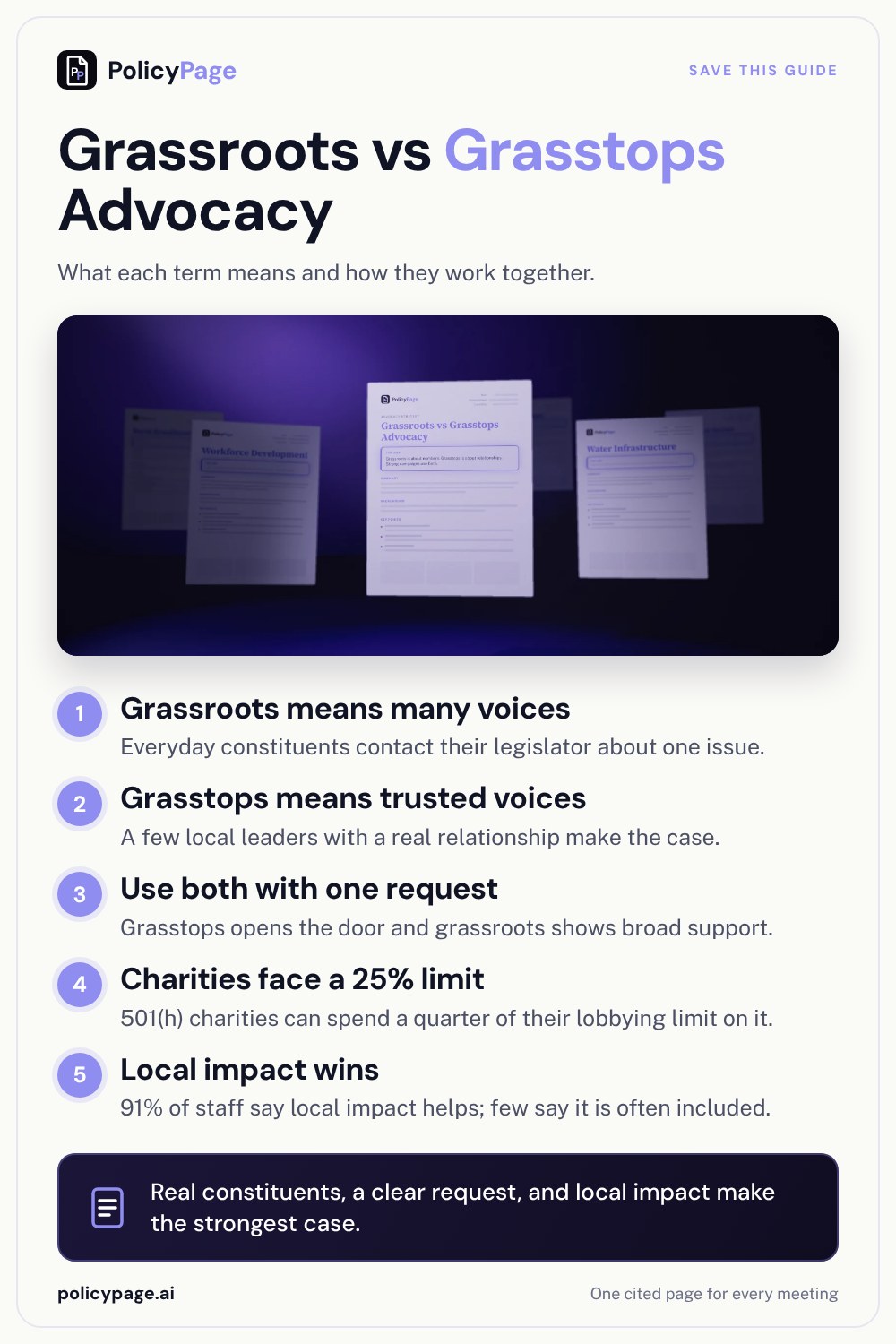
Grassroots advocacy is many voices. Grasstops advocacy is a few trusted ones. Grassroots shows a legislator that a lot of voters care, while grasstops shows that people the legislator already respects care. Federal tax law treats grassroots lobbying by charities as a separate category with its own 25 percent limit for groups that make the 501(h) election, and federal disclosure law focuses on direct contacts by paid professionals. Surveys of congressional staff point to the same practical lesson for both approaches: real constituents, a specific request, and clear local impact make the strongest case.
Save this guide
Frequently asked questions
What does grassroots advocacy mean?
Grassroots advocacy means organizing many everyday people, especially a legislator's own constituents, to contact that legislator about an issue through calls, emails, letters, and visits.
What does grasstops mean?
Grasstops refers to influential local leaders, such as business owners, local officials, and community leaders, who already have a relationship with a legislator. Grasstops advocacy asks those few trusted people to make the case.
What is the difference between grassroots and grasstops advocacy?
Grassroots relies on many ordinary constituents to show that lots of voters care. Grasstops relies on a few trusted leaders to show that people the legislator respects care. Most strong campaigns use both.
What is grassroots lobbying under federal tax law?
For charities, grassroots lobbying is an attempt to influence legislation by affecting the opinions of the general public. Under Treasury rules, the message must refer to specific legislation, reflect a view on it, and encourage people to take action.
How much grassroots lobbying can a charity do?
A charity that makes the 501(h) election can spend up to 25 percent of its overall lobbying limit on grassroots lobbying, under 26 U.S.C. 4911. Going over triggers an excise tax.
Why is grassroots advocacy important?
Congressional staff say constituent contact matters. Roll Call reported in 2017 that, in Congressional Management Foundation surveys, more than 90 percent of congressional staffers said in-person constituent visits could influence a lawmaker.
What is astroturfing?
Astroturfing is organized activity that creates a false impression of a spontaneous grassroots movement when it is actually started and controlled by a hidden group or organization.
Terms in this article
Sources
- 1.Lobbying, Internal Revenue Service
- 2.Measuring Lobbying Activity: Expenditure Test, Internal Revenue Service
- 3.26 U.S.C. 4911: Tax on excess expenditures to influence legislation, Legal Information Institute, Cornell Law School
- 4.26 CFR 56.4911-2: Lobbying expenditures, direct lobbying communications, and grass roots lobbying communications, Legal Information Institute, Cornell Law School
- 5.2 U.S.C. 1602: Definitions (Lobbying Disclosure Act), Legal Information Institute, Cornell Law School
- 6.Lobbying Disclosure Act Guidance, Clerk of the U.S. House of Representatives and Secretary of the U.S. Senate
- 7.Report Shows 'Untapped Power' of Constituent Advocacy, Roll Call
- 8.Grassroots, Merriam-Webster
- 9.Astroturfing, Merriam-Webster
New to some of the terms here? The advocacy glossary defines them in plain English.