
What Is the NDAA? How the Annual Defense Bill Passes Every Year
The NDAA is the yearly law that sets defense policy and authorizes Pentagon funding. Here is what it does, how it passes, and where the FY2027 bill stands.
11 minute read9 sources
In this article
- What is the NDAA in Congress?
- What does the NDAA do?
- NDAA vs defense appropriations: what is the difference?
- How does the NDAA get passed, step by step?
- Step 1: The budget request and hearings
- Step 2: Subcommittee and full committee markups
- Step 3: The House floor
- Step 4: The Senate floor
- Step 5: Working out a final version
- Step 6: The President signs or vetoes
- Why does the NDAA pass every year?
- Where is the FY2027 NDAA now?
- What the NDAA means for a meeting with a congressional office
- The bottom line
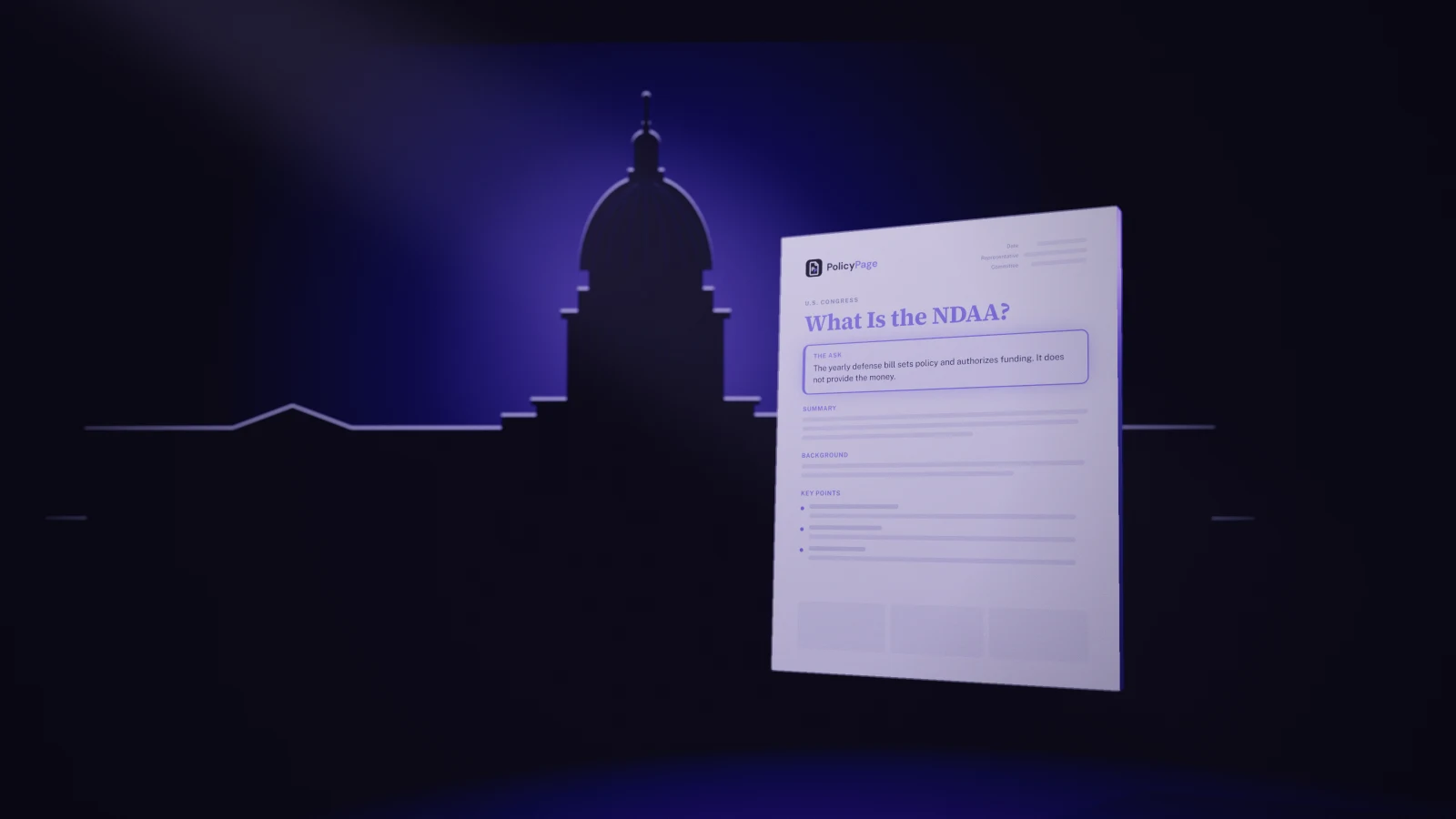
The National Defense Authorization Act (NDAA) is the law Congress passes every year to set policy for the U.S. military and to authorize funding for the Department of Defense, the nuclear weapons programs of the Department of Energy, and other defense activities. It decides what the military may do and how much it should spend, but it does not hand over the money itself. That comes later, in a separate defense appropriations bill.
The NDAA is also famous for something else: it has become law every single year for more than six decades. This guide explains what the NDAA does in plain English, how it differs from the defense spending bill, the six steps it takes from the President's budget to a signed law, and where the fiscal year 2027 bill stands right now.
People search for this topic in many ways: "what is the NDAA in Congress," "what does the NDAA do," "NDAA vs appropriations," "how does the NDAA get passed," and "NDAA 2027 status." Each one is answered below.
What is the NDAA in Congress?
The Congressional Research Service (CRS), the nonpartisan research arm of Congress, describes the NDAA in its primer Defense Primer: The NDAA Process. The bill provides "authorization of appropriations" for the Department of Defense (DOD), the nuclear weapons programs of the Department of Energy, and other defense-related activities. It also sets defense policies and restrictions and handles organizational matters inside DOD.
Two committees own the bill. The House Armed Services Committee (HASC) and the Senate Armed Services Committee (SASC) have jurisdiction over matters relating to the common defense, so people often call them the authorizers. Each committee has seven subcommittees in the current Congress, covering areas like military personnel, readiness, seapower, and strategic forces.
The name changes slightly from year to year because each bill covers one fiscal year, the federal budget year that runs from October 1 to September 30. The bill Congress is working on now is the National Defense Authorization Act for Fiscal Year 2027. Some years the final law also carries an honorary name. The House Armed Services Committee keeps a list of every defense authorization law with its public law number, going back to fiscal year 1962.
One more note on names. CRS points out in its FY2027 NDAA status report that DOD is using a secondary "Department of War" designation under an executive order dated September 5, 2025. You will see both names in this year's bill text and amendments. They refer to the same department.
What does the NDAA do?
Think of the NDAA as the rulebook and the shopping list for the military, written fresh each year. It does three main jobs.
First, it authorizes appropriations. That means it sets the amounts Congress thinks should be spent on each part of the defense budget, from ships and aircraft to military construction. The fiscal year 2025 NDAA, Public Law 118-159, ran 794 pages and included discretionary authorizations totaling $883.7 billion, according to CRS.
Second, it sets policy. The NDAA is where Congress changes the rules for military pay and benefits, buying weapons, running bases, training troops, and much more. It also sets the number of people each military service may have, called end strength.
Third, it reorganizes and directs. Congress uses the bill to create or close offices inside DOD, order reports and studies, and place limits on what the department can do.
Because the bill is so broad, it reaches into many everyday issues. The House committee's FY27 NDAA resources page groups this year's bill into themes like servicemember quality of life, combat readiness, technology, and the border, and it also has a section on Community Project Funding, the House's current name for earmarks.
NDAA vs defense appropriations: what is the difference?
This is the most common point of confusion, and it matters a lot for anyone who wants to influence defense policy. The NDAA is an authorization. It sets the rules and recommends the amounts. A defense appropriations bill provides the actual money.
CRS states it plainly: unlike an appropriations bill, the NDAA "does not provide budget authority." The Constitution, in Article I, Section 9, says no money may be drawn from the Treasury except through appropriations made by law. CRS also notes, though, that the NDAA has historically been "a fairly reliable indicator" of how Congress will later fund particular programs.
The two bills are written by different committees on different tracks. CRS explains the spending side in Defense Primer: Defense Appropriations Process.
| NDAA (authorization) | Defense appropriations | |
|---|---|---|
| What it does | Sets defense policy and authorizes funding levels | Provides the money agencies can spend |
| Who writes it | House and Senate Armed Services Committees | House and Senate Appropriations Committees, mainly their Defense subcommittees |
| Provides spending authority? | No | Yes |
| What happens if it is late | Many authorities in the bill expire at the end of the fiscal year | A continuing resolution or a funding gap |
| Covers | DOD, Department of Energy nuclear weapons programs, other defense activities | Defense, plus military construction and Department of Energy defense work through other subcommittees |
For the bigger picture of how both tracks fit into the yearly budget, see our guide on how the federal budget process works.
How does the NDAA get passed, step by step?
The NDAA follows the same basic path as any bill, but with a few habits of its own that have helped it pass every year. Here are the six steps, based on the CRS primer.
- The President sends a budget request, and the committees hold hearings.
- Subcommittees and then the full committees mark up their bills.
- The House debates its bill under a special rule, often with hundreds of amendments.
- The Senate takes up its bill or the House bill.
- The House and Senate work out one final version.
- The President signs or vetoes it.
Step 1: The budget request and hearings
CRS says the NDAA process begins on or about the first Monday in February, when the President's budget request goes to Congress, though the request is sometimes late. This year it was. According to CRS, the President submitted the documents supporting the fiscal year 2027 budget request on April 3, 2026.
Once the request arrives, both Armed Services Committees hold posture hearings. Senior civilian and military leaders from DOD and each military service testify about their budget. Subcommittees follow with hearings on narrower topics. DOD also sends Congress packages of legislative proposals it would like to see in the bill.
Step 2: Subcommittee and full committee markups
A markup is the meeting where a committee debates, amends, and votes on a bill. In a typical year, CRS says, both committees are ready to mark up by late April or May. Each subcommittee works on the part of the bill in its jurisdiction, and the full committee handles everything else in the chair's mark before voting on the whole package.
The two committees run their markups differently. The House committee streamed its fiscal year 2027 full committee markup online, according to its resources page. The Senate committee generally holds its full committee markup and most subcommittee markups in closed session, and it usually reports its bill as an "original bill," meaning text that was not formally introduced beforehand.
The House committee also has two working habits that keep the bill moving, according to CRS. Members who offer an amendment touching another committee's turf must bring a letter from that committee's chair waiving its right to review the bill. And amendments that would raise spending on an item have often had to name an offset, meaning a cut somewhere else to pay for it.
Step 3: The House floor
On the House floor, the NDAA is considered under a special rule written by the Rules Committee. The rule sets how long debate lasts and which amendments members may offer. CRS notes that the rule has sometimes made in order hundreds of amendments, many of which are approved in large bundles called en bloc amendments.
This year shows how the step works in practice. The first proposed rule for the fiscal year 2027 bill failed on June 30, 198 to 224. A second rule passed on July 21, 214 to 211, and made in order 320 floor amendments, according to CRS. The House passed the bill, H.R. 8800, on July 22 by a vote of 216 to 212, as recorded in the official action history on Congress.gov.
Step 4: The Senate floor
In the Senate, debate and amendments are usually organized through a series of unanimous consent agreements. The Senate has sometimes considered more than 100 floor amendments to the NDAA, CRS says. But because Senate debate can run long, the Senate may also need one or more cloture votes, which take three-fifths of senators (usually 60), to limit debate and reach a final vote.
CRS adds a detail that surprises many readers: the Senate often does not pass its own bill. Instead it takes up the House-passed bill and swaps in its own text as an amendment. Our guide to what cloture is explains how those 60-vote steps work.
Step 5: Working out a final version
The Constitution requires both chambers to pass the exact same text before a bill goes to the President. For the NDAA, the traditional tool is a conference committee, mostly made up of members of the two Armed Services Committees, which writes a single compromise called a conference report. A conference report cannot be amended on the floor, though in the Senate it may still need cloture.
Congress can also skip conference and trade amendments between the chambers. That is what happened last year. According to the GovInfo record for Public Law 119-60, the Senate passed its bill, S. 1071, on August 1, 2025. The House passed it with changes on December 10, 2025, and the Senate agreed to the House changes after considering them on December 11 and December 15 through 17.
Step 6: The President signs or vetoes
The fiscal year 2026 NDAA was approved on December 18, 2025, and became Public Law 119-60, according to GovInfo. That is the usual pattern: the bill often lands near the end of the calendar year, after the fiscal year has already started.
A President can also veto the NDAA, and Congress can try to override. CRS lists six years in which defense authorization legislation was enacted over a presidential veto: fiscal years 1979, 1989, 1996, 2008, 2016, and 2021. Our guide to veto overrides explains the two-thirds votes that requires.
Why does the NDAA pass every year?
CRS counts fiscal year 2025 as the 64th fiscal year in a row for which a defense authorization was enacted, and the House committee's list shows the fiscal year 2026 law, Public Law 119-60, added one more. Few other major bills come close to that record.
CRS credits the streak to "adherence to process and consistency in procedures, schedules, and protocols." In practice, that means the same two committees start from the President's request every year, follow the same calendar, and use the same tools to manage a very large bill.
There is also a practical reason. CRS notes that many authorities in the NDAA expire at the end of the fiscal year, so Congress puts a lot of effort into finishing it. The bill rarely makes the October 1 start of the fiscal year, though. CRS found that since fiscal year 1977, the defense authorization has been enacted on average 45 days after the fiscal year began.
That steady track record also makes the NDAA a popular vehicle. Because members expect it to pass, they try to attach their own ideas to it, which helps explain why the House considered 320 amendments this year and why Congress.gov lists 885 amendments filed to the Senate committee's bill, S. 4784.
Where is the FY2027 NDAA now?
Here is the fiscal year 2027 bill's path so far, from the CRS status report and the official action records on Congress.gov:
- May 13, 2026: H.R. 8800 introduced in the House.
- June 4: The House Armed Services Committee votes 44 to 12 to report the bill.
- June 10: The Senate Armed Services Committee votes 18 to 9 to report its own bill after closed markups.
- June 15: Both committees file their reports (H. Rept. 119-698 and S. Rept. 119-127), and S. 4784 is placed on the Senate calendar.
- July 14: In the Senate, the vote to limit debate on taking up S. 4784 fails, 50 to 46. The Senate roll call record shows three-fifths was required. The majority leader entered a motion to reconsider, which allows another try later.
- July 22: The House passes H.R. 8800, 216 to 212.
- September 14: The House-passed bill is received in the Senate.
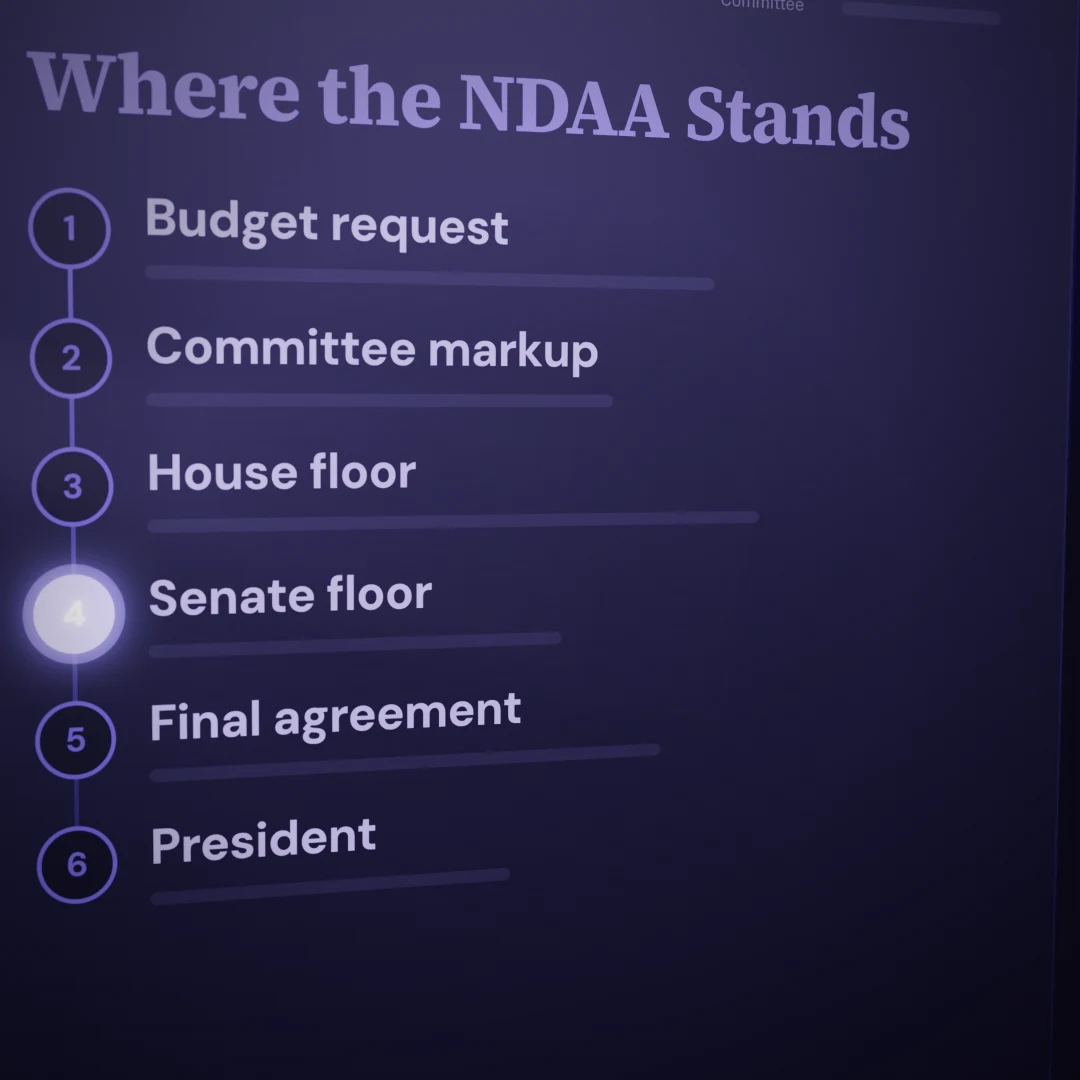
As of today, the latest Senate action on S. 4784 listed on Congress.gov is from July 27, 2026, when another motion to proceed to the bill was made. The bill has not passed the Senate, no final version has been agreed to, and fiscal year 2027 began on October 1, 2026. That puts this year's bill already past the 45 day average CRS describes.
What the NDAA means for a meeting with a congressional office
The NDAA reaches far beyond the Pentagon. It touches military families, defense businesses, universities with research contracts, communities near bases, and local projects through Community Project Funding. If your issue connects to defense in any way, a few points will help you get more out of a meeting.
- Know which bill you need. If your ask is a policy change or a new requirement, it belongs in the NDAA. If your ask is money for a program, the decision is made in defense appropriations. Asking the wrong committee's staff wastes the meeting.
- Know the calendar. The best time to shape the bill is before committee markup in the spring, when members can still add language. Later in the year, the final text is in the hands of a small group of negotiators.
- Know where the office sits. A member of the Armed Services Committee can offer amendments in markup. Other members usually work through floor amendments.
- Bring the current status. Staff appreciate visitors who know whether the bill has passed their chamber, whether it is stuck, and what comes next.
That last point is where most visitors fall short, because the facts change every week. If you are preparing for a meeting with a member of Congress, PolicyPage can build a one-page, cited brief for the specific office you are visiting, with your ask and the current status of the bill on a single page. It is free to start.
The bottom line
The NDAA is Congress's yearly defense policy law. It authorizes funding and sets the rules for the military, while a separate appropriations bill provides the money. It moves through budget hearings, committee markups, the House and Senate floors, a final agreement, and the President's desk, and it has become law every year for more than six decades. The fiscal year 2027 version has passed the House and is waiting on the Senate.
Frequently asked questions
What is the NDAA in simple terms?
The National Defense Authorization Act is the law Congress passes each year to set policy for the military and authorize funding for the Department of Defense and defense programs at the Department of Energy. It does not provide the money itself.
What is the difference between the NDAA and defense appropriations?
The NDAA is an authorization: it sets rules and recommends funding levels. The defense appropriations bill, written by the Appropriations Committees, provides the actual money agencies can spend.
How does the NDAA get passed?
The President sends a budget request, the House and Senate Armed Services Committees hold hearings and markups, each chamber debates the bill, the two chambers agree on one version through a conference committee or an exchange of amendments, and the President signs or vetoes it.
Has the NDAA ever failed to pass?
Not in more than six decades. CRS counts fiscal year 2025 as the 64th consecutive year with an enacted defense authorization, and the fiscal year 2026 law was signed on December 18, 2025.
Has a president ever vetoed the NDAA?
Yes. CRS lists six years in which defense authorization legislation was enacted over a presidential veto: fiscal years 1979, 1989, 1996, 2008, 2016, and 2021.
Has the FY2027 NDAA passed?
Not yet. The House passed H.R. 8800 on July 22, 2026, by 216 to 212. In the Senate, a cloture vote on taking up S. 4784 failed 50 to 46 on July 14, 2026, and the bill has not passed the Senate.
Who writes the NDAA?
The House Armed Services Committee and the Senate Armed Services Committee write their own versions, each working through seven subcommittees, and members of both committees usually negotiate the final version.
Terms in this article
Sources
- 1.Defense Primer: The NDAA Process (IF10515), Congressional Research Service
- 2.FY2027 NDAA: Status of Legislative Activity (IN12704), Congressional Research Service
- 3.Defense Primer: Defense Appropriations Process (IF10514), Congressional Research Service
- 4.History of the NDAA, House Armed Services Committee
- 5.FY27 NDAA Resources, House Armed Services Committee
- 6.H.R.8800, National Defense Authorization Act for Fiscal Year 2027: All Actions, Congress.gov
- 7.S.4784, National Defense Authorization Act for Fiscal Year 2027: All Actions, Congress.gov
- 8.Roll Call Vote 119th Congress, 2nd Session, Vote Number 195, U.S. Senate
- 9.Public Law 119-60, National Defense Authorization Act for Fiscal Year 2026, GovInfo, U.S. Government Publishing Office
New to some of the terms here? The advocacy glossary defines them in plain English.